How Much Wallpaper to Buy: Roll Size, Pattern Repeat, and Waste
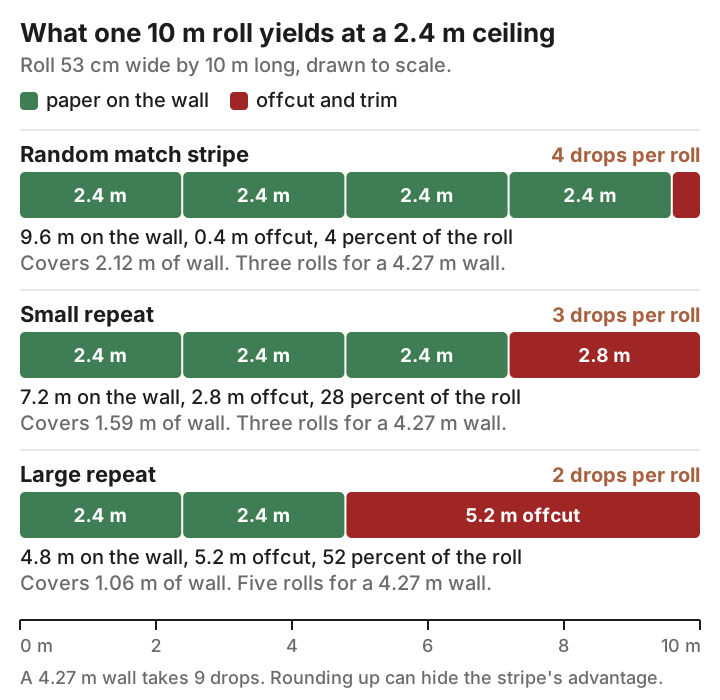
Farrow & Ball publish a figure that settles most wallpaper orders before anyone picks up a tape measure. On a 2.4-meter wall, one of their 10 meter rolls gives four drops of a striped paper, three drops of a small repeat, and two drops of a large one. The roll and the wall are the same in all three cases, and the large repeat still covers half as much as the stripe.
Nothing changed except what is printed on the paper. A stripe can be cut anywhere along its length. A large repeat can only be cut where the pattern allows, and everything between one legal cut and the next goes in the trash. That offcut is the subject of this guide, because it is the part of an order that square footage cannot see.
That is why Milton & King, who sell the stuff, tell buyers in capital letters to not use square footage when deciding what to order.
A Roll Is Not a Unit of Coverage
Start with the word itself. In the United States market, “a roll” describes at least six different objects, and they are not interchangeable.
York Wallcoverings say their wallpaper comes in two sizes: 20.5 inches wide by 33 feet long, and 27 inches by 27 feet. Both are priced by the single roll and shipped as double rolls. Thibaut does the same, priced and sold by the single roll but packaged in double-roll bolts. A bolt and a double roll are one thing: WIA defines a double roll as two single rolls in a continuous strip, priced as two but packaged as one. Neither brand sells the single roll as an object, and Milton & King warn that a suspiciously low listing price often means only half the paper.
| Format | Width | Length | Coverage | Where it turns up |
|---|---|---|---|---|
| American double roll | 20.5 in | 33 ft | 56 sq ft | York and most US brands |
| American double roll, wide | 27 in | 27 ft | 60.75 sq ft | York wide-width residential |
| European roll | 52 cm | 10.05 m | 5.23 sq m, 56.3 sq ft | Sanderson, Cole & Son |
| European roll | 53 cm | 10 m | about 57 sq ft | Farrow & Ball |
| House format | 24 in | 32.9 ft | 64 to 66 sq ft | Milton & King |
| Commercial Type II | 54 in | sold by the linear yard | 13.5 sq ft per yard | contract wallcovering |
| Peel and stick double roll | 20.5 in | 11 yd | 56 sq ft | Tempaper |
| Peel and stick roll | 20.5 in | 18 ft | about 31 sq ft | NuWallpaper by Brewster |
| Panels, not rolls | 2 ft | 3 to 12 ft | 6 to 24 sq ft | Spoonflower, Chasing Paper |
Every row is the maker’s own published specification: Sanderson at 52cm by 10.05 meters, Tempaper’s three formats, Brewster’s NuWallpaper rolls, Spoonflower’s 2-foot panels.
Commercial wallcovering is a different unit again. York’s Transition product is 54 inches wide, sold in 3-foot lengths of 13.5 square feet at $50, a Type II vinyl under ASTM F793/F793M-25, which classifies wall and ceiling coverings by use characteristics and says nothing about roll size or quantity.
The Repeat Is a Center-to-Center Measurement
The repeat figure on a product page is not the height of the motif. WIA defines pattern repeat as the distance from the center of one motif to the center of the next. Farrow & Ball put it as the distance between the pattern starting, finishing and starting again.
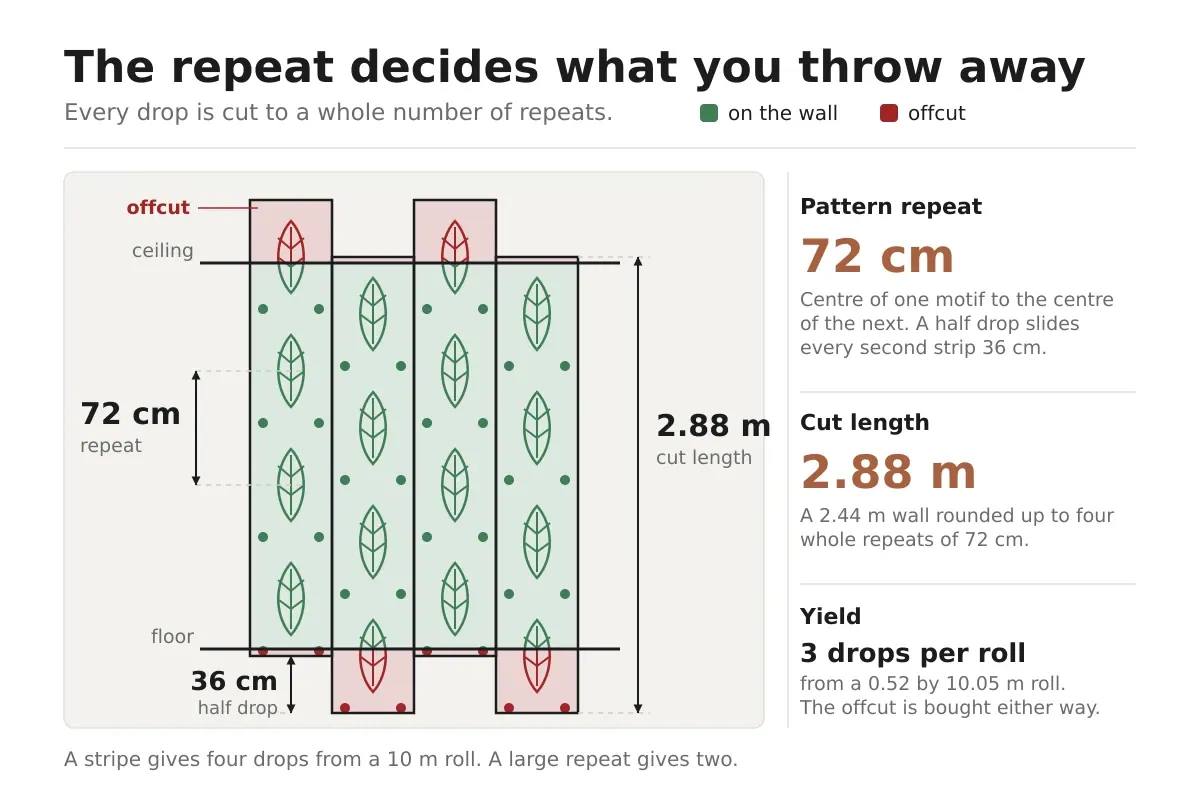
That distance is the unit in which paper gets consumed. Every strip on a wall has to begin at the same point in the pattern, so the length you cut is never the wall height. It is the wall height rounded up to a whole number of repeats, plus trim.
Sanderson publish the working version of that rule: drop length is the height of the wall plus the height of the pattern repeat, rounded up to the next whole decimal meter. On a 2.44-meter wall with Cole & Son’s Woods, which carries a 72 cm repeat on a 0.52 by 10.05-meter roll, that rule gives 3.16 meters, rounded to 4. Two drops come off a 10.05-meter roll at that cut length, and 2.05 meters is scrap before the first strip touches the wall. The repeat arithmetic on its own is less punishing: 2.44 meters needs four whole repeats, which is 2.88 meters, and that yields three drops per roll. The gap between two drops and three is the safety margin built into Sanderson’s rule, and it is worth knowing which of the two numbers an order is priced against.
Roman Products, who make the adhesive, sort papers into three buckets for their calculator, no repeat, under 12 inches and over 12 inches, noting that larger repeats create more waste and less useable material per roll.
Random, Straight, Half Drop, Third Drop
Match type decides how far the pattern on one strip has to slide vertically to meet its neighbor, and that slide is where the extra material goes.
Cole & Son list four. A random match has no pattern at the joining edge to match, such as a vertical stripe. A straight match repeats side to side and joins in the same place on the next drop. A half drop drops down one half of the repeat before repeating, and a third drop drops down one third. Sanderson describe the half drop identically, as every other horizontal repeat dropped down one half of its length, and Tempaper add that a half drop takes three strips to complete the design, and a multiple drop four or more.
Convert that into inches on the wall. On Woods, with its 72 cm repeat, a half drop slides each strip 36 cm against its neighbor. A third drop on the same repeat slides 24 cm. A straight match slides nothing, and a random match imposes no vertical alignment at all.
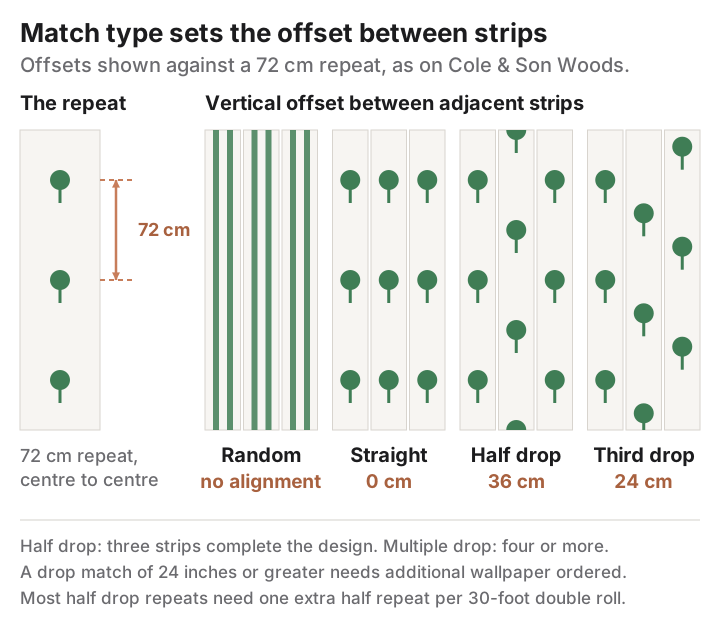
Two figures put a cost on the drop match. WIA set a threshold: patterns with a drop match of 24 inches or greater will require additional wallpaper to be ordered. Thatcher quantify it, estimating that most half drop repeats need one extra half repeat of material per 30-foot double roll.
At the extreme the pattern does not fit inside one roll at all. Milton & King sell two-roll sets where ordering a quantity of one delivers two double rolls labeled A-ROLL and B-ROLL, hung alternately.
Usable Square Feet Versus the Number on the Label
Gross roll area is printed on the label. Usable area is not, and the gap between them is wide enough to change the order.
Sherwin-Williams put a number on the gap, giving usable square feet per single roll against the size of the repeat: 25 square feet for a repeat of 0 to 6 inches, 22 for 7 to 12 inches, 20 for 13 to 18 inches, and 18 for 19 to 23 inches. A 23-inch repeat costs 28 percent of the roll against a plain one. Set that against gross area: a York 27-inch double roll holds 60.75 square feet, about 30 gross per single, of which 18 reach the wall on a large repeat.
The published figures contradict each other. On one page Sherwin-Williams state that a single roll contains 25 usable square feet regardless of width. On another, the same company gives approximately 50 square feet of usable paper, regardless of its width. WIA’s dictionary offers a third figure, 34 to 36 square feet per single roll. The 50 reads as a double-roll number wearing a single-roll label, and the 34 to 36 is a gross figure quoted where a usable one belongs. The 25 agrees with Sherwin-Williams’ own yield table and with the divisor WIA use in their estimator, so treat 25 as the working number for a small repeat and the table for anything larger.
Farrow & Ball’s drops-per-roll figures say the same thing in whole strips. Four drops of a stripe put 9.6 meters of that 10-meter roll on the wall and leave 0.4 meters, 4 percent. Three drops of a small repeat put up 7.2 meters and waste 2.8, or 28 percent. Two drops of a large repeat put up 4.8 meters and waste 5.2, which is 52 percent of what you paid for. At 53 cm wide, those rolls cover 2.12, 1.59 and 1.06 meters of wall each, so a 4.27-meter wall taking 9 drops needs 3 rolls, 3 rolls, or 5.
Counting Drops One Wall at a Time
Square footage divides. Wallpaper does not. A strip 8 inches short of the next wall cannot be carried round a corner without a visible seam and a broken pattern, so the round-up happens per wall and per roll, never once across the room. Sanderson’s published method has two separate round-ups for that reason: wall width divided by roll width rounded up to whole drops, then drop length rounded up, then 5 percent added for trimming.
Worked Example: A 12 by 14 Room With 8-Foot Ceilings
Paper: York Scalloped Stripe in Grey, 27 inches wide, 27 feet long, 25.25 inch repeat, straight match, $150 per double roll.
- Count drops per wall. A 12-foot wall is 144 inches, and 144 divided by 27 is 5.33, so 6 drops. A 14-foot wall is 168 inches, which is 6.22, so 7 drops. Two of each gives 26 drops.
- Find the cut length. The wall is 96 inches high, and 96 divided by the 25.25 inch repeat is 3.80, so each drop consumes 4 full repeats, or 101 inches.
- Find drops per roll. The roll is 324 inches long, and 324 divided by 101 is 3.21, so 3 drops, with 21 inches left.
- Divide and round up. Twenty-six drops at 3 per roll is 8.67, so 9 double rolls, at $1,350.
Run the same room through the other published methods. The walls total 416 square feet gross, or 356 after deducting 20 square feet each for one door and two windows.
| Method | Arithmetic | Result |
|---|---|---|
| Product-page square footage | 356 sq ft ÷ 60.75 sq ft per double roll | 6 double rolls |
| WIA estimator, 25 sq ft per single roll | 416 sq ft ÷ 25 | 17 single rolls |
| Sherwin-Williams yield, 19 to 23 in repeat | 356 sq ft ÷ 18 | 20 single rolls |
| York bolt rule, 6 ft of wall per bolt | 52 ft ÷ 6 ft | 9 bolts |
| Drop count, wall by wall | 26 drops ÷ 3 per roll | 9 double rolls |
Four of the five agree. The WIA figure of 17 single rolls is 8.5 doubles, Sherwin-Williams’ 20 singles is 10 doubles, and York’s own rule that one bolt covers about 6 feet of wall up to a 9-foot ceiling lands on 9. Only the product-page division disagrees, and it is short by three rolls and $450.
Sherwin-Williams note that working from two rolls sometimes cuts down on waste when matching up a pattern, because an offcut from one roll can head the next drop. That saving belongs to the installer’s cutting plan, not to your purchase order.
Doors and Windows: Three Sources, Three Answers
No code or standard governs how much wallpaper to buy. ASTM F793 classifies use characteristics and says nothing about quantity, so the openings deduction is house convention, and the houses disagree.
Sherwin-Williams subtract 20 square feet for each standard door or window. York deduct one bolt for every four openings, about 14 square feet each on a 56 square foot bolt. Graham & Brown take the opposite position and say to ignore doors and windows entirely, because excluding them should give just the right amount of excess.
All three are defensible, because the offcut left above a door and below a window is exactly the material a full-height drop wastes. York and Graham & Brown absorb the waste into the openings. Sherwin-Williams deduct the openings and add waste back as a percentage.
The percentages split the same way. Sanderson add 5 percent for trimming, then round up to the next full meter. Graham & Brown ask for an extra 10 percent, and B&Q for at least 10 percent. Farrow & Ball refuse a percentage and say instead to add one more roll, whatever you estimate. On a nine-roll order that extra roll costs $150. Ordering it later may cost more, or be impossible.
Run Numbers, Dye Lots, and the Roll You Cannot Reorder
Wallpaper is printed in batches, and each batch carries a run or lot number on the label. Rolls from one run match. Rolls from two runs do not, and York state it flatly: buy from the same run number, because it is impossible to achieve an exact match from one run to another. Cole & Son describe a batch number as marking rolls produced together, which should be hung together to avoid roll to roll color discrepancies, and Sherwin-Williams warns that colors vary slightly but noticeably between batches.
Digital printing does not exempt you. Spoonflower advise ordering as much as you need for the project the first time because their dye lots vary between orders too, and Thatcher note that their dye lots tend to sell out quickly, with no guarantee that paper from the matching lot will still exist.
If a mix is unavoidable, Thatcher publish the salvage instruction: always break the dye lot in a wall corner rather than mid-wall, and never stagger lots A B A B along a run. A corner already carries a shift in light. A mid-wall change does not.
Check the delivery before anything is cut. WIA advises verifying pattern, color, quantity and matching lot numbers across all rolls on arrival, and Cole & Son set a deadline of 14 days from receipt.
Peel and Stick, Prepasted, and Unpasted
Adhesive type barely changes coverage. It changes what the paper will stick to, which is the larger question.
Traditional papers arrive prepasted or unpasted, and York state there is no quality difference between the two, only that professionals favour unpasted for control over the amount of paste. What matters is not mixing methods: York do not recommend applying wet paste to prepasted wallpaper, because it is unnecessary and nullifies any guarantee of easy removability. Prepasted paper is activated in water and then booked, folded paste to paste for several minutes to relax, which Spoonflower put at at least 3 to 5 minutes.
Peel and stick is where wall condition becomes a purchase decision. Tempaper require smooth surfaces with eggshell, satin or semi-gloss paint, rule out texture beyond orange peel, and ask for at least 30 days after painting. WallPops publish a do-not-hang list covering textured walls, existing wallpaper, brick, unpainted drywall or plaster, and non-stick paint, with a 4 week minimum cure. Chasing Paper ask for 4 to 6 weeks and warn that matte paint lets the adhesive bond to the paint and pull it away.
Bathrooms split the manufacturers, product by product rather than as a disagreement about physics. Tempaper list theirs as suitable for bathrooms and areas with steam and indirect moisture. Spoonflower state theirs is not suitable for high-moisture environments. Milton & King give the mechanism: non-coated, non-vinyl peel and stick will bubble, lift, or peel off unless labeled moisture-proof. Read the product page, not the category.
Preparation is not optional on any of them. WIA call for filling dents and nail holes, taping large cracks, treating mold, and priming with an acrylic primer made specifically for wallpaper. York separate two jobs often sold as one: primer seals the wall so paste is not absorbed, sizing adds grip and slip, and sealing is what allows future removal.
What a Roll Costs and What an Installer Adds
Prices below are typical United States ranges taken from the sellers’ own pages.
| Category | Typical US price | Coverage | Price per sq ft |
|---|---|---|---|
| Budget peel and stick roll | $11.99 to $59.99 | 20.5 in x 18 ft | $0.39 to $1.95 |
| Peel and stick double roll | $12.99 to $150.00 | 56 sq ft | $0.23 to $2.68 |
| Mid-market traditional | $100.00 to $220.00 | double roll, size varies | check the roll spec |
| Mainstream American brand | $150.00 | 60.75 sq ft | $2.47 |
| Commercial Type II vinyl | $50.00 | 13.5 sq ft | $3.70 |
| Designer European roll | $258.00 to $440.00 | 56 to 57 sq ft | $4.59 to $7.71 |
The right-hand column is arithmetic on the two beside it, not a published figure. The prices are published: $11.99 to $59.99 at Brewster, $12.99 to $150.00 at Tempaper, $100.00 to $220.00 at Graham & Brown, $258.00 for Cole & Son Woods, and $270.00 to $440.00 across Farrow & Ball’s pattern range. WIA note that the same paper runs from premium decorator pricing down to discounts of 10 to 50 percent or more at home improvement retailers.
Labour is quoted four different ways. Fixr list $30 to $80 per hour, $30 to $70 per roll, $2 to $6 per square foot, or $18 to $54 per yard, with a national average project of $800 to $1,200. Taskrabbit report a national average of $62 per hour, from $55 in Los Angeles to $85 in Boston, and $6 to $14 per square foot for grasscloth or murals. For the 356 square feet in the worked example, $2 to $6 per square foot is roughly $700 to $2,100 of labour on top of $1,350 of paper.
Buying the Waste on Purpose
The number that ends up on the order is not the wall area. It is the wall area plus the paper the pattern refuses to let you use, and that second figure is fixed by the repeat and the match type before anything is measured.
Three checks catch nearly every bad order. Confirm what the seller means by a roll, since a single roll is a price and a double roll is a product. Read the repeat and the match off the specification tab rather than the description, because 25.25 inches straight and 72 centimetres half drop are different purchases of the same wall. Then count drops per wall and drops per roll separately, and round both up, because a strip cannot cross a corner and an offcut shorter than a full drop is scrap.
What remains is one decision about overage, and it is not really about waste. It is about the second order you will not be able to place, because the lot has sold out and the color will not match. Farrow & Ball’s advice to add a roll and Sherwin-Williams’ advice to buy extra for future repairs are the same instruction arriving from opposite ends of the price range. Buy the spare with the job, write the run number on it, and put it in the roof space.