Choosing Paint Sheen When the Color Is Already Decided
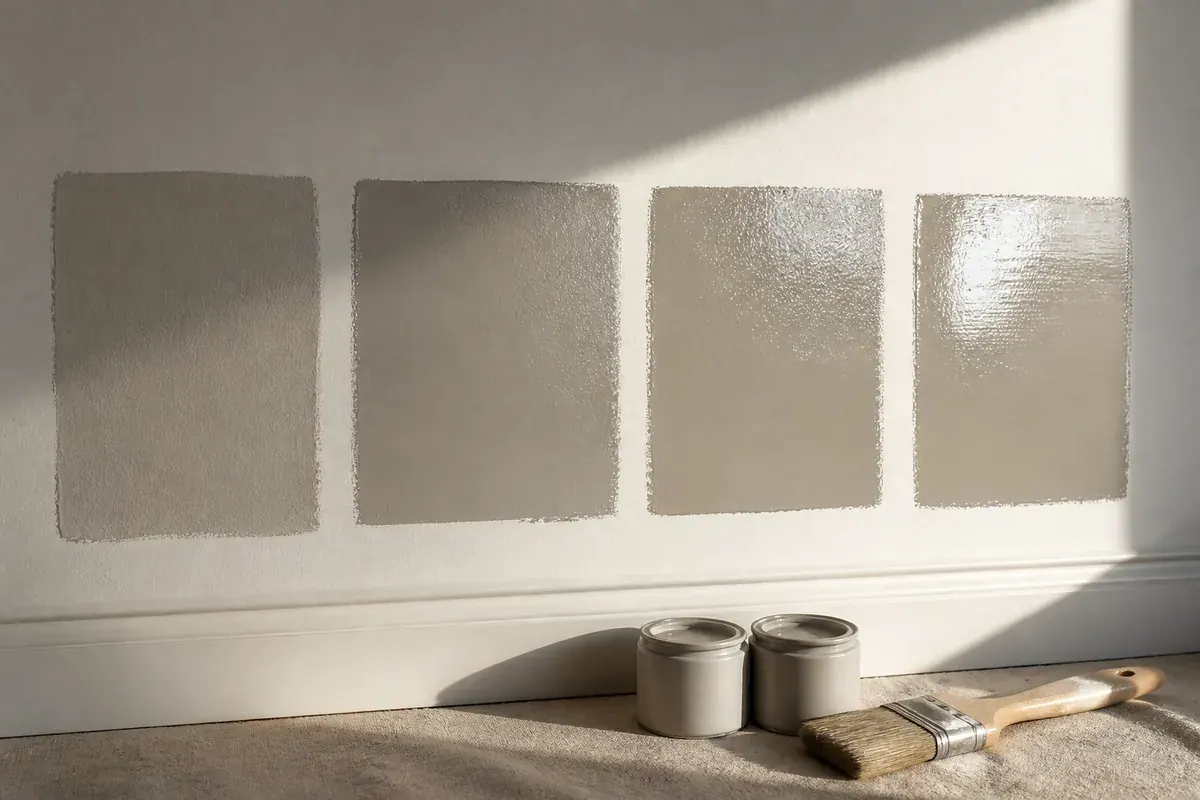
Sheen is usually sold as a durability slider. Flatter for looks, glossier for cleaning, and your job is to pick a point between the two. That framing is incomplete, and it is the less useful half of the decision.
What it leaves out is that sheen also changes the color. The same tinted base in flat and in semi-gloss will not read as the same color once it is on a wall, because the two films return light to your eye in very different proportions. Picking sheen after the color is settled is not a footnote. It is the second half of the color decision.
The Gloss Scale Under the Marketing Names
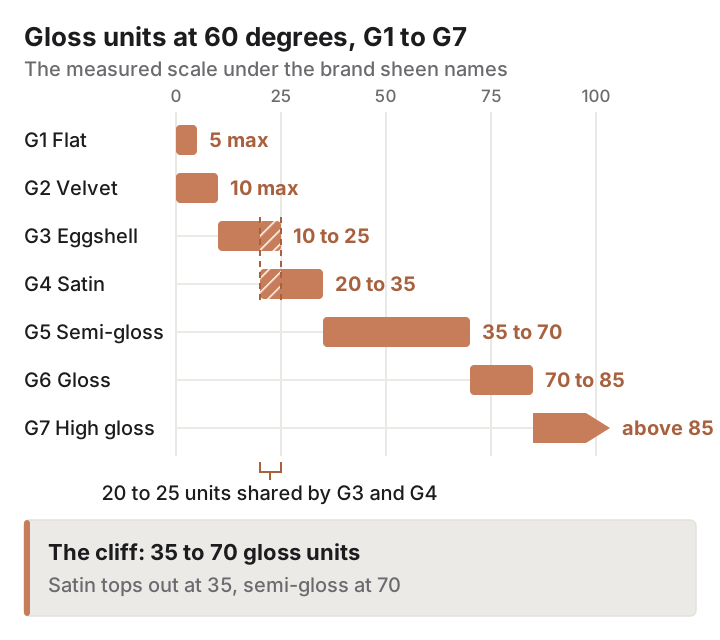
Brand sheen names are marketing copy. “Matte,” “velvet,” “pearl,” “low lustre” and “satin” mean different things at different companies, and nothing forces two brands’ satins to match. The measurable version is gloss units, read by a meter aimed at the painted surface at a fixed angle: 60 degrees for mid-range finishes, 85 degrees for the very low ones. The Master Painters Institute sorts the full range into seven numbered levels with published unit bands, summarized by Rodda Paint’s gloss selection guide.
| MPI level | Common shelf name | 60° gloss units | 85° sheen units | Typical placement |
|---|---|---|---|---|
| G1 | Flat, matte | 5 max | 10 max | Ceilings, low-contact walls |
| G2 | Velvet, matte enamel | 10 max | 10 to 35 | Washable matte wall lines |
| G3 | Eggshell | 10 to 25 | 10 to 35 | Bedrooms, living rooms |
| G4 | Satin | 20 to 35 | 35 min | Kitchens, baths, hallways |
| G5 | Semi-gloss | 35 to 70 | not specified | Trim, doors, cabinets |
| G6 | Gloss | 70 to 85 | not specified | Furniture-grade millwork |
| G7 | High gloss | above 85 | not specified | Lacquer-look doors and cabinets |
Two practical facts fall straight out of those numbers. First, the eggshell band and the satin band overlap between 20 and 25 units, which is exactly why one company’s eggshell can arrive glossier than another company’s satin. Second, the step from satin to semi-gloss is the largest jump on the whole scale, from a 35-unit ceiling to a 70-unit ceiling. Every other neighboring pair is a nudge; that one is a cliff.
Why One Color Reads as Two Colors
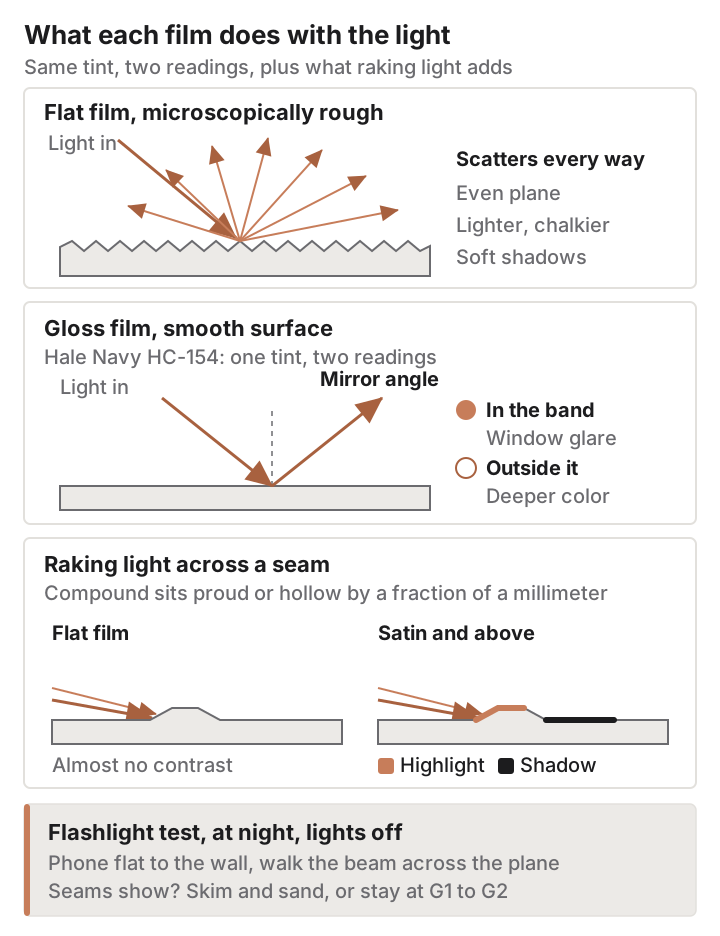
A flat film is microscopically rough. Light that hits it scatters in every direction, so you see pigment color from wherever you stand, in roughly the same strength. The wall reads as an even plane. Color looks a touch lighter and chalkier than the can suggests, and shadows across it stay soft.
Glossy films are smoother. They send a large share of the incoming light back out at the mirror angle, which does two things at once. Stand outside that mirror angle and less light returns to you, so the color reads deeper and more saturated than the chip. Stand inside it and you are looking at a bright reflection of the window or the lamp, not at the color at all.
The practical result is that a high-sheen wall is darker across most of the room and blown out in one moving band. Deep colors show this hardest. Benjamin Moore’s Hale Navy HC-154 in a flat finish reads as a soft solid field of navy; in semi-gloss the identical tint reads heavier in the body and carries a bright reflected shape of whatever window is opposite it.
There is a fix, and it is not complicated. Printed paint chips carry very little sheen of their own, so a chip you fell for sits closest to what flat and matte will give you. A common workaround among decorators committing to satin or above on a mid-tone or deep color is to move one step lighter on the strip than the chip that sold them, then sample to confirm.
Raking Light, Drywall Seams, and Roller Stipple
Raking light travels nearly parallel to a surface instead of striking it head-on. It comes from a window in an adjacent wall, a sconce mounted close to the plaster, a picture light, or a hallway lit from one end only. It is the single most unforgiving thing that can happen to a painted wall.
No wall is truly flat. Joint compound over seams and fastener heads sits proud or hollow by a fraction of a millimeter, roller stipple varies with nap and pressure, and old patches absorb differently from the field around them. A flat film scatters light, so those height differences generate almost no contrast. Satin and above produce a highlight on the high side of every ridge and a shadow on the low side, which draws you a map of the drywall.
Run this check before you commit. At night, with the room lights off, hold a phone flashlight flush with the wall so the beam travels along the surface, then walk it slowly across the whole plane. Whatever that beam finds, a satin finish will find in daylight. If it finds seams and patches, either skim and sand them or stay at G1 to G2 and buy your durability from chemistry rather than from gloss.
How Washable Matte Changed the Old Sheen Rules
The old rule held that durability came from gloss, because glossier films carried more binder and less pigment and therefore survived scrubbing. Modern binder chemistry has partly decoupled the two. Behr’s Ultra Scuff Defense is sold as a flat paint with scuff and mar resistance, aimed specifically at hallways, entryways and shared living spaces. Sherwin-Williams advertises “advanced washability in all finishes” for Emerald Designer Edition, which runs flat through gloss.
What has not changed is burnishing. Rub any low-sheen film hard enough in one spot and the surface polishes itself to a localized shine that no amount of further cleaning removes. Washable mattes resist it better than ordinary flats. None of them are immune.
Low sheen also keeps one advantage the durability charts never mention: touch-up. A dab of matte over a scuff disappears; a dab of satin leaves a visible patch because the repair sits at a different gloss than the surrounding film. In a rental, a hallway, or a child’s room, that alone can decide the sheen.
One caution on shopping. “Washable” and “scrubbable” are front-label words with no shared meaning between brands. Read the technical data sheet and look for a named scrub or scuff test, not the marketing panel.
Where Each Sheen Level Earns Its Place, Surface by Surface
| Surface | Sheen usually specified | Reasoning |
|---|---|---|
| Ceilings | Flat, G1 | Every fixture in the room grazes the ceiling at a shallow angle |
| Bedrooms, formal living rooms | Matte or eggshell, G1 to G3 | Low hand contact, walls should read as planes |
| Hallways, stairwells, playrooms | Washable matte, G2, or eggshell, G3 | Contact concentrated at one height, and touch-up matters |
| Kitchens | Satin, G4, or a washable matte | Airborne grease wipes off without a halo |
| Bathrooms | Purpose-built bathroom matte, or satin | Humidity and steam, plus mildew resistance |
| Trim, doors, window casings | Satin to semi-gloss, G4 to G5 | Must survive contact and separate visually from the wall |
| Cabinet doors and drawer fronts | Semi-gloss alkyd, G5 | Hardest film, cleans without abrasion |
Bathrooms are the place the old rules bent furthest. Purpose-built lines now let you keep a matte look in a wet room: Benjamin Moore’s Aura Bath & Spa is a matte-only formula for high-humidity rooms, listed by the manufacturer at $108.99 per gallon at the time of writing, with 350 to 400 square feet of coverage. For cabinets and trim, a waterborne alkyd still wins on film hardness; Benjamin Moore’s Advance in semi-gloss is listed at $88.99 per gallon, covers 400 to 500 square feet, and asks for a 16-hour recoat window, which is the real cost of that finish.
Keep the sheen steps consistent through a room. Ceiling lowest, walls in the middle, trim one or two levels above the walls. If you want trim to read as its own element without introducing a second color, the same tint at two sheens does the job cleanly.
Sampling Sheen: A Seven-Step Board Test
Color sampling is routine. Sheen sampling almost never happens, which is how so many rooms end up with the right color at the wrong finish. Do this before ordering gallons.
- Buy the chosen color in both candidate sheens, in sample size. Two small pots cost a fraction of one gallon and far less than repainting a wall.
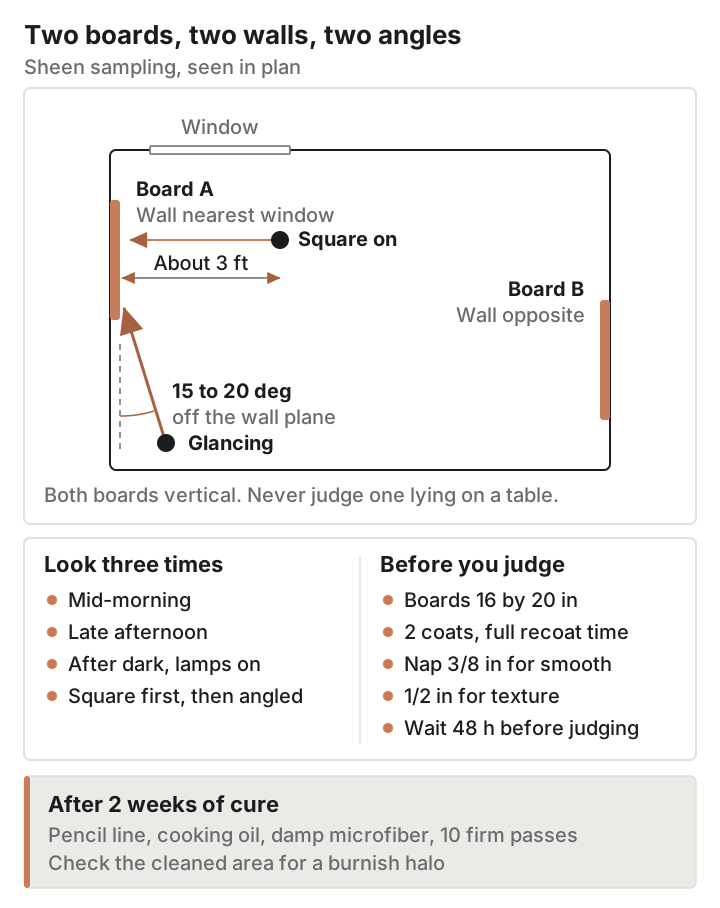
- Prime two rigid white boards, roughly 16 by 20 inches each. Use primer, not bare board: an absorbent substrate pulls binder out of the film and flattens the sheen you are trying to judge.
- Apply two coats to each board, waiting the full label recoat time between them. Roll with the same nap you plan to use on the wall, 3/8 inch for smooth drywall and 1/2 inch for texture, because roller stipple controls how much the sheen shows.
- Wait 48 hours before judging anything. Gloss keeps developing as the film coalesces, so a satin assessed three hours in reads flatter than it will look next week.
- Tape one board flat against the wall nearest the window and the other against the wall opposite. Never judge a vertical surface from a board lying on a table.
- Look three times: mid-morning, late afternoon, and after dark with the lamps on. Each time, stand about 3 feet back and square to the board, then move until you are viewing it at roughly 15 to 20 degrees off the wall plane. That glancing view is where sheen lives.
- After two weeks of cure, mark each board with a pencil line and a fingerprint of cooking oil, then clean with a damp microfiber using ten firm passes. Check the cleaned area under raking light for a burnish halo. That result tells you more than any front label.
One more thing worth sampling: cut a small board in the trim sheen and hold it against the wall sample. The contrast between wall and trim is a design decision in its own right, and it is much easier to judge side by side than in your head.
Two Questions That Settle the Sheen in Any Room
Once the color is locked, the finish comes down to a pair of questions you can answer in about a minute per room.
Question one: what touches this surface, and how often? Hands, mop handles, cooking grease, steam, a dog’s shoulder, or nothing at all. The honest answer sets the lowest acceptable durability, which is the floor of your sheen range.
Question two: does light rake across this surface at a shallow angle, and how flat is what’s underneath? Run the flashlight test if you are unsure. The answer sets the highest sheen you can use without the wall reporting every seam, which is the ceiling of your range.
Where the floor and the ceiling overlap, that’s your sheen. When the floor sits above the ceiling, which happens constantly in hallways that have a window at one end and handprints along the whole length, the answer is not to climb the gloss scale anyway. Buy a washable matte and let the light keep its veto.