How to Light a Room That Gets No Sun
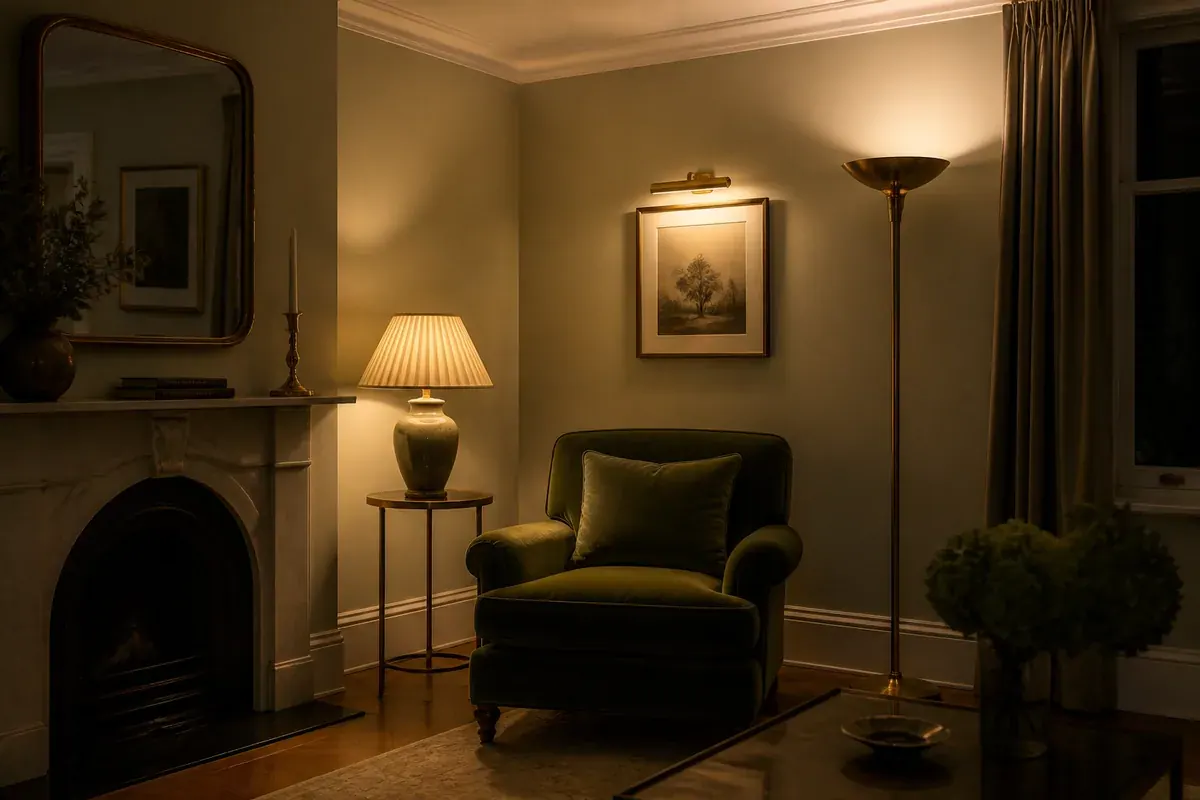
A lamp in every corner, all of them switched on, and the room still reads flat and grey. This is the ordinary failure in a north-facing sitting room, a finished basement, or an interior room with no window at all. The reflex is to go buy a sixth lamp. Quantity is the wrong variable to adjust, because five shaded fixtures standing at the same height and pushing light down onto the same low horizontal plane give you five copies of one lighting condition rather than a layered one.
Daylight is not simply more light. It arrives as one enormous source, it lands on vertical surfaces as heavily as horizontal ones, and it reports color across a full spectrum. Three separate properties, and a shaded table lamp supplies none of them. Replacing a missing window means replacing each property on purpose.
What follows is the specification order that logic implies: how many lumens, at what Kelvin, at what color fidelity, aimed at which surfaces, over paint of what reflectance. The shopping list comes last, because it is the least consequential decision in the sequence.
The Three Layers a Sunless Room Is Missing
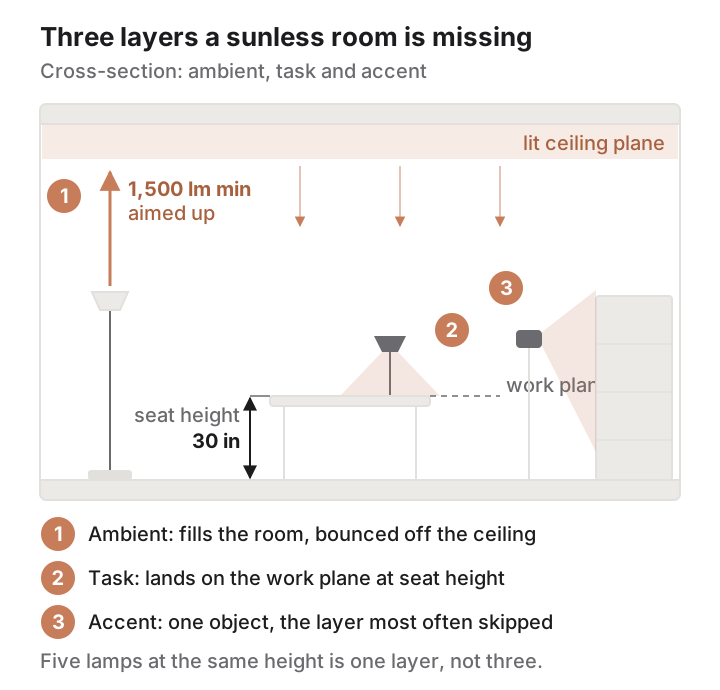
Lighting splits into three jobs. Ambient light fills the volume of the room and sets its base level. Task light concentrates on a working plane: a book, a cutting board, a keyboard. Accent light is directional, aimed at one object or one surface, and it is the layer that gives a room visible depth.
Rooms with no sun usually own exactly one of these. Every corner lamp is ambient, every one sits at seat height, every one points down. Nothing washes the ceiling, nothing grazes a wall, nothing is meaningfully brighter than anything else. Even illumination at a low level is the technical description of grey.
Accent is the cheapest layer to add and the one most often skipped. One small directional fixture aimed at a bookcase or a framed print gives the eye a bright reference to calibrate against, and the rest of the room then reads as deliberately low rather than underlit.
Lumen Targets: Sizing the Ambient Layer by Square Footage
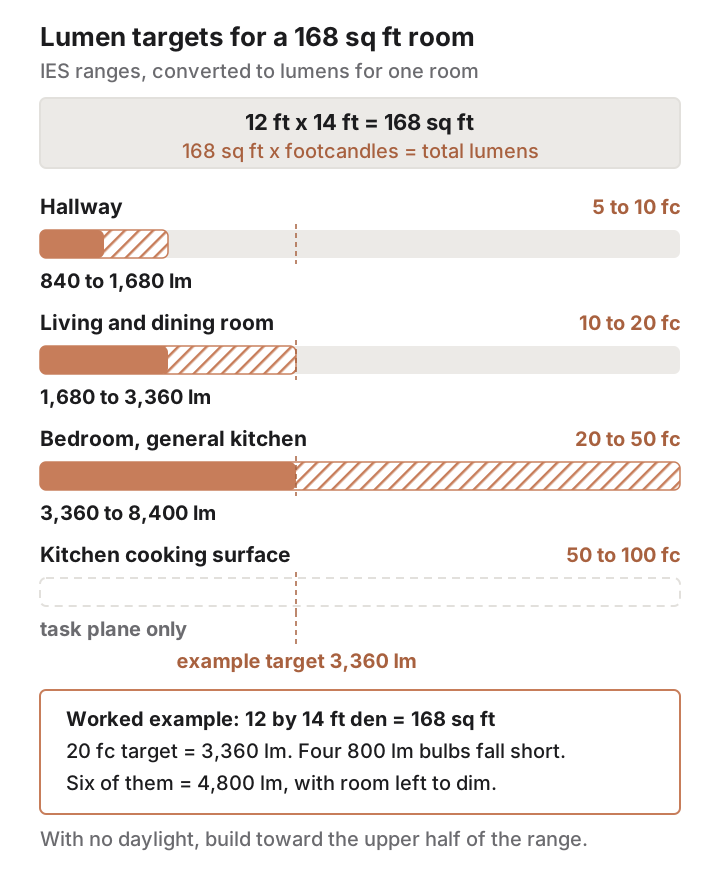
Begin with floor area, not fixture count. Multiply the area in square feet by a target footcandle level and you have a rough total lumen requirement for the room. A published summary of the Illuminating Engineering Society ranges puts living and dining rooms at 10 to 20 footcandles, bedrooms and general kitchen lighting at 20 to 50, cooking surfaces at 50 to 100, and hallways at 5 to 10.
| Space | Footcandle range | Total lumens, 168 sq ft, low end | High end |
|---|---|---|---|
| Hallway | 5 to 10 | 840 | 1,680 |
| Living room | 10 to 20 | 1,680 | 3,360 |
| Dining room | 10 to 20 | 1,680 | 3,360 |
| Bedroom | 20 to 50 | 3,360 | 8,400 |
| Kitchen, general | 20 to 50 | 3,360 | 8,400 |
| Kitchen, cooking surface | 50 to 100 | task plane only | task plane only |
That arithmetic assumes every lumen a bulb produces arrives on the floor plane, which never happens. Shades absorb some, dark walls swallow more, and light bounced off a ceiling returns diffused and reduced. In a room with zero daylight contribution the sensible move is to build toward the upper half of the range and put the ambient layer on a dimmer.
Work an example. A 12 by 14 foot basement den is 168 square feet, so 20 footcandles calls for 3,360 lumens, and four 800-lumen A19 bulbs will not quite reach it. Six of them, split between a ceiling uplight, a wall-directed fixture and two lamps, land at 4,800 lumens and leave you room to dim.
2700K, 3000K and 4000K With No Daylight Reference in the Room
Color temperature is easier to get right in a windowless room than in one with a window, because no daylight sits beside your lamps inviting comparison. The eye adapts to whatever it is handed. The common mistake is not picking the wrong Kelvin; it is picking three of them and running them in the same room.
| Kelvin | Reads as | Suits | Watch for |
|---|---|---|---|
| 2700K | Warm, close to old incandescent | Sitting rooms, bedrooms, dens | Cool greys and blues flatten out |
| 3000K | Warm neutral | Kitchens, bathrooms, hallways | Slightly hard against orange-toned wood |
| 4000K | Neutral white | Laundry, workshop, garage | Reads institutional in seating areas |
Choose one number and hold it across every socket in the room, including the closet and the hallway you can see from the sofa. Dim-to-warm bulbs are worth knowing about here, since a sunless room usually runs its lights from morning to night. The Philips Ultra Definition A19 shifts from 2700K down toward 2200K as it dims, an 8 watt bulb rated at 800 lumens and 95 CRI on an E26 base, 15,000 hours, and it retails in the region of $5 to $7 per bulb in multipacks.
CRI 90 and the R9 Figure Sitting Behind It
Color rendering index scores how faithfully a source shows color against a reference. The Department of Energy notes that a minimum CRI of 80 is recommended for interior lighting and that 90 or higher indicates excellent color fidelity, while adding the caveat that CRI is far from a perfect metric.
Consider what that means in a room with no window. Elsewhere, a mediocre bulb only misreports color after dark. Here, every color decision you already paid for is being described to you by the bulb and nothing else. Terracotta drifts to brown, a warm white wall drifts to yellow-grey, and the fault gets blamed on the paint.
That caveat is the reason to look past the headline figure for R9, the deep red value. The same Department of Energy page notes that CRI is especially poor at predicting the fidelity of saturated reds, for which the supplemental value R9 is often used, and manufacturers publish R9 separately when it is worth publishing. Waveform Lighting’s CENTRIC HOME A19 lists 95+ CRI with R9 at 80 or better, 800 lumens from 10 watts, 2700K or 3000K on an E26 base, and 25,000 hours, at $28 per bulb. It is not dimmable and not rated for enclosed fixtures, which is the trade for that spec sheet.
Ceilings, Walls and Where the Mirror Goes
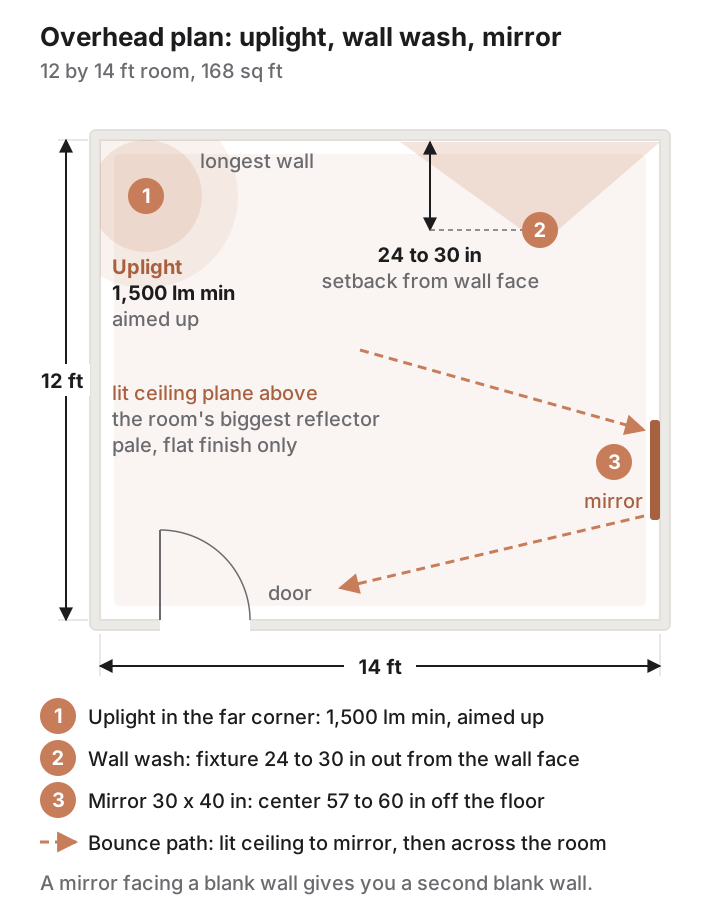
Your largest available reflector is the ceiling. An uplight aimed at it converts a hard point source into a soft luminous plane roughly the footprint of the room, which is the nearest thing to a window that money can buy. This only works over a pale ceiling in a flat finish, since a colored ceiling tints the return and a glossy one throws back a hot spot instead of a wash.
Wall washing handles the second half. Light on a vertical surface is what the eye reads as brightness when it scans a room, so a lit wall does more for the impression of daylight than the same lumens spilled on a rug. The usual wall-wash setback is 24 to 30 inches out from the wall face, with the beam aimed to break near the ceiling line, which spreads the pool instead of stamping a circle.
Mirrors are reflectors, never sources, and they return only what stands in front of them. A mirror facing a blank wall gives you a second blank wall. Hang it so it faces the brightest thing in the room, or on the wall running perpendicular to your uplight so it picks up the lit ceiling plane and carries it across. For a 30 by 40 inch mirror, the common hanging convention puts the center point 57 to 60 inches off the floor, close to standing eye level for most adults.
Paint LRV: The Number Printed Under the Color Name
Light reflectance value states the share of visible light a surface sends back. The scale runs from no reflected light to complete reflection, and paint companies publish it as a figure out of 100. Benjamin Moore lists Chantilly Lace OC-65 at an LRV of 90.04, which explains how often it lands on ceilings in rooms that need the help.
For a room with no sun, the working targets are 85 or higher on the ceiling and 60 or higher on the walls. Under roughly 50, the walls take back more than the fixtures can hand them, and each added lamp buys less than the last. A dark room painted dark is a coherent choice; it is simply not one you can light your way out of.
Keep the wall-to-trim gap narrow when you want the surfaces to behave as one continuous reflector. The British accessibility standard BS 8300:2018 treats a 30-point LRV difference as the threshold for adequate visual contrast, which is a useful figure to stay well beneath when contrast is the opposite of your goal.
The Build-Up Sequence: First Fixture, Second, Third
Order matters, because each layer changes how hard the next one has to work. Add them in this sequence and stop as soon as the room is right.
- Ceiling uplight, in the corner farthest from the door. Aim for at least 1,500 lumens directed up. A torchiere or a pair of small can uplights both do it. This single move usually accounts for most of the visible change.
- Wall wash on the longest uninterrupted wall. Set the fixture 24 to 30 inches out from the face and let the beam break high. Two lit vertical planes is the target, not one.
- Task light at the chair you genuinely use. IKEA’s TERTIAL work lamp is $19.99 with a 7 inch shade, a 4 foot 11 inch cord and a 13 watt ceiling on an E26 socket, and the bulb is sold separately.
- One accent fixture on one object. A small directional lamp on a shelf, a picture light, or an uplight tucked behind a plant.
- Re-bulb the whole room to a single Kelvin at 90 CRI or better. People reach for this step first, though it belongs here, once the geometry is settled.
- Dimmers on the ambient layer only. Verify bulb compatibility before buying, since several high-CRI bulbs are not dimmable.
Then take a reading. A handheld lux meter or a phone light meter app, held face up at seat height around 30 inches above the floor, returns a value in lux; divide by 10.764 to convert to footcandles. Measure once mid-room and once in the darkest corner, then record both numbers before you change anything else.
Order of Operations, and the Reading to Take Afterward
One fixture goes in first: the uplight, aimed at the ceiling, in the corner farthest from where you enter. Everything else described above is a refinement of what that fixture starts. Wall wash second, task light third, accent fourth, and a re-bulb pass last to bring every socket to one Kelvin at 90 CRI or better.
Afterward, compare your two readings against the range for the room’s function. A center reading that has climbed into range while the gap between center and corner has narrowed means the layers are carrying the room. A center reading in range with a corner still in shadow means one lamp is doing the ambient work alone, and the wall wash is the next thing to buy.