Matching Houseplants to the Light You Measured
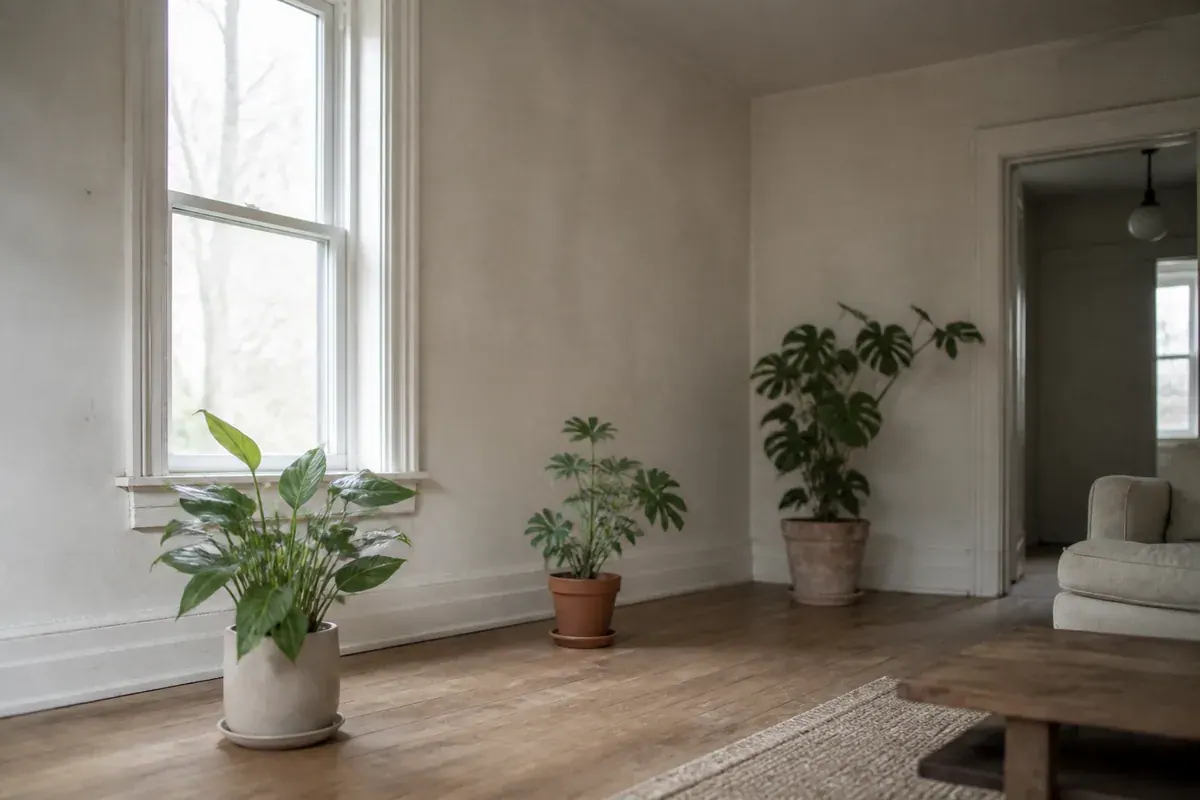
Bright indirect light. Low light. Medium light. Those three phrases cover most of what a plant tag says about light, and not one of them is a measurement.
A measurement carries a unit and a place: 115 foot-candles at midday, three feet back from an east window, at the height the leaves will sit. That sentence can be checked against a published requirement. The tag phrasing cannot.
Two rooms can both read as bright to a person and still differ by a factor of ten at the pot. Human vision adjusts within seconds, so a hallway that feels usable for reading a paperback can sit far below what a fiddle-leaf fig needs to hold its lower leaves. Meters do not adjust.
The order that works is the reverse of the usual one: read the spot, then shop against the number. Tools run from free to a few hundred dollars. The reading itself takes about ten minutes.
Foot-Candles, Lux, and the Number 10.764
Two units appear in plant light guidance. Lux is the metric unit of illuminance and what nearly every phone app reports. The foot-candle is the customary unit, used by American horticultural references. One foot-candle equals about 10.764 lux, which makes the conversion a single division.
Run it once and it stops feeling abstract. An app reading of 1,240 lux is 1,240 divided by 10.764, or 115 foot-candles. A reading of 480 lux is 45 foot-candles, and a reading of 5,600 lux is 520 foot-candles. Those three results land in three different plant categories, which is the entire reason for taking them.
One caveat belongs here. Illuminance is defined in lumens per unit area, so it describes light the way an eye receives it, and plants respond instead to photons in the 400 to 700 nanometer range, which research instruments count directly in micromoles per square meter per second. Extension references still publish houseplant requirements in foot-candles, so for daylight through a window an illuminance reading remains the practical starting point.
Why the Reading Collapses Three Feet Into the Room
Back away from a window and the figure falls faster than your eye suggests. For a point source, intensity drops with the square of the distance, so doubling the distance leaves a quarter of the light. A window is a broad source rather than a point, so its falloff is gentler than a strict inverse square. The curve still bends hard inside the first several feet.
Plants pay for that curve. Something holding its color on the sill can fade on a console table six feet back, and the room gives no visible sign of the difference.
Obstruction stacks on top of distance. Sheer curtains, a window screen, a balcony deck overhead, a neighboring wall, a maple in full leaf: each subtracts before any light reaches the glass. Take readings with the screen in place and the curtains hanging the way you keep them.
What a North Window Gives and a South Window Takes Away
Orientation sets the ceiling on everything else. The University of Georgia’s indoor plant bulletin reports an eastern exposure at 5,000 to 8,000 foot-candles with direct morning sun until midday and shade afterward, a southern exposure carrying the widest swing of any aspect with noon summer readings near 10,000 foot-candles, and a northern exposure as low as 200 foot-candles on a clear winter day.
Read those as figures at the exposure, not at a pot standing across the room. Latitude, glazing, and whatever sits outside your particular window all move them. The bulletin gives no separate figure for a western exposure, calling south and west interchangeable for most plants. The ranking survives regardless: south delivers the most and the least consistent, east delivers usable morning intensity against a cooler afternoon, west trades the morning for late-day intensity, and north stays low and steady.
A Nine-Step Routine for Reading a Window and the Floor In Front of It
Free tools handle most of this. Photone runs on iPhone, iPad, and Android, is free to download, and reports PAR/PPFD in µmol/m²/s, DLI in mol/m²/d, illuminance in both lux and foot-candles, and correlated color temperature in Kelvin. A dedicated handheld such as the Extech LT300 mounts its sensor on a 12-inch coiled cable, expandable to 24 inches, so your body never shades the reading; Extech specifies it to 40,000 foot-candles at plus or minus 5 percent of reading. A research-grade quantum meter, the Apogee MQ-500, reads 0 to 4,000 µmol per square meter per second at 5 percent calibration uncertainty and lists at $550.
- Mark the exact spot where the pot will stand, and measure its distance from the glass in feet.
- Wait for a clear or lightly overcast day, and take the first set between 11 a.m. and 2 p.m.
- Hold the sensor at the height the leaves will occupy, not on the floor, unless the sill is where the plant is going.
- Aim the sensor the way the foliage will face, then take a second reading with it pointed straight up. Record both. A wide gap between the two means the light is strongly directional.
- Keep your body, your phone, and your forearm out of the light path. This is where a remote sensor on a cord earns its price.
- Walk a straight line out from the center of the window and read at the glass, at 3 feet, at 6 feet, and at 10 feet.
- Repeat the full set near 9 a.m. and again near 4 p.m., to capture the shape of the day rather than one instant.
- Convert every lux figure to foot-candles by dividing by 10.764.
- Write the readings, the date, the time, and the sky condition on a card. You will want them again in six months.
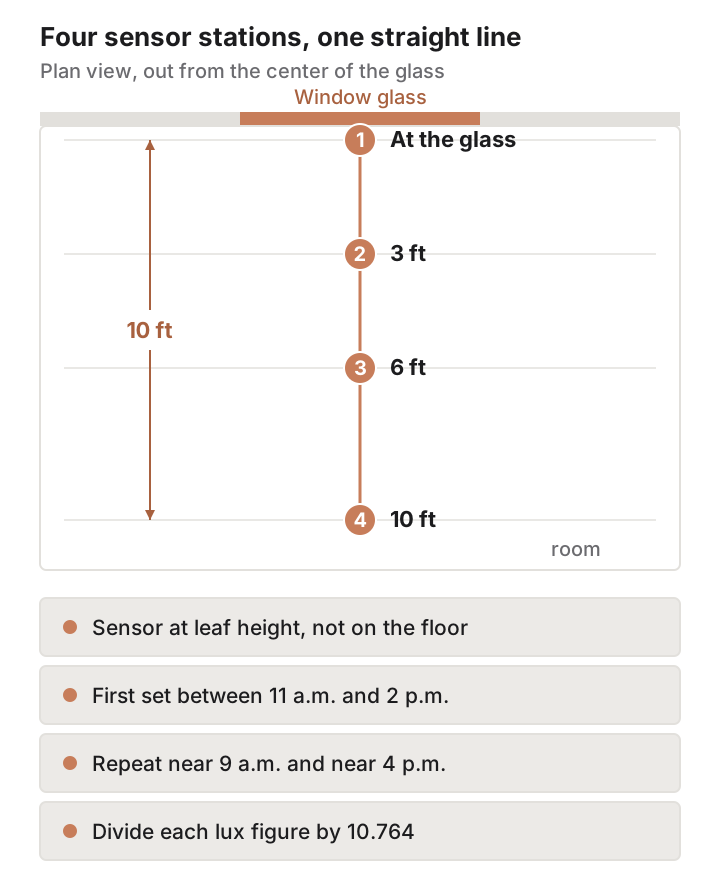
Nine steps is one walk out from the window with a phone, repeated twice more the same day.
Sorting Plants Into Bands by Their Foot-Candle Minimums
The Georgia bulletin splits indoor plants into four bands, and gives each band both a survival minimum and a preferred range. That split is the useful part, because a plant sitting at its minimum is holding on rather than growing. The brackets run from 25 foot-candles at the low end to 1,000 and up at the top.
| Band | Minimum (ft-c) | Preferred (ft-c) | Preferred in lux | Plants commonly sold in this band |
|---|---|---|---|---|
| Low | 25 to 75 | 75 to 200 | 807 to 2,153 | Cast-iron plant (Aspidistra elatior), ZZ plant (Zamioculcas zamiifolia), Chinese evergreen (Aglaonema) |
| Medium | 75 to 150 | 200 to 500 | 2,153 to 5,382 | Golden pothos (Epipremnum aureum), peace lily (Spathiphyllum), heartleaf philodendron (Philodendron hederaceum) |
| High | 150 to 1,000 | 500 to 1,000 | 5,382 to 10,764 | Fiddle-leaf fig (Ficus lyrata), croton (Codiaeum variegatum), jade (Crassula ovata) |
| Very high | 1,000 and up | 1,000 and up | 10,764 and up | Cacti, echeveria (Echeveria), Meyer lemon (Citrus x meyeri) |
Bracket figures above come from the bulletin. The species column reflects how nurseries shelve these plants, not any ruling by the bulletin; the plants it names on the dim side are African violet, cast-iron plant, and ferns, with croton and cacti at the bright end.
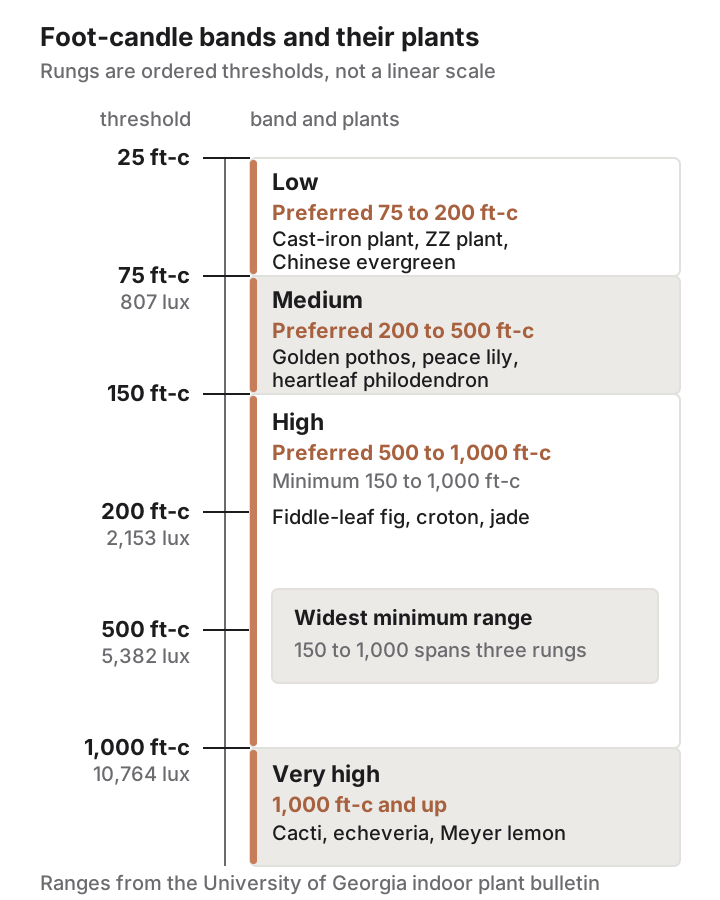
Return to the three converted readings from earlier. 45 foot-candles falls inside the low band’s minimum range, below the 75 foot-candle floor for good growth. 115 foot-candles clears the medium band’s minimum but misses its 200 foot-candle preferred floor. 520 foot-candles sits inside the high band’s preferred window.
The Same Windowsill Reads Differently in January
Sunlight penetrates farther into a room during winter, the bulletin notes, because the summer sun climbs to a higher angle. A south-facing room can therefore gain usable depth in December and give it back in June, the opposite of the usual assumption. Deciduous shade works the other direction. A maple that subtracts nothing in February can cut a west window’s afternoon figure once it leafs out.
Take the reading set twice a year and file both on the same card. Late June and late December bracket the extremes. If a plant slides in one season and recovers in another, the two sets will usually explain why without any guesswork about watering.
Where the Screen and the Storm Panel Fit In
Storm panels, low-e coatings, and insect screens all sit between sky and leaf, and none announces its cost in foot-candles. Measure through whatever is installed. If you remove screens in winter, that is a second reason the December set will differ from the June one.
Grow Lights: The Spec Sheet Line That Decides Whether One Helps
One number decides a grow light: PPFD at a stated distance from the fixture, in micromoles per square meter per second. Wattage, equivalent wattage, and lumens describe the fixture or human vision. None of them tells you how many photons land on a leaf 18 inches down.
Daily light integral, from the same reference cited above, is calculated as 3.6 x 10⁻³ multiplied by PPFD multiplied by light-hours per day, in moles per square meter per day. A fixture delivering 150 µmol/m²/s at leaf height for 12 hours yields 3.6 x 10⁻³ x 150 x 12 = 6.48 mol/m²/day. Trim the timer to 10 hours and the same fixture yields 5.4. That reference also notes DLI becomes particularly limiting below 5 mol per square meter per day, which puts the shorter run close to the edge.
Manufacturers that publish the figure let you run that arithmetic before buying. Soltech lists the Aspect Gen 2 LED Growlight at $200 and 36 watts, with roughly 50 µmol/m²/s at 1 meter, 34.9 at 4 feet, and 15.5 at 6 feet. Take the 1-meter figure at 12 hours and the fixture returns 3.6 x 10⁻³ x 50 x 12 = 2.16 mol/m²/day, well under 5 on its own. Drop the pendant to 4 feet of separation and it falls to 1.51. That is the honest shape of one decorative fixture: it supplements a window rather than standing in for one. Where a catalog gives no PPFD at a stated distance, hang the fixture and measure at leaf height after dark, so daylight stays out of the reading.
Everything a grow light needs can arrive on a cord. Plug-in fixtures and clamp lamps ask nothing of the house wiring, which is why they are the sensible answer for one plant on a console table. A hardwired pendant, a new receptacle, or a dedicated switched circuit is a different purchase entirely, one a licensed electrician makes on your behalf, to the electrical code your city or county enforces.
The Readings to Take Before You Buy a Single Plant
Four figures per location, plus a date. Read at the glass, at 3 feet, at 6 feet, and at 10 feet along a line straight out from the center of the window, at leaf height, between 11 a.m. and 2 p.m. on a clear day, with the screen in and the curtains where you keep them. Divide each lux value by 10.764.
Then carry the converted figure for the one spot you actually have in mind. Compare it against the preferred range rather than the minimum, and the phrase on the tag becomes what it always was: a rough label, sitting next to a real number.