Water on the Inside of the Window
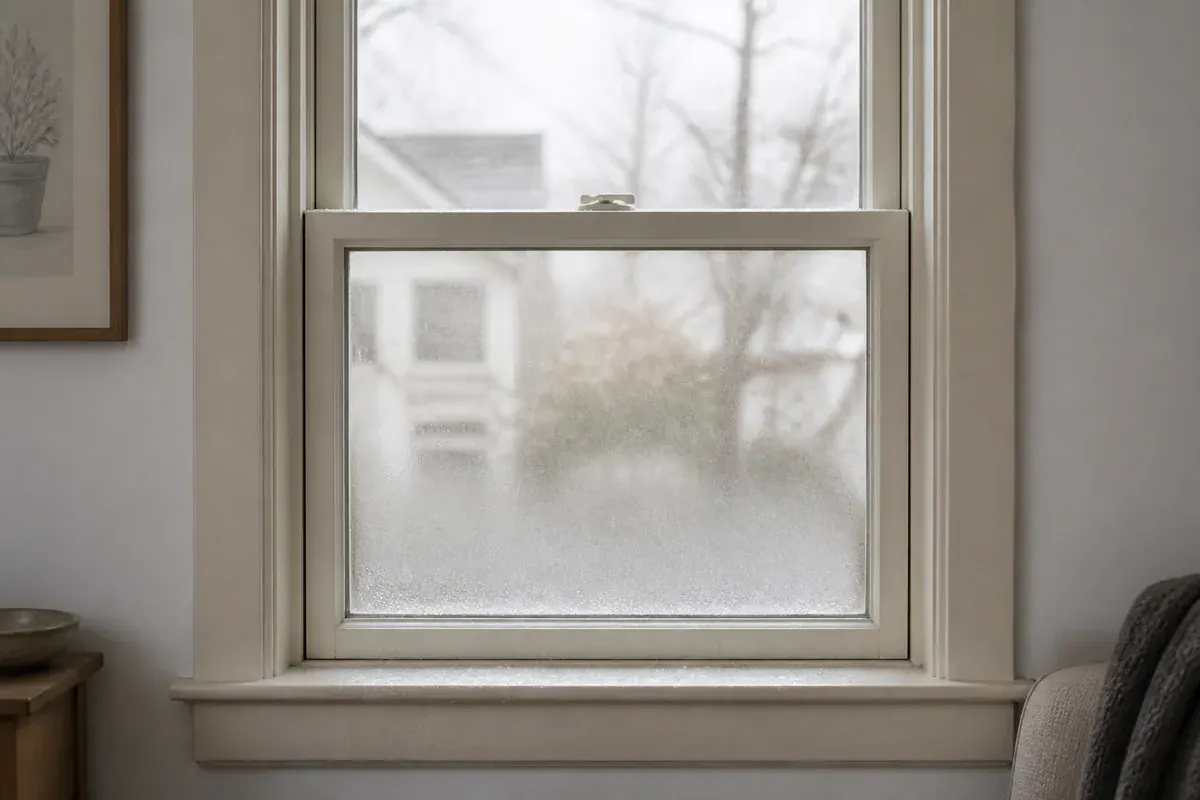
Condensation is not a leak and it is not fog drifting in from outside. It is liquid water that was already in the room, carried invisibly as vapor, arriving at a surface cold enough to force it back into a liquid. Air holds a limited amount of water vapor at any temperature, and cooler air holds less. When room air drifts against a pane chilled from outdoors, the film touching that glass loses temperature, loses capacity, and sheds its surplus as droplets.
So the water reports two measurements at once. The first is how much moisture the indoor air carries. The second is how cold the room-side face of the glass has become. Alter either variable and the droplets stop, which is why two houses on the same block can run identical humidity and only one streams water every January morning.
Most advice treats this as a humidity problem and stops there. Sometimes that is right. Sometimes the air is reasonable and the window is simply a poor one, and no dehumidifier settles it.
The Dew Point Is the Number That Decides
Relative humidity by itself cannot predict whether a window will wet, because the figure is relative to the air temperature it was measured at. The value that travels with the air is the dew point. The National Weather Service defines it as the temperature air must be cooled to in order to reach 100 percent relative humidity, and the same page shows why the relative figure misleads: air at 30°F with a 30°F dew point reads 100 percent, while 80°F air with a 60°F dew point reads only 50 percent.
Applied to glass, the rule is short. Any surface colder than the indoor dew point collects water; any surface warmer stays dry. The window is not wet because the house is humid in general, but because one surface crossed one line.
The table below shows where that line sits. These dew points come from the August-Roche-Magnus approximation, using the constants b = 17.625 and c = 243.04 °C, chosen to minimize deviation from minus 40 to plus 50 °C.
| Indoor relative humidity | Dew point at 68°F room air | Dew point at 70°F room air |
|---|---|---|
| 25% | 31°F | 33°F |
| 30% | 35°F | 37°F |
| 35% | 39°F | 41°F |
| 40% | 43°F | 45°F |
| 45% | 46°F | 48°F |
| 50% | 49°F | 51°F |
| 55% | 51°F | 53°F |
| 60% | 54°F | 55°F |
Compare the two columns. Nudging the thermostat up two degrees at a steady humidity reading pushes the dew point up about two degrees as well, because warmer air at the same relative percentage carries more actual water. Turning the heat up warms the glass slightly and loads the air at the same time, and neither effect rescues a window badly out of range.
Why the Glass Runs Colder Than the Wall Beside It
Glass is the thin spot in the thermal envelope, losing heat faster per square foot than the insulated wall around it. Whole-window U-factors certified by the National Fenestration Rating Council span a typical range of 0.10 to 2.00, and the same label carries an optional Condensation Resistance score rated 1 to 100, where a higher number means less water on the glass. A single pane sits at the punishing end of both scales. Add a second pane over a sealed cavity and the room-side face runs warmer; a third warmer still.
The pane is also not uniformly cold. Heat escapes fastest around the perimeter, where the spacer bar holding the panes apart bridges the cold outer lite to the warm inner one. That is why fogging usually starts as a band along the bottom rail and creeps upward rather than appearing as an even sheet.
Frames leak the same way. An aluminum frame with no thermal break conducts heat straight through the sash, so the frame face and the glass edge beside it run colder than the center. Vinyl, fiberglass, and wood conduct far less, so a house can have excellent glazing and still wet at the corners.
Finding the Humidity Target for Tonight’s Outdoor Low
Take two readings, then work backward to a number you can hold.
- Get a hygrometer that reports a real figure rather than a smiley face. The TempPro TP50, for example, is specified to read 10 to 99 percent humidity at plus or minus 2 percent between 30 and 80 percent. Leave it in the room that fogs, away from vents and from the window itself.
- Note the room temperature and humidity, then find the dew point in the table above.
- On a genuinely cold night, aim an infrared thermometer at three spots: the center of the glass, two inches above the bottom, and the frame corner. Record the lowest.
- Compare that lowest reading against the dew point. Below the dew point, water forms there. Above it, the glass stays clear.
- Work backward to a target. A worked case: 70°F room air, 54°F at the center of the glass, 44°F at the bottom edge. The center stays clear at any livable humidity, so the 44°F edge governs. At 70°F room air, 40 percent humidity carries a 45°F dew point, above 44°F, and wets that edge; 35 percent carries a 41°F dew point, below it, and does not. The target for that outdoor temperature is 35 percent or lower.
- Repeat the glass reading after the outdoor temperature drops another fifteen or twenty degrees. The dew point of the air has not moved, but the glass is colder, so the target humidity has to come down with it.
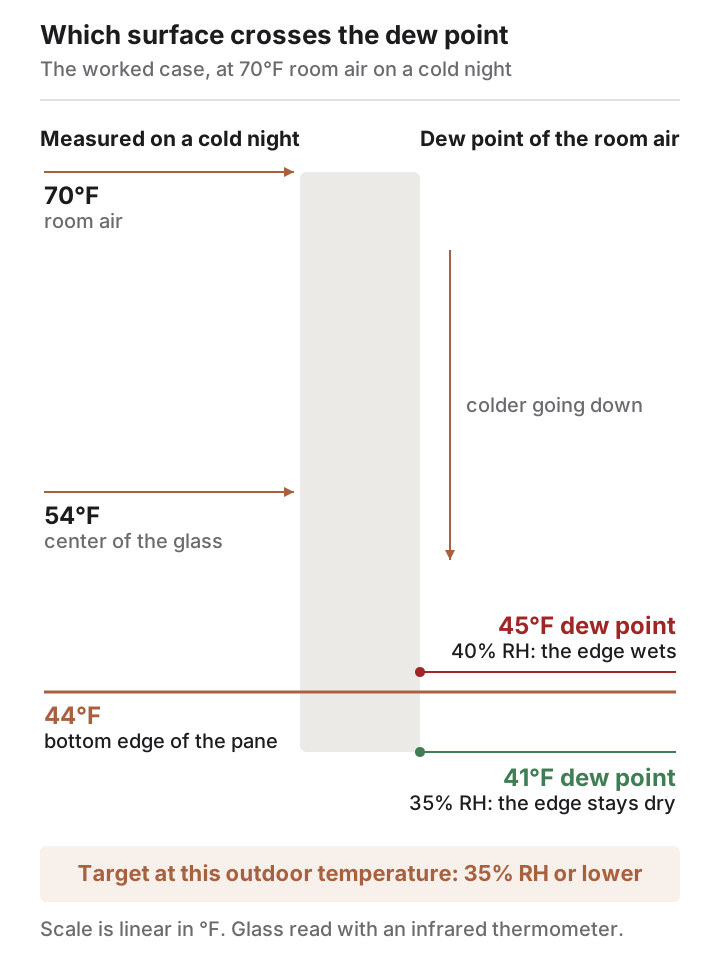
That is the whole relationship. Outdoor temperature sets the glass temperature, the glass temperature sets the ceiling, and indoor humidity has to live under it. The EPA advises keeping indoor relative humidity below 60 percent and ideally between 30 and 50 percent. If the windows demand something below 30 percent to stay dry, the windows are the problem, not the air.
Where the Water in Your Air Is Coming From
Showers and baths are the loudest source, followed by cooking on an open pot, dishwashers venting steam at the end of a cycle, and clothes dryers not ducted outdoors. A drying rack in a bedroom puts every ounce of that laundry water into the air you sleep in. Aquariums, a large houseplant collection, and a whole-house humidifier left at a summer setting contribute steadily rather than in bursts.
Two sources are less obvious. A damp crawl space or unsealed dirt basement feeds moisture upward through the floor all winter, usually where there is no ground vapor barrier. Unvented combustion appliances, including portable gas heaters, release water vapor into the room along with combustion byproducts, carbon monoxide among them. Gas lines and gas-fired appliances are off limits to homeowners under most state rules: a licensed gas fitter or an HVAC contractor connects, vents and tests them, and the venting is what an inspector comes to look at.
New construction adds one more. Fresh concrete, plaster, and framing lumber release water for months, so a first winter often fogs where the second does not.
Ventilation That Removes Moisture Instead of Circulating It
Exhaust only helps if it terminates outside the building. A fan ducted into an attic or soffit cavity moves moisture to a colder part of the house, where it condenses on sheathing and framing instead of on the glass. IRC section M1505.2 requires bathroom exhaust to discharge directly outdoors and forbids discharge into an attic or crawl space, subject to local amendments. Check where the duct ends before blaming the fan.
Run time matters more than people expect. Bath fans do their real work in the twenty minutes after the shower stops, while walls and towels are still releasing water, so a timer switch beats a fan wired to the light. The Broan-NuTone AE110 is one widely stocked ENERGY STAR certified fan in this class, rated 110 CFM at 1.0 sone with a 4-inch duct and a 9-1/4 by 10 by 5-3/4 inch housing to plan a joist bay around. A licensed electrician handles the wiring side of any fan change: a new cable run, a circuit of its own, or a different switching arrangement. What counts as permitted work there is set by the electrical code in force where you live.
Kitchen range hoods follow the same logic: a recirculating hood filters grease and returns every bit of the steam to the room.
Drapery and Blinds That Chill the Glass
Air circulation against the pane raises the surface temperature; anything that seals the glass off from the room lowers it. Lined curtains puddled on the floor, cellular shades tracked tight at the edges, and a sofa back against a sill create a still, cold pocket where the glass runs colder than it would otherwise. The window then fogs at a humidity that would have been fine with the curtains open.
The fixes are unglamorous. Leave a gap at the bottom of window coverings on cold nights, lift blinds during the day, and keep supply registers under windows clear so warm air washes up the pane. Where a room has no register near its coldest window, a small fan aimed at the glass will do more than a dehumidifier.
Fog Sealed Between the Panes Means the Seal Is Gone
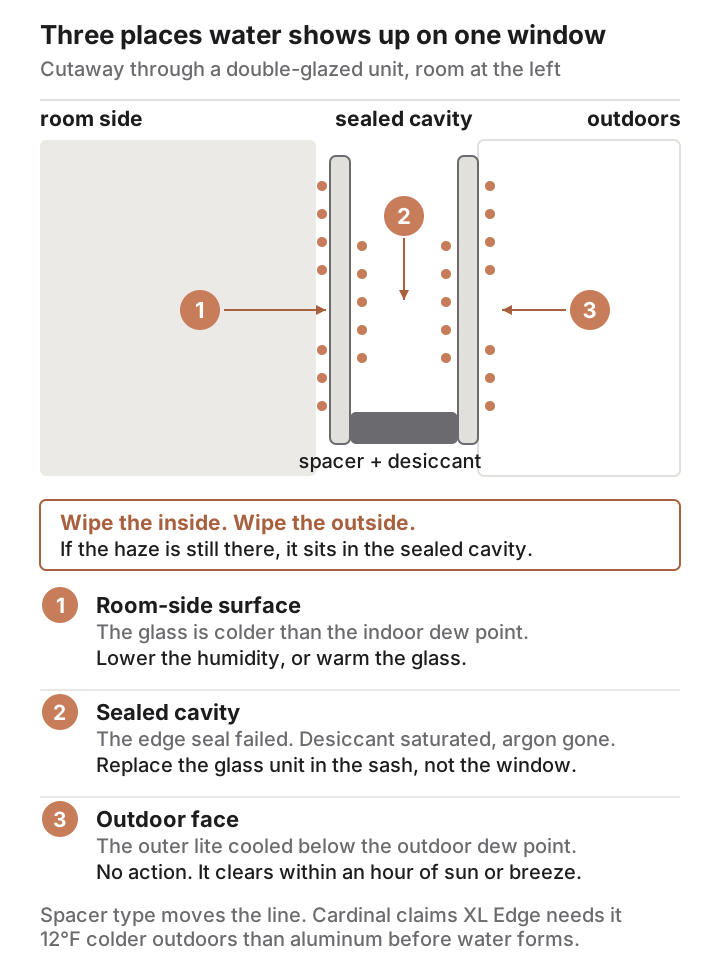
Wipe the inside. Wipe the outside. If the haze is still there, it sits inside the sealed cavity, and no change to indoor humidity will ever touch it.
An insulating glass unit is two lites bonded to a spacer that carries desiccant, sealed at the edge to keep moisture out and gas fill in. Cardinal’s XL Edge spacer, for example, is a stainless steel spacer with airtight bent corners and a dual seal of compressed polyisobutylene and silicone; the manufacturer claims a 0.2 percent failure rate over twenty years behind a 20-year warranty. When that seal fails, the desiccant saturates, the argon leaks out, and humid outdoor air condenses on inner faces no cloth can reach.
Warm-edge spacers also move the condensation line. Cardinal states on the same page that for a typical wood or vinyl window it would have to be 12°F colder outside before condensation forms on a unit with XL Edge than on one with an aluminum spacer. Quanex Super Spacer, sold in variants including Premium and TriSeal, takes the same approach with an all-foam, no-metal edge.
A failed unit rarely requires a new window. The glass unit alone can usually be replaced in the existing sash, far cheaper than a full frame replacement, and the sash brand and glass code are often stamped in the spacer at a bottom corner. A glazier measures the sash and orders the unit to size.
Dew on the Outside of the Glass Is the Opposite Signal
Some mornings the water is on the exterior face, usually in late spring or early fall after a clear calm night. The outer pane radiates heat to the open sky, drops below the outdoor dew point, and collects dew exactly as a parked car does.
That is not a defect but the glazing doing its job: the outer lite is thermally disconnected from the heated interior, so it cools to the ambient dew point instead of being warmed from behind. It clears within an hour of sun or breeze.
Deciding Between a Humidity Problem and a Window Problem
The two failures share no fixes, so sorting them first saves money.
Water on many windows across several rooms, worst in bathrooms and bedrooms, with a hygrometer above 50 percent through the winter, is a moisture problem. Chase the sources, duct the exhaust outside, dry the crawl space, turn the humidifier down. The windows are merely the coldest surface reporting a house-wide condition.
Water on one or two windows, always the same ones, always starting at the perimeter, while the hygrometer sits in the mid-thirties, is a window problem. Nothing done to the air will fix a single pane in an aluminum sash on a north wall. That is a repair budget question about storm panels, insert units, or replacement.
Haze locked between the panes is a third case, answered by a glass unit and not by a dehumidifier. Dew on the outdoor face is a fourth, answered by leaving it alone.