Sizing a Range Hood: Airflow, Capture Area, and the 400 CFM Line
Seven range hoods were bought off the shelf and run through a test rig at Lawrence Berkeley National Laboratory. Their capture efficiency ranged from less than 15 percent to more than 98 percent. All seven worked, and all seven carried an airflow rating on the carton.
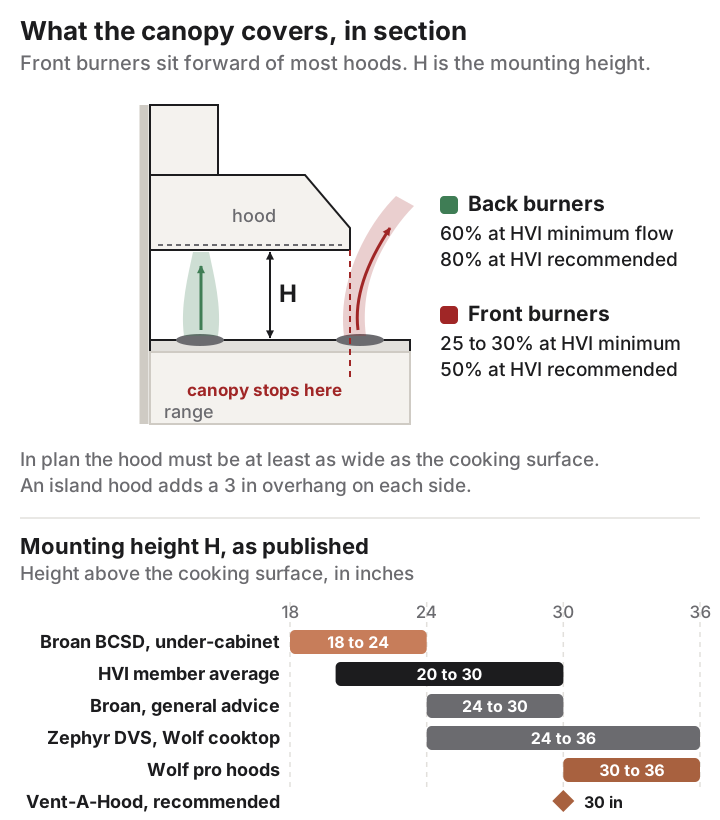
Capture efficiency is the fraction of what rises off a burner that actually leaves the building. At the minimum airflow ASHRAE 62.2 and the Home Ventilating Institute allow, LBNL measured roughly 60 percent capture from back burners and 25 to 30 percent from the oven and front burners. At HVI’s recommended airflow those rise to 80 percent at the back, 60 at the oven and 50 at the front.
The front of the cooktop, where most cooking happens, is where hoods lose. Sizing one means settling four numbers: the airflow target, the geometry above the cooktop, the duct carrying the air out, and the loudness at the speed the hood actually gets run.
Three Sizing Rules That Give Three Different Answers
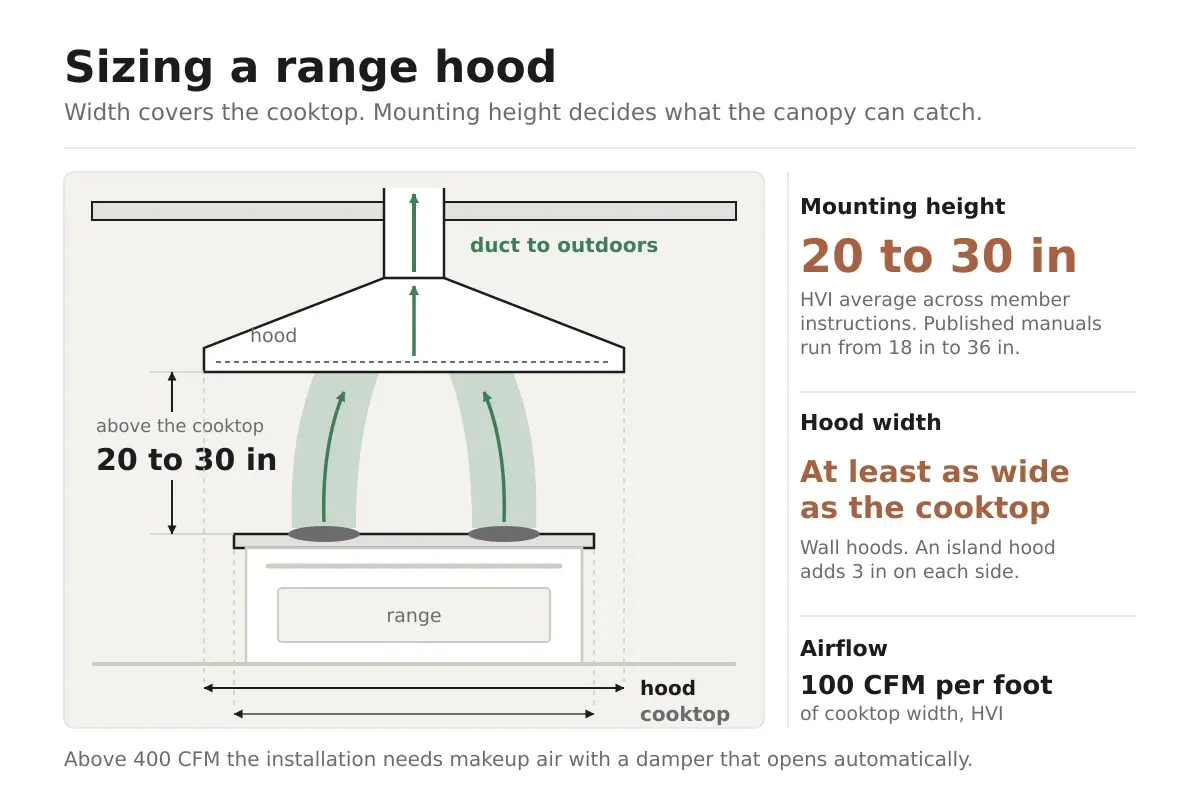
HVI sizes a hood off the cooktop, not the room. Its guidance is 100 CFM per linear foot of cooktop width for a wall-mounted hood, with 40 CFM per foot as the bare minimum. Islands get more, because no wall stands behind the plume to contain it, and the same table publishes 150 and 50 CFM per foot over an island. Read the prose instruction alone and the numbers come out wrong: HVI tells you to multiply by 1.5, but that holds only for the recommended rate. Its published island minimum is 50 CFM per foot, not 60. LBNL restates all four rates.
| Cooktop width | Wall, recommended | Wall, minimum | Island, recommended | Island, minimum |
|---|---|---|---|---|
| 2 ft 6 in | 250 CFM | 100 CFM | 375 CFM | 125 CFM |
| 3 ft | 300 CFM | 120 CFM | 450 CFM | 150 CFM |
| 4 ft | 400 CFM | 160 CFM | 600 CFM | 200 CFM |
The second rule sizes off heat: divide total BTU output by 100 and read the answer as CFM. Trade-Wind publishes it as a rule of thumb and says plainly that no true industry standard sits behind it. Their method totals gas as the surface burners plus the highest-rated oven burner, and converts electric and dual-fuel by multiplying watts by 3.5. It is not on HVI’s page.
The two disagree by more than a rounding. A 30-inch gas range is 2.5 feet wide, so the width method asks for 250 CFM. If that range totals 60,000 BTU, the BTU method asks for 600. One sits under the threshold that triggers a makeup air requirement and the other well over it.
A code floor runs under both. ASHRAE 62.2 requires local exhaust in every kitchen, satisfied by 100 CFM on demand or 5 kitchen air changes per hour continuously, while Table M1505.4.4 of the 2021 IRC sets 100 CFM intermittent or 25 CFM continuous for a kitchen, against 50 and 20 CFM for a bathroom. That gap is the difference between the rooms. A bath fan only has to be in the room. A hood has to sit over a rising plume, answer to combustion safety, and carry much larger duct.
Hood Width and Mounting Height Decide What Gets Caught
Width is the least negotiable dimension. Wolf’s guidance is that a wall hood should be at least as wide as the cooking surface, and that an island hood should exceed the cooking surface by a minimum of 3 inches on each side.
Depth is where the losses happen. LBNL found capture consistently higher at back burners, presumably because most hoods covered only part of the front burners. The best performer was a large open hood whose canopy covered most of the front burners, and flat profiles scored lower than open canopies at similar airflows. Geometry beat airflow, which is why LBNL also advises using the back burners preferentially.
Height is a function of hood type, and the published ranges do not agree. The clearance to combustible cabinets above the cooktop is a separate, code-set figure.
| Source | Height above the cooking surface |
|---|---|
| HVI, average across member instructions | 20 to 30 in |
| Broan-NuTone, general recommendation | 24 to 30 in |
| Broan BCSD under-cabinet manual | 18 in minimum to 24 in maximum |
| Zephyr DVS and DLA chimney hoods | 24 in minimum to 36 in maximum |
| Wolf cooktop hoods, then pro hoods | 24 to 36 in, 30 to 36 in |
| Vent-A-Hood PRH18-466 and DAH30-254 | 30 in recommended |
An under-cabinet hood mounts legitimately below the HVI aggregate and a pro hood sits above it. Broan frames its 18-inch minimum in capture language, not clearance language: for best capture of cooking fumes the bottom of the hood must not be less than 18 inches and at a maximum of 24. Read the manual for your model and discard any general figure that contradicts it.
Capture Efficiency Is Becoming a Code Number
Capture now has a test standard, ASTM E3087, and California writes it into law. Table 150.0-G of the 2022 Title 24 standards lets a hood comply on capture efficiency or on raw airflow, and asks more of gas than electric: 50 percent capture or 110 CFM over electric above 1,500 square feet, rising to 85 percent or 280 CFM over gas under 750. Downdrafts get no capture route at all: the companion Table 150.0-E sends them to a flat 300 CFM, or 5 air changes per hour in an enclosed kitchen. Washington has proposed its own version on different numbers, so treat these thresholds as adopted state by state.
A Rated CFM Is a Test-Bench Figure
HVI certifies range hood airflow at a static pressure difference of 25 pascals, about 0.1 inch of water column. The codes do not all rate at that point: California’s prescriptive duct table wants the airflow rating met at 0.25 inch of water, 62.5 pascals, two and a half times the back pressure. Either way it is a bench condition. Your duct is not.
How far the number falls depends on the fan inside. Going from free air to the 25-pascal rating point, LBNL measured axial propeller fans losing 26 and 34 percent of their airflow while centrifugal blowers lost 7 to 10 percent, with one centrifugal exception that lost 23. Against each manufacturer’s published rating, most of the sample delivered 80 to 100 percent and one ENERGY STAR unit delivered about 52 percent, confirmed on a second unit of the same model.
Installed hoods do worse than lab hoods. LBNL cites 17 Canadian houses where airflows averaged only 31 percent of rated values, with only three units exceeding 50 percent, and 15 California residences where flow reached 70 percent of the advertised figure in only 5 of 15 units.
Prefer a certified hood, since HVI warns that inflated performance ratings are common for range hoods that are not HVI-certified. Vent-A-Hood lists its PRH18-466 at 1,200 CFM alongside an equivalent CFM of 1,800. The page defines the second figure as a comparison against other brands’ filter-based systems, not as a measured airflow of that hood.
Duct Diameter Governs, and the Narrowest Fitting Governs Hardest
Duct resistance is counted in equivalent feet: every part of the run expressed as the length of duct that costs the same. Wolf’s chart shows that diameter, not just length, does the work, and it prices the straight duct too. A foot of straight 8-inch round is the 1:1 reference at 1 equivalent foot, while the same foot is 4 equivalent feet in 6-inch round and 0.3 in 10-inch. One 90-degree elbow is worth 24 equivalent feet in 6-inch round duct, 12 in a 3-1/4 by 10-inch rectangular duct, 7 in 8-inch round and 3 in 10-inch round, as published in the Wolf ventilation guide. The same fitting therefore costs eight times more in 6-inch duct than in 10-inch. A roof or wall cap costs 60 equivalent feet at 6 inches, 20 at 8 and 9 at 10.
Run one ordinary installation through those figures. Ten feet of straight duct, two 90-degree elbows and one wall cap totals 148 equivalent feet in 6-inch duct, 44 in 8-inch and 18 in 10-inch. Wolf caps a run at 50 equivalent feet, or 40 for a downdraft, and asks for 15 inches of straight duct between fittings. Zephyr’s worksheet sets its ceiling at 150 equivalent feet. The two ceilings are not measured the same way, since Zephyr counts a foot of straight round duct as 1 equivalent foot at every diameter and Wolf does not, so neither number transfers to the other maker’s chart. Your hood’s manual governs.
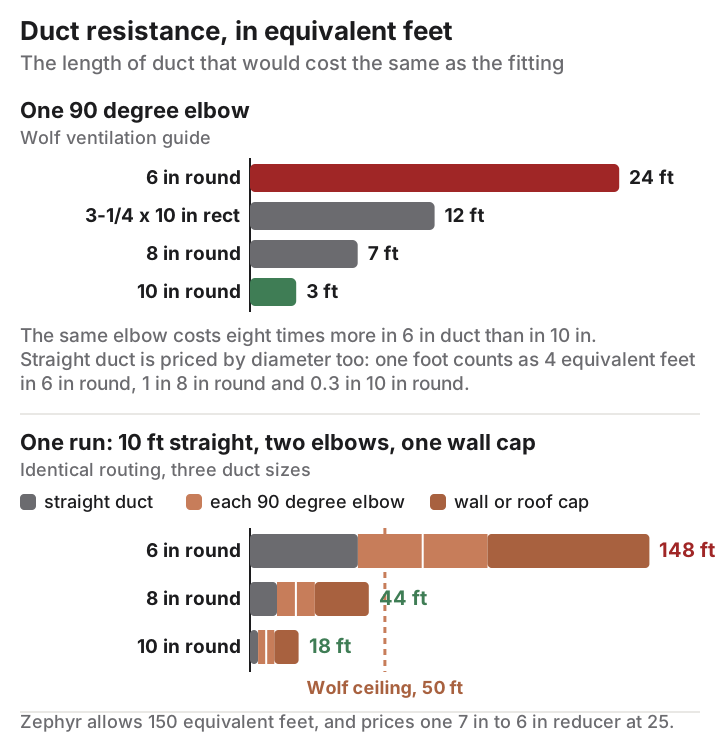
The narrowest point sets the result, and Zephyr prices that directly. On its worksheet a single tapered reducer from 7-inch to 6-inch is worth 25 equivalent feet, against 15 for a round 90-degree elbow and 1 for a foot of straight duct. One necked-down fitting left in to clear an existing hole can cost more than the rest of the run.
Diameter has a code floor too. Table 150.0-H of the 2022 Title 24 standards, reproducing ASHRAE 62.2 Table 5-3, sets a minimum rigid diameter of 8 inches at 250 CFM and 10 inches at 400 CFM. Flexible duct needs a larger diameter at 100, 150 and 200 CFM, matches rigid at the other listed rates, and at 450 CFM and above the table does not permit it at all.
Rectangular duct is worse than its area suggests. That table calculates the diameter of noncircular duct as four times the cross-sectional area divided by the perimeter. Apply it to a 3-1/4 by 10-inch duct: 32.5 square inches over a 26.5-inch perimeter gives about 4.9 inches. By area alone it looks like 6.4-inch round pipe. Hydraulically it is closer to 5. Material compounds it: HVI requires metal duct and prefers smooth, because the ridges in flex create turbulence, and Wolf bans flexible metal duct outright.
What Changes When the Hood Crosses 400 CFM
Above 400 CFM a hood stops being a fan purchase and becomes a mechanical system. The section is M1503.6 in the 2018, 2021 and 2024 IRC and M1503.4 in the 2015 edition; the mechanical code carries it as IMC 505.2 in the 2015 and 2018 editions and IMC 505.4 in the 2021. All use 400 CFM, and ICC hosts the IRC section for the source text.
What differs between the two code families is the trigger, and that is the trap. The IMC wording is unconditional: any hood capable of exhausting in excess of 400 CFM shall be provided with makeup air at approximately the exhaust rate. The 2021 IRC wording is conditional, applying only where a gas, liquid or solid fuel-burning appliance that is neither direct-vent nor mechanically drafted sits within the dwelling unit’s air barrier, so an all-electric house is not caught. The 2024 residential printing keeps that condition word for word. Treat 400 CFM as the number everywhere and confirm the trigger against the edition and the code your jurisdiction adopted.
One detail survives every version. Where makeup air is required, the opening needs a gravity or electrically operated damper that opens automatically whenever the exhaust system runs, so a manual vent nobody remembers to open does not qualify. The one exception to the requirement itself covers exhaust installed for the exclusive purpose of space cooling and intended to run only when windows or other air inlets are open.
The cost is real. Washington’s code council costed the trigger at roughly $1,000 extra, or $1 to $2 per square foot by dwelling size, and the market has priced it too. Zephyr sells a blower limiter it launched as an alternative to makeup air kits for builders and developers, and on the current Anzio spec sheet a hood rated 200 to 600 CFM can be capped at 390 or 290 CFM to meet local code. A manufacturer selling a way to stop at 390 is the best evidence that 400 is a real boundary.
Safety sits under the paperwork. A hood pulling harder than the house can replace air pulls it down the nearest flue, which is why the ENERGY STAR criteria LBNL records bar any setting above 500 CFM: very high airflow rates are more likely to cause backdrafting of combustion appliances.
Sones, and the Hood That Gets Left Off
Noise belongs in a sizing guide because LBNL names the failure directly: hood use is infrequent, and noise is one main reason cited. A hood switched off has a capture efficiency of zero at any rating.
Sones are the useful scale because they are linear. HVI’s explanation is that double the sone value is double the loudness, and that one sone is equivalent to the sound of a quiet refrigerator. Against decibels, 1 sone is about 40 dBA, 2 sones about 50 and 4 sones about 60. ASHRAE 62.2 sets a 3-sone limit at the required kitchen rate, and ENERGY STAR recommends 1 sone or less for a kitchen fan run continuously and 3 or less for one run intermittently.
Real hoods struggle against that. LBNL measured sound generally above published ratings, and at airflows approaching the HVI recommended rate the levels exceeded those associated with conversation. Only four of the seven came in under 50 dBA at low speed, moving 85 to 150 CFM. Quiet arrives at the airflows where capture collapses.
Zephyr’s Tempest II publishes paired figures for each blower, which puts the trade on one hood body.
| Blower | Airflow | Sound |
|---|---|---|
| CBI-290B internal | 200 to 290 CFM | 1.4 to 3.2 sones |
| CBI-600B internal | 240 to 600 CFM | 1.8 to 6 sones |
| Dual PBI-1100A internal | 500 to 1,100 CFM | 3.5 to 8 sones |
Others land in the same place. Vent-A-Hood’s DAH30-254 is a 54-inch hood rated 600 CFM at 6.5 sones, and its 66-inch PRH18-466 is 1,200 CFM at 6.6 sones. On a scale where doubling the number doubles the loudness, that is more than four times the loudness of a 1.5-sone under-cabinet unit.
Recirculating Mode and the Filters It Keeps Needing
Ductless hoods are permitted. Both codes carve them out, with the IMC exception and IRC M1503.3 stating that listed and labeled ductless range hoods need not discharge to the outdoors; on the mechanical side that exception sits in 505.1 in the 2015 and 2018 editions and in 505.3 in the 2021. Permitted is not equivalent. Charcoal adsorbs odor. It does not remove water vapor, heat, or combustion products, which is why the EPA’s instruction for gas cooking is specific: install and use an exhaust fan vented to outdoors over gas stoves. The same agency reports carbon monoxide often at 5 to 15 parts per million near properly adjusted gas stoves and 30 or higher near poorly adjusted ones.
The mode also carries a running cost. Broan instructs that non-ducted filters be changed every 3 to 6 months, more often for frying and wok cooking, and sells them separately. Zephyr prompts for charcoal at 200 hours of fan use and grease filters at 60.
What a Price Ladder Buys in a Hood
The Broan Glacier BCSD130SS is 30 inches wide, 300 maximum blower CFM, 1.5 sones, on 7-inch round duct, convertible to top venting, rear venting or non-ducted, listed at $223.99 against a $347.19 list price. The BCSQ130SS is one step up at 375 maximum blower CFM, listed at $264.00 against $444.71. Both are convertible, and on both the charcoal filters that non-ducted use requires are sold separately.
What money buys is clearest in the LBNL sample, since all seven went on one rig. They were models available in the United States in 2011, and at those prices the set ran from a $40 axial unit at 6 sones moving about 190 CFM to a $650 open-canopy hood at 5.4 sones moving about 273 CFM. The expensive one moved 43 percent more air, and because its canopy covered most of the front burners its capture exceeded 80 percent at the oven and front burners. Nor is the label a shortcut: hoods meeting ENERGY STAR criteria in that sample captured less than 30 percent at the front and oven burners.
Where a Bigger Number on the Box Stops Helping
Airflow is the easiest of the four numbers and it collects all the attention. A 3-foot wall hood targets 300 CFM by HVI’s width method, and a gas range usually pushes the BTU method higher. Where the two disagree the larger figure is the safer one to size to, and the next question is whether it crosses 400 CFM, because that line decides whether the job includes a dampered makeup air system. The rest is geometry and resistance: a canopy stopping short of the front burners loses half of what those burners emit whatever the blower is rated at, and ten feet of 6-inch duct with two elbows and a wall cap totals 148 equivalent feet against a manufacturer ceiling of 50.
Four things are worth confirming before anything is ordered. Measure the cooktop width and compare it against the hood’s width, not its CFM. Read the mounting height range in the manual for the exact model, since 18 inches is right for one hood and wrong for another. Trace the duct from the outlet to the cap and find its narrowest diameter, because that is the diameter the whole run behaves like. And look up the sone rating at the speed the hood will actually be run, which is rarely the speed printed on the box.