Why Your Living Room Sounds Louder Than It Should
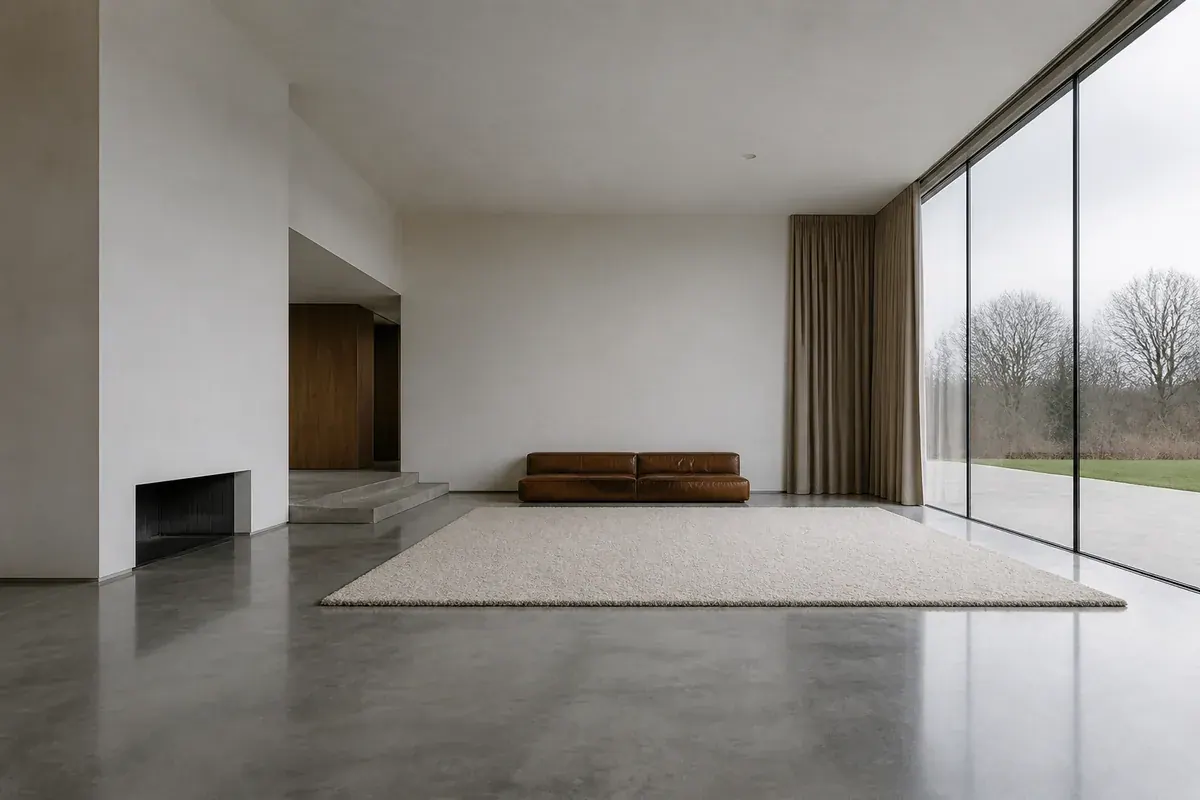
A room like this is recognizable from its inventory. Wide-plank floors with nothing laid over them. Painted drywall on all four sides, broken by a window wall or a slider. One low sofa, a coffee table with a stone or glass top, a television on a bracket, and very little else.
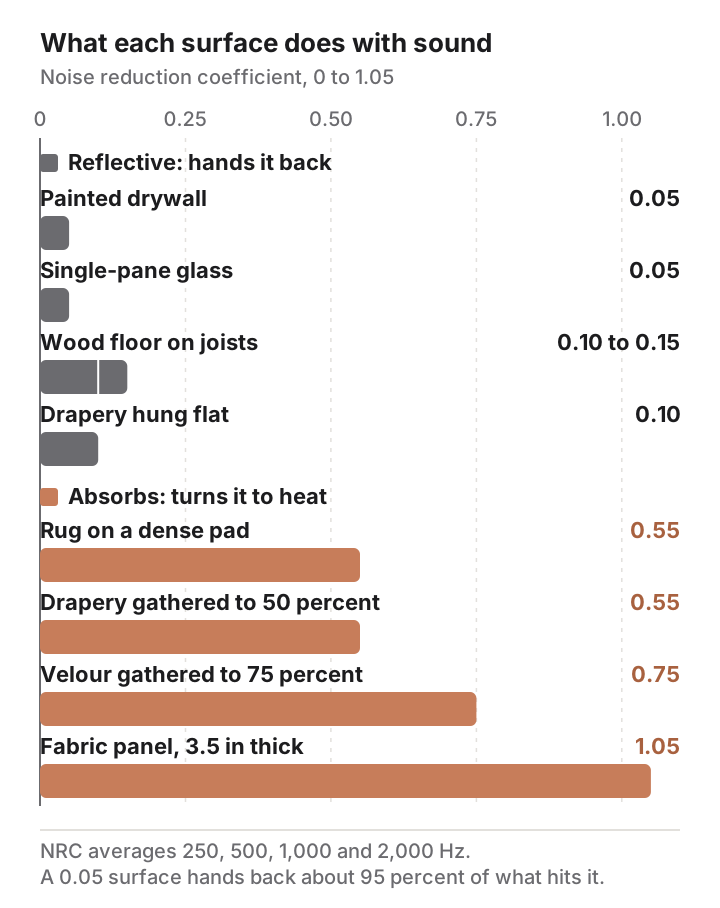
Every surface on that list is dense, flat and rigid. Rigid surfaces return sound instead of swallowing it. Painted drywall carries a noise reduction coefficient near 0.05, single-pane glass sits at roughly the same figure, and wood flooring on joists lands around 0.10 to 0.15 in published absorption tables. NRC is the average of a material’s absorption coefficients across the 250, 500, 1,000 and 2,000 Hz octave bands, so a surface rated 0.05 is handing about 95 percent of the mid-frequency energy that strikes it back into the room.
That returned energy is the whole complaint. Conversation in a hard room is not being produced any louder. It is taking longer to leave, so each syllable lands on the decaying tail of the one before it. The ear reads that pile-up as volume, harshness and effort.
Reverberation: Why the Room Keeps Answering
Reverberation time, written RT60, is the interval a sound pressure level needs in order to fall by 60 decibels once the source stops. The measurement is defined in ISO 3382-1 for performance spaces, ISO 3382-2 for ordinary rooms and ASTM E2235 in the United States. As rough boundaries, NTi Audio notes that smaller spaces above two seconds are regarded as echoic, while anything below 0.3 seconds is considered acoustically dead.
Sabine’s equation explains why rearranging furniture changes so little and covering the floor changes so much. RT60 equals 0.049 multiplied by room volume in cubic feet, divided by total absorption in sabins, and that absorption figure is reached by summing each surface’s area times its coefficient at each frequency.
Two consequences fall out of the formula. Volume works against you, so a vaulted ceiling makes an identical floor plan worse than a flat one. Area counts as heavily as material, which is why one foam square accomplishes nothing while eighty square feet of rug accomplishes a great deal.
Flutter Echo Between Two Bare Parallel Walls
Flutter is a separate defect with a separate cause. It happens when energy gets trapped bouncing between two parallel surfaces in a repeating loop, producing a rapid string of reflections that Acoustical Surfaces describes as a phantom zinging noise traveling alongside the original sound.
Finding it takes about four seconds. Stand midway between two facing hard walls, away from furniture, and clap once and sharply. A settled room gives back a short thud. A fluttering room adds a brief buzzing ring behind the clap, pitched somewhere near a zipper being pulled.
Breaking that loop does not require touching both walls. Anything that stops the two planes from facing each other cleanly will interrupt it: a tall bookcase, a hung textile, a run of panels on one side, or a piece of furniture with genuine depth.
Absorption Is Not Blocking, and a Curtain Proves It
Absorption and isolation solve different problems using different physics. Absorption reduces energy already loose inside your room by converting it to heat inside a porous material. Isolation stops energy from crossing a boundary, and that job runs on mass, stiffness and airtightness rather than porosity.
A curtain has almost no mass per square foot. It will shorten your room’s decay noticeably, and it will do essentially nothing about a neighbor’s television through a shared wall. The same holds for foam wedges, felt tiles and wall hangings, whatever the packaging says.
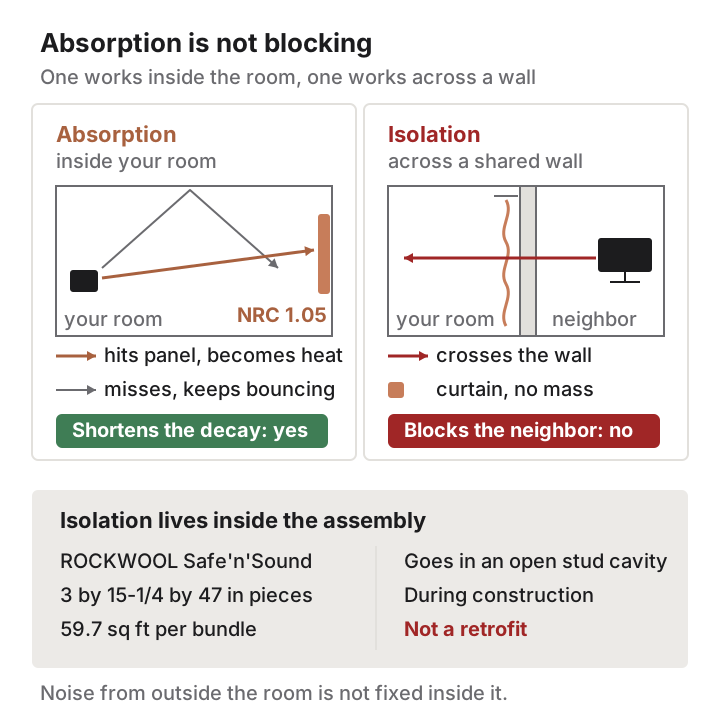
Isolation lives inside the assembly instead. ROCKWOOL Safe’n’Sound stone wool batts, sold in 3-inch by 15-1/4-inch by 47-inch pieces covering 59.7 square feet per bundle, go into an open stud cavity during construction; they are one component of a wall build, not a retrofit you can apply to a finished room. The distinction is worth drawing clearly because the mistake is expensive: if the noise originates outside your four surfaces, nothing you hang on those surfaces will address it.
The Absorption Ledger: What a Rug, a Sofa and Drapery Buy You
Absorption is bookkeeping. Multiply the square footage you are adding by its coefficient, subtract whatever the surface used to contribute, and you have the real gain. The table below runs that arithmetic for the three interventions most living rooms can reach.
| Intervention | Area involved | NRC | Absorption units gained |
|---|---|---|---|
| 8 by 10 ft rug on a dense pad | 80 sq ft | 0.55 | 44 |
| The bare wood floor it covers | 80 sq ft | 0.12 | 9.6 (subtract this) |
| One pair of 55 by 98 in curtains, gathered to about half | ~37 sq ft of wall covered | 0.55 | 20 |
| Four 23.6 by 47.2 in fabric-wrapped panels | 30.9 sq ft | 1.05 | 32 |
| Three-seat fabric sofa in place of leather | ~25 sq ft | 0.35 to 0.55 | 9 to 14 |
The seating range is wide because upholstery varies: published figures put sofas, armchairs and cushioned seating between 0.35 and 0.55, with leather and vinyl covers sitting at the bottom of that band and woven fabric at the top.
Net of the floor it replaces, the rug is worth roughly 34 units on its own, the largest net gain of any single item in the table, which is why floor covering is the conventional opening move in a hard-surfaced room.
Pad density is doing more of that work than most people assume, and it matters here more than fiber choice does. A thin foam sheet compresses under a rug and adds little. RUGPADUSA’s Superior-Lock, built from recycled felt with a natural rubber backing and offered at 1/4-inch as well as 7/16-inch thickness, gives the rug a compliant layer to work against rather than a hard plane immediately beneath it. Coefficients climb with what sits under the pile, not just the pile itself.
Pleat Ratio: The Drapery Number That Changes the Coefficient
Fabric weight gets the attention; gather ratio does more of the work. Drapery hung flat against a window measures around 0.10, essentially the same as leaving the glass bare. The identical panel gathered to 50 percent reaches about 0.55, and heavy velour gathered to 75 percent reaches roughly 0.75, per the absorption tables cited above. The folds add depth and surface area, and depth is what absorbs.
Order fabric by the rod, not by the window. Drapery workrooms cut panels at roughly two to two and a half times finished rod length, and that fullness is exactly what produces the folds the absorption figures assume. A 48-inch rod wants roughly 96 to 120 inches of fabric across it. IKEA’s SANELA curtains, 100 percent cotton velvet at 55 by 98 inches per panel and $89.99 for a pair, deliver 110 inches of width, which lands at about 2.3 times a 48-inch rod.
Locating First-Reflection Points With a Mirror
Panels placed decoratively underperform panels placed geometrically. Reflection angles mirror incidence angles, so a hand mirror finds the exact spots where sound from your speakers bounces off a wall and arrives at the seat a fraction behind the direct sound.
- Seat someone in the main listening position and measure the height of their ears above the floor with a tape. On a standard sofa that usually lands somewhere around 38 to 42 inches, but measure rather than assume, since seat height alone varies by several inches between frames.
- Have a second person slide a small mirror, 8 by 10 inches is plenty, flat along the side wall at that same height.
- Mark with painter’s tape every spot where the seated person sees the soundbar or a main speaker reflected. Those marks are first-reflection points.
- Repeat on the opposite side wall, on the wall behind the display, and on the ceiling with the mirror taped to a broom head.
- Center a panel on each mark. A 23.6 by 47.2 inch panel hung vertically and centered near 48 inches above the floor covers the seated ear band with margin at top and bottom.
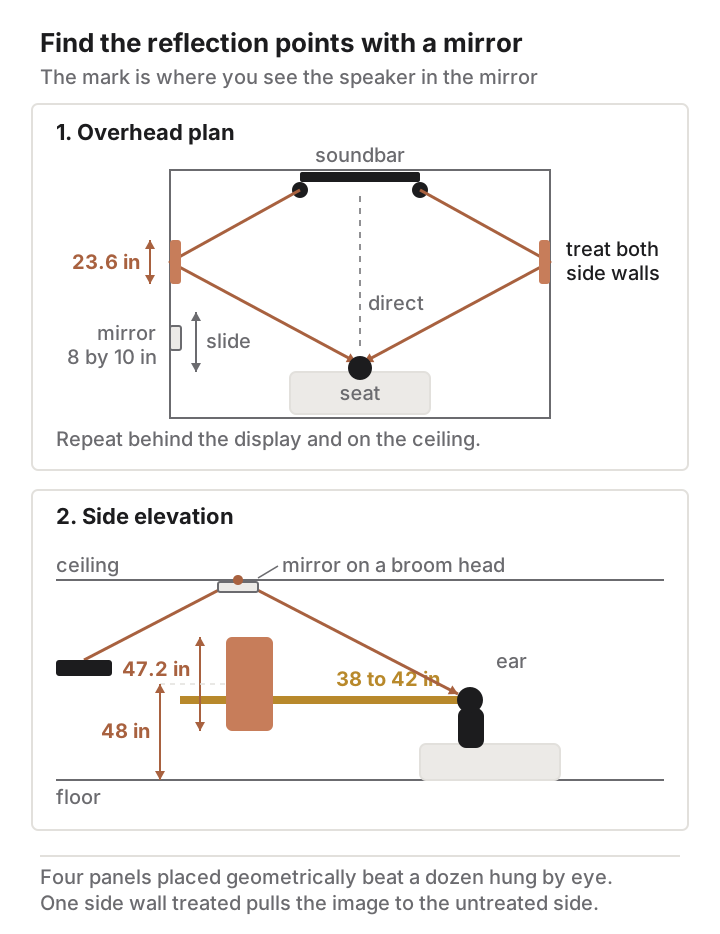
Panels on those marks intercept the earliest reflections, the ones arriving close enough behind the direct sound to smear speech, so four placed geometrically do more work than a dozen hung by eye. Symmetry matters too: treating one side wall and not the other leaves the stereo image pulled toward the untreated side.
Bookcases, Ceilings and the Two Planes People Skip
A full bookcase is not an absorber, and pretending otherwise leads to disappointment. What it does is present a face of varied depths that scatters reflections instead of returning them as one coherent front, which is the diffusion strategy the flutter guidance above recommends. Set book spines at irregular depths, some flush with the shelf edge, some recessed an inch or two, and leave part of each run open rather than packing it solid. The recesses are what break a returning wavefront into pieces.
Ceilings get skipped almost universally. Once the floor is covered, the ceiling becomes the largest untreated reflective plane in the room and the top half of the biggest parallel pair. A fabric-wrapped cloud suspended over the seating area addresses that plane, and it is the usual next move in rooms where the floor is already covered and the space still sounds live.
Panel specifications are worth reading rather than guessing at. GIK Acoustics publishes an NRC of 1.05 for its FlexRange panel, formerly sold as the 242, at 3.5 inches thick and available at 23.6 by 47.2 inches, with pricing starting at $84.00. Thickness is the variable that matters most; thin decorative felt tiles handle high frequencies and leave the muddy midrange untouched.
Sequencing the Work: Rug, Seating, Drapery, Panels
Cost and effect do not rise together, which is the useful part. The sequence below runs from most absorption per dollar to least, and each rung assumes the previous one is done.
Start with the rug and a dense pad, sized to cover as much open floor as the layout allows. Add or reclaim soft seating next, since fabric upholstery near 0.55 costs nothing if you already own it and are choosing between two arrangements. Hang lined, generously gathered drapery across the glass third, because that surface is both highly reflective and easy to cover without commitment.
Put a deep bookcase on one of the parallel walls fourth, if flutter survives the first three steps. Then place four panels at first-reflection points, which at the pricing above lands somewhere near $340 for a set. Leave the ceiling cloud for last, not because it works least, but because it costs the most in installation effort and is hardest to reverse.
What the Rug and Pad Do That the Wall Treatments Cannot
The floor is the largest uninterrupted reflective plane in nearly every living room, and it is the one surface that changes without touching a wall, a stud or a lease. Eighty square feet moving from roughly 0.12 to 0.55 is the biggest net absorption gain in the ledger above, and it lands on the plane that faces the ceiling, so covering it breaks the floor-to-ceiling parallel pair at the same time it shortens overall decay. Drapery over glass shortens decay without touching that vertical pair, and wall panels reach a different pair of surfaces entirely.
What the floor cannot do is change transmission. A rug over a hard subfloor will not quiet footfall for the unit below the way a floated assembly does, and it will not reduce what arrives through a shared wall. Those stay construction problems, answered with mass and airtightness inside the assembly. Inside the four surfaces of the room, the arithmetic runs the other way: area times coefficient, floor first.