Rug Pads by Material, Thickness, and Floor Type
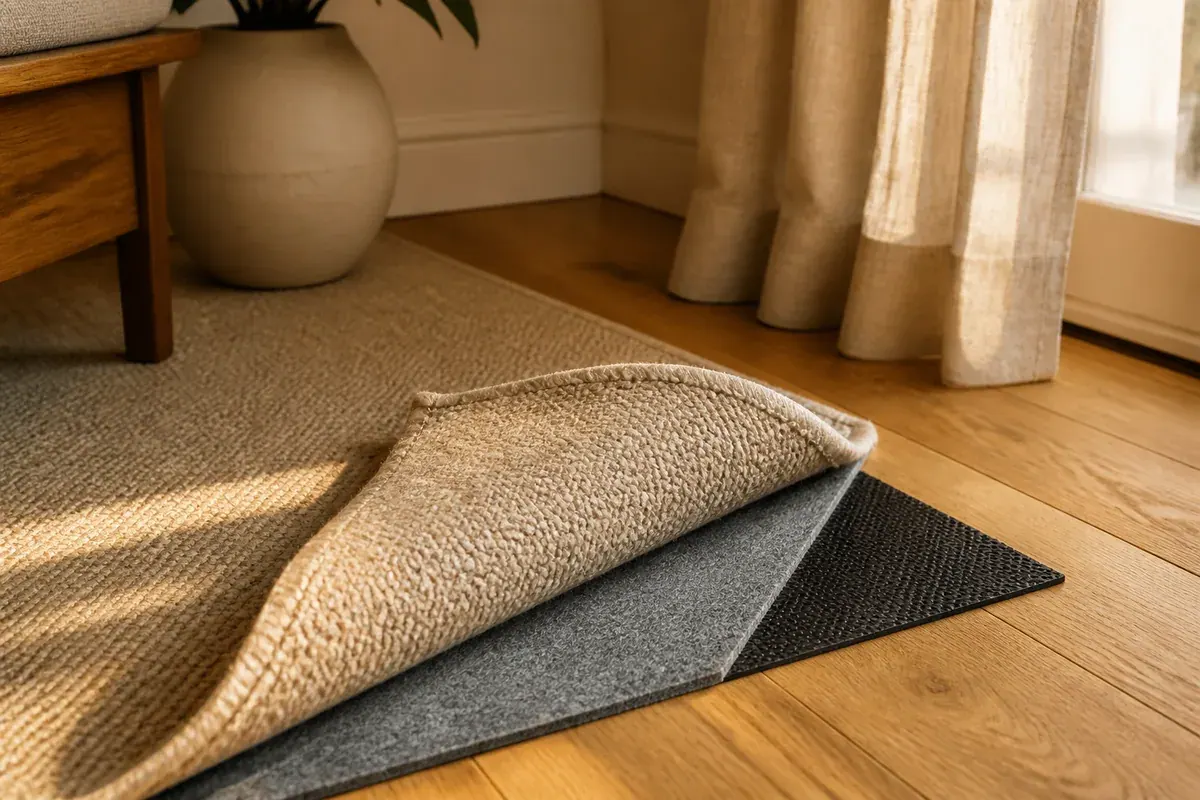
A rug pad works on a problem the buyer never considers: holding the rug’s own structure off a plane that will not give. Every footstep presses the rug’s foundation, the grid of warp and weft that knots or tufts anchor to, down onto wood, tile, or concrete. That grid needs somewhere to flex. Against a bare floor it has nowhere to go, so the underside abrades, the pile packs down, and the textile ages from the bottom up.
Slipping is the symptom that sends people shopping. It is the smallest part of the problem a pad solves.
Treat the pad as a structural layer rather than a grip accessory and the decision narrows to three questions: what it is made of, how thick it is, and whether your floor can sit against it for a decade without changing color.
The Load Path From Your Foot to the Floorboard
Follow the weight downward. It lands on the pile, passes into the foundation, and terminates somewhere. With a pad present it ends in a compressible layer that spreads the load. With nothing there, foundation meets board directly.
Grit is the second half. Sand and street dirt filter down through the pile and settle on the rug’s back, where every step grinds those particles against the underside and the floor finish at once. A pad gives that debris somewhere to sit other than a polished surface.
Perimeters are the third. An unpadded rug shifts a fraction of an inch with each step, and that motion concentrates at the border, which curls and frays long before the field shows wear.
Felt, Natural Rubber, and the Job of Each Layer
Nearly every legitimate pad is built from two materials.
Felt Handles Compression
Felt is needle-punched fiber, often recycled, pressed into a dense mat. It is the cushioning half and the floor-protecting half at once, and it does not grip. A felt-only pad stays put through mass and friction alone, which is enough under a heavy hand-knotted wool rug and nowhere near enough under a 4 by 6. Felt-only pads are sold in 1/4, 3/8, and 1/2 inch and suit a rug that is large, heavy, and already lying flat.
Natural Rubber Handles Grip
Rubber does the opposite job. It is thin, it contributes almost no cushion, and its entire function is friction against the floor. The thinnest gripping pads run around 1/16 inch, about as little material as a pad can carry and still work.
Composites Put Felt Up and Rubber Down
The standard pad is a composite: coarse felt facing up into the rug’s back, natural rubber facing down onto the floor. Contour-Lock from RugPadUSA is 1/8 inch, 100 percent recycled felt over a thermo-bonded natural rubber backing, and the maker aims it at flat-weaves such as kilims and dhurries. Superior-Lock, from the same company, comes in 1/4 inch and 7/16 inch with a needle-punched felt face and a grooved natural rubber base; its maker points it at large rugs already anchored by furniture.
PVC, Adhesive Backings, and the Plasticizer Problem
Below that sits the cheap tier: the white waffle-cut sheet, the tacky mesh, the peel-and-stick pad. Most are PVC, and PVC has a specific chemistry problem when it lives pressed against a floor finish for years.
PVC on its own is rigid. Plasticizers are added to make it flexible, and they are not chemically bonded to the polymer. A 2023 paper in Toxics on DEHP migration from consumer PVC products describes the attachment as non-covalent, which is precisely what “facilitates easy migration.” Leaving the sheet is normal behavior for the additive, not a manufacturing fault.
Flooring companies address this in their own care documents. Shaw tells vinyl floor owners to use mats without latex or rubber backings to reduce possible discoloration. Bruce, writing about hardwood, says to avoid rugs with rubber or vinyl backings because they can trap moisture.
Note how broad that second phrasing is: it does not carve out natural rubber. Felt over natural rubber is the widely published recommendation for finished wood, but inside a warranty period the governing document is the one your flooring manufacturer wrote, not a pad seller’s marketing page. Discoloration that has already set into a finish is a sanding and refinishing job for a flooring contractor.
Thickness in Inches, Door Swing, and the Edge Step
Thickness runs roughly 1/16, 1/8, 1/4, 3/8, and 7/16 inch, with 1/2 inch felt at the top end. That number is not a comfort dial. It settles two things you cannot undo once the pad is cut: whether your doors still swing, and how tall a step the rug’s border makes.
Start with the doors: measure the gap between the bottom of the door leaf and the finished floor along the arc of the swing. Suppose it reads 5/8 inch, which is 0.625. Then measure the rug’s uncompressed thickness, say 1/4 inch. Subtract the combined stack from the undercut and the shortlist writes itself.
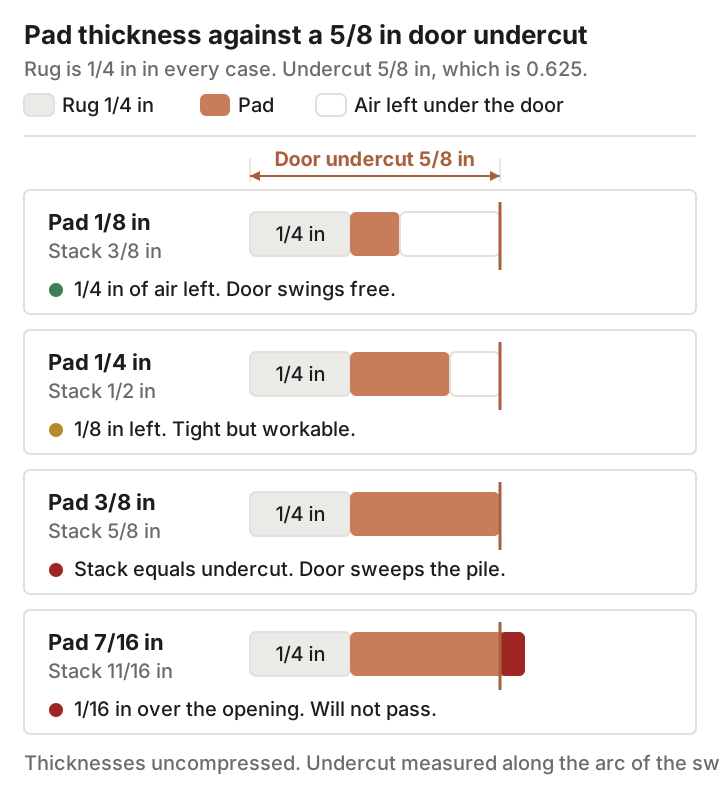
A 1/8 inch pad gives a 3/8 inch stack and leaves 1/4 inch of air. A 1/4 inch pad gives a 1/2 inch stack and leaves 1/8 inch, tight but workable. A 3/8 inch pad brings the stack to exactly 5/8 inch, so the door sweeps the pile every time it moves. A 7/16 inch pad puts the stack at 11/16 inch, which is 1/16 inch taller than the opening; that door will not pass at all.
Then there is the border. A rug’s perimeter is a change in level, and the only published figures for one come from accessibility rules written for public buildings. Section 303 of the 2010 ADA Standards permits a change in level up to 1/4 inch to be vertical, and requires anything between 1/4 inch and 1/2 inch to be beveled at a slope no steeper than 1:2.
Those figures apply to public accommodations, not to houses; residential thresholds fall under your local building code, which varies by jurisdiction. The numbers are still the most sensible yardstick available. A 1/4 inch rug on a 1/4 inch pad stands 1/2 inch tall at the edge, the top of that range, and a rug that thin will not bevel itself.
Pile Height Decides Pad Firmness
The rug above sets the firmness, and the relationship runs opposite to what most people assume. A thin, limp flat-weave wants a thin, firm pad. Set a kilim on 7/16 inch of soft felt and it will ripple, because it has neither the mass nor the stiffness to press that loft flat. A pad around 1/8 inch is the right order of magnitude there.
High-pile, tufted, and hand-knotted rugs want more. They carry enough weight to compress a thick pad evenly, and they gain most from the rebound. A quarter inch answers most rooms; 7/16 inch belongs where people sit on the floor.
Pads on Wood, Tile, and Wall-to-Wall Carpet
| Floor | What it is prone to | Specify | Avoid |
|---|---|---|---|
| Finished solid or engineered wood | Finish discoloration, moisture held under a sealed backing | Needle-punched felt over natural rubber, 1/4 inch | PVC waffle sheet, adhesive-backed pads, solid rubber rug backings |
| Vinyl plank and sheet vinyl | Staining inside the wear layer | A felt-only pad, if your care sheet excludes rubber and latex as Shaw’s does | Any latex or rubber backing the flooring maker names |
| Ceramic, porcelain, and stone tile | Little chemical risk; a slick, hard plane the rug travels on | Felt and natural rubber, weighted toward grip; 1/4 inch | Adhesive-backed pads, anything meant to bond to the surface |
| Wall-to-wall carpet | The rug bunching and walking rather than sliding | A rug-on-carpet pad, rubber face up into the rug, felt face down into the carpet | A standard composite installed rubber side down onto pile |
That last row is where people go wrong. A rug over carpet needs the grip pointed at the rug, not the floor, and the pads built for it are flipped by design. RugPadUSA’s Carpet-Lock is 7/16 inch and carries over 45 ounces of rubber and felt per square yard, with a natural rubber surface layer against the rug’s back and a needle-punched felt underside textured to catch the carpet fibers below.
Density in Ounces, and What a Soft Pad Does to Vacuuming
Weight per square yard is the specification worth reading, and almost nobody does. That 45 ounce figure says more about a pad than the fraction on the label. Two pads of the same thickness can hold very different amounts of fiber, and the lighter one packs down into a thin, dead sheet far sooner under the same traffic.
Vacuuming is where an over-soft pad announces itself. A vacuum head works by pressing into the pile and lifting it; on a deep, low-density pad the whole assembly sinks under the head instead of the pile lifting. If your upright has a height adjustment, a thick pad usually means moving up a setting.
Lift the rug twice a year, vacuum the pad’s face and the floor under it, and rotate the rug 180 degrees while it is up. That is the only reliable way to catch discoloration under a pad while it is still small.
Cutting a Pad to the Inset Figure
Pads finish smaller than the rug they serve. Rugs Direct puts the figure at 1 to 2 inches smaller than the rug on every side. The reason is drape: a pad reaching the edge props the border into a ramp, and a pad that peeks past it is visible from every seat.
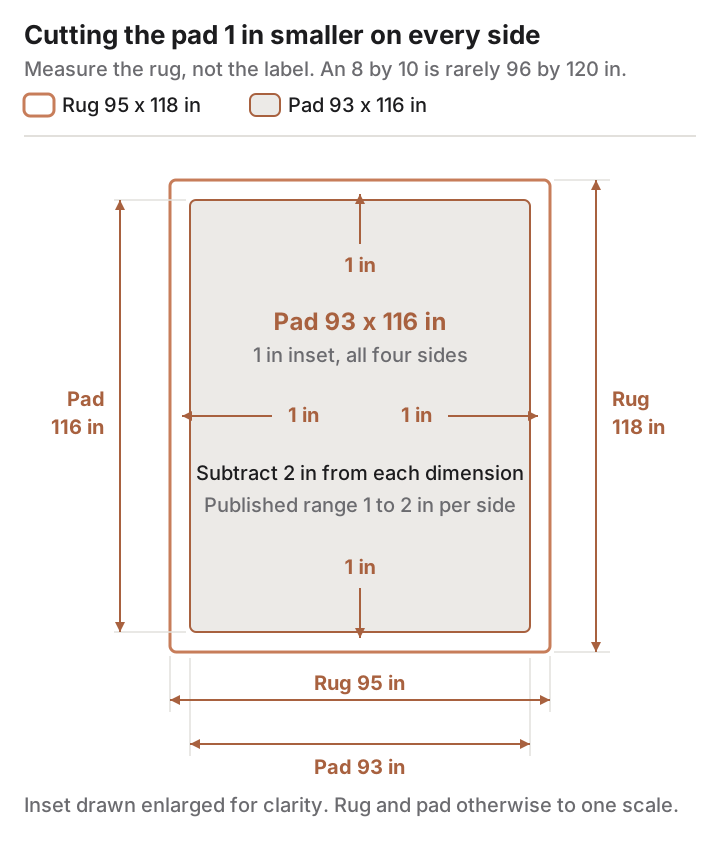
Rugs sold as 8 by 10 are rarely 96 by 120 inches, so start with your rug, not the label.
- Measure the rug itself at three points along each dimension and take the smallest reading. Suppose it comes to 95 inches by 118 inches.
- Subtract 2 inches from each dimension, 1 inch per side. Your target is 93 by 116 inches.
- Unroll the pad felt side up on a hard floor, never on the rug, and leave it an hour so the roll curl drops out.
- Mark both cut lines in chalk against a straightedge, measuring from the pad’s factory edges so you inherit their squareness.
- Cut plain felt with heavy shears. For anything with a rubber underside, use a utility knife with a fresh blade against a straightedge and score in two or three passes rather than forcing a single cut.
- Lay the pad rubber side down, center it, and check the reveal on all four sides. You want an even inch of bare floor showing between pad edge and rug edge.
- Set the rug on top and walk the perimeter, pressing the border flat.
The Pad Spec That Settles It for Your Floor
Every floor type reduces to a single specification, and thickness is not it. On finished wood the specification is backing chemistry: felt over natural rubber, nothing carrying PVC or adhesive. Vinyl and LVP hand the decision to your own manufacturer’s care sheet, and when that sheet rules out rubber and latex in plain terms, buy felt. Tile and stone care about grip alone. Wall-to-wall carpet cares about orientation: rubber up, felt down.
Measure the gap under your door before any of that, since the number there can veto a thickness you already settled on. Then buy for the floor.