How Far a Shelf Can Span Before It Sags

Sagging is not a weight problem. That one correction saves more shelves than any hardware upgrade, because it points at the variable doing the damage. Forty pounds of books on a 24-inch shelf will sit flat for decades. The same forty pounds on the same board stretched across 48 inches will bow visibly inside a year.
Nothing about the books changed. The clear distance between the supports changed, and that unsupported span is the governing variable, with material stiffness and board thickness close behind it. Total weight matters least of the four, which is why “it only holds paperbacks” is not the reassurance people take it for.
Span Is Cubed, Thickness Is Cubed, Weight Is Not
The engineering term for the bow is deflection. The Sagulator, a shelf design calculator published by WoodBin, states the relationships plainly: if shelf span is doubled, deflection is eight times greater, and if span is reduced by one fifth, stiffness roughly doubles. Thickness runs the same exponent in the other direction. Double the thickness and deflection drops to one eighth.
Depth is the gentle one. Doubling shelf depth cuts deflection in half, a straight linear trade rather than a cubed one.
Push those rules through a real decision. Going from 3/4 inch stock to 1 inch stock multiplies thickness by 1.33, and cubed that is 2.37, so deflection falls to about 42 percent of what it was. Taking half the books off only halves it. The quarter inch wins.
Depth is slipperier than it looks. Moving from a 10-inch shelf to a 12-inch shelf multiplies depth by 1.2 and should cut deflection to roughly 83 percent. Fill those extra two inches with more books, though, and the load per running foot climbs by about the same 1.2, so most of the gain cancels itself out.
The Sag Threshold Cabinetmakers Work To
You need a pass mark to test against, and there is a conventional one. The Sagulator’s guidance is that the eye will notice a deflection of 1/32 inch, or 0.03 inch, per running foot, which comes to 3/32 inch across a three-foot bookshelf. Its suggested design target is tighter still: 0.02 inch per foot or less. The margin exists because of creep, since wood shelves sag an additional 50 percent over time beyond the deflection the load produces on day one.
Convert that target into the spans you are weighing. A 30-inch span is allowed 0.05 inch. A 54-inch span is allowed 0.09 inch.
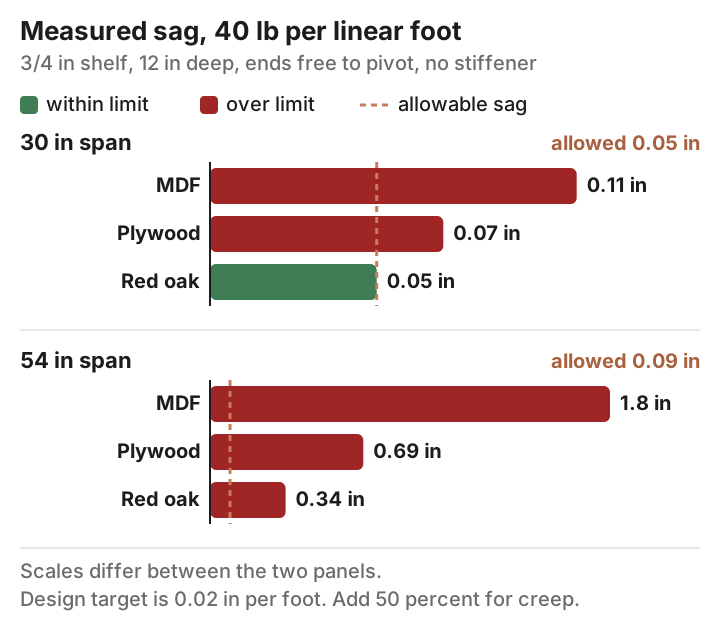
WoodBin published sag measured on 3/4-inch shelves 12 inches deep at 20, 30 and 40 pounds per linear foot, using a pass mark of 0.10 inch or less. At 40 pounds per linear foot with the ends free to pivot and no front or rear stiffener, a 30-inch shelf sagged 0.11 inch in MDF, 0.07 inch in plywood and 0.05 inch in red oak. Run the same test at 54 inches and MDF reached 1.8 inches, plywood 0.69 inch, red oak 0.34 inch.
The MDF is the tell. An 80 percent increase in span produced roughly a sixteenfold increase in sag, because the longer shelf also carried proportionally more books.
What Each Material Spans Before It Fails the Test
WoodBin’s shelf design reference publishes maximum no-sag spans for 10-inch-deep shelves under typical bookshelf loading. It also supplies the load figure everything else depends on: a fully loaded bookshelf carries 20 to 25 pounds per running foot.
| Shelf material and thickness | Maximum no-sag span |
|---|---|
| 3/4 in. particleboard | 26 in. |
| 3/4 in. plywood | 32 in. |
| 3/4 in. yellow pine | 36 in. |
| 3/4 in. red oak | 44 in. |
| 1 in. yellow pine | 48 in. |
| 1 in. red oak | 52 in. |
| 3/4 in. plywood with two 1-1/2 in. cleats | 48 in. |
Melamine belongs in the first row. A melamine shelf is a particleboard panel with a thin decorative laminate pressed onto its faces, so it belongs with particleboard whenever span is the question.
That 26-inch number explains a great deal of flat-pack furniture. IKEA’s BILLY bookcase in the 80 cm width measures 80 by 39 by 202 cm, uses particleboard shelves, and its stated maximum load is 42 kg per shelf. Take the side panels out of that 80 cm and the clear span lands somewhere near 30 inches.
Load ratings and sag limits answer different questions. A stated maximum load tells you what the shelf carries without failing; it does not promise the shelf stays straight. And 42 kg is about 93 pounds, well past the 60 or so pounds a 30-inch run of books weighs at 25 pounds per foot.
Glass Shelves Answer to a Different Chart
A Wood magazine chart reproduced in a WoodWeb discussion of glass shelf bearing capacity gives capacities for annealed glass supported at two ends only. Over a 36-inch span, 1/4 inch glass carries 5 pounds, 3/8 inch carries 18 pounds, and 1/2 inch carries 33 pounds.
Hold thickness at 1/2 inch and vary the span instead. That same chart lists 345 pounds at 12 inches, 81 pounds at 24 inches and 33 pounds at 36 inches. Tripling the span cost a factor of ten in capacity.
A published chart is the wrong place to size a glass shelf. Hand the span, the depth and the intended load to the glass supplier, specify tempered, and ask for a thickness in writing.
How the Shelf Ends Are Held Changes the Answer
Every span figure above assumes a shelf simply resting on something at each end. A shelf sitting on pin-style clips is free to pivot there. A shelf housed in a dado, screwed to cleats, or captured front and back behaves closer to fixed, and fixed ends resist the rotation that lets the middle drop.
The measured tables separate those cases, and the gap is not subtle. At 54 inches and 40 pounds per linear foot, the plywood shelf that sagged 0.69 inch with floating ends and no stiffeners came in at 0.18 inch with fixed ends plus front and rear support. MDF fell from 1.8 inches to 0.11 inch. At 30 inches, all three measured 0.02 inch in that fixed and supported configuration.
Adjustable shelving trades some of this away by design. Knape & Vogt’s 255 series steel pilaster standard is a mortise-mount strip 5/8 inch wide and 3/16 inch deep, slotted in half-inch increments and sold in lengths from 12 to 96 inches, and it pairs with 256 series clips. You gain shelf positions you can move. You also accept ends that pivot.
What a Front Nosing Does, Measured in Inches
A nosing, sometimes called an edge stiffener or a support cleat, is a strip of wood glued along the shelf edge and standing up in the direction the shelf bends. The reference table puts a number on it. Three-quarter inch plywood that tops out at 32 inches reaches 48 inches once two 1-1/2 inch support cleats are added, a 50 percent longer span bought with an offcut.
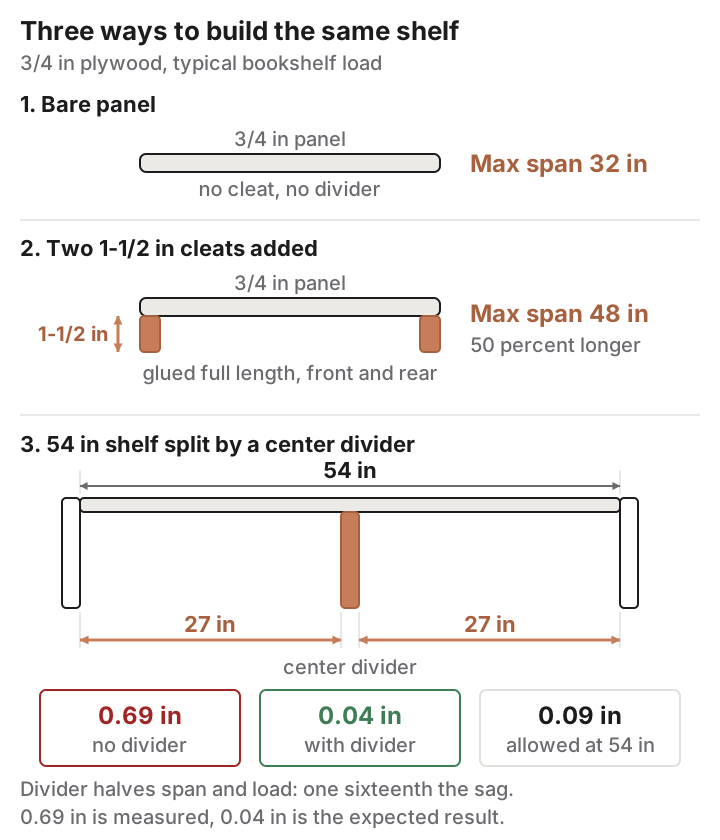
The strip works by adding height to the shelf’s cross section in the plane of the bending, exactly the dimension the cube rule applies to. It also places material at the front edge, where a loaded shelf is stretched hardest.
Glue is what makes it structural. A continuous glue line along the full length beats a handful of screws, because the strip only helps insofar as it is forced to bend with the panel instead of sliding along it. Trim that can slip is trim.
Adding a Center Support Cuts Sag to a Sixteenth
A vertical divider at midspan does two jobs at once. It halves the span, and it halves the load that each remaining bay carries. Apply the cube rule to the first and simple proportion to the second: one eighth multiplied by one half is one sixteenth.
Take the measured 54-inch plywood shelf at 0.69 inch. Split it with a divider into two 27-inch bays and the expected sag falls to roughly 0.04 inch, comfortably inside the 0.09 inch that a 0.02-inch-per-foot target allows across 54 inches. No thicker stock, no better species, no hardware.
Wall-hung shelving deserves one caution. Two or three hundred pounds of books does not stop at the bracket; it runs into the studs behind it and travels down through the wall. Hanging from studs already in place is carpentry. Notching one, cutting one out, or building a shelf that bears directly on framing is a licensed contractor’s job, and how much of a stud may be removed is a figure your local building code sets rather than a rule of thumb.
Books and Decor Are Not the Same Load
Books are the worst case and also the most common one. They fill a shelf end to end and front to back, close to a perfectly uniform load, and at 20 to 25 pounds per running foot they are dense. They accumulate, too. A shelf that passed at half full fails three years later at capacity, creep quietly adding its 50 percent the whole time.
Decor loads lighter and lumpier. Two ceramic vases and a stack of three books might total 15 pounds across a four-foot shelf, which no sensible material would notice. Placement is the catch: objects land near the middle, where a shelf resists least, and toward the front, where the panel has no help.
Small rooms carry the planning consequence. A 54-inch alcove that will hold books needs a divider or a hardwood shelf; one holding a lamp, a plant and three frames stays flat in 3/4 inch plywood.
Checking a Planned Shelf Before You Cut It
- Measure the clear span, support face to support face, rather than the board length. A 36-inch board in a 34-inch opening spans 34 inches.
- Caliper the panel you actually own. Nominal and actual thickness differ on sheet goods, and thickness enters the calculation cubed. Identify the construction as well: Columbia Forest Products sells its PureBond hardwood plywood in veneer core and in formaldehyde-free MDF and particleboard composite cores, and a plywood span figure does not describe a composite core.
- Fix the load. Books run 20 to 25 pounds per running foot. Multiply by the span in feet for the total.
- Compare against the span table. If your planned span exceeds the material’s listed figure, stop and change something before you cut.
- Set the pass mark: span in feet multiplied by 0.02 inch.
- Mock it up. Lay the real board across two blocks at the planned span, load it with the real books, stretch a string from end to end and measure the gap at the middle.
- Multiply that measured result by 1.5 to account for creep. If the answer still sits under your pass mark, build it.
Step six is the one everyone skips, and the only one that tests the board in your garage rather than a species average. Half an hour on the floor with a string beats rebuilding a bookcase.
Where a Glued Nosing Stops Being Enough
The cheapest structural change is a strip of hardwood ripped to 1-1/2 inches and glued along the front edge. It costs an offcut, some glue and a row of clamps, it needs no change to the case around it, and the reference table credits that move with taking 3/4 inch plywood from 32 inches to 48. On a shelf already up and already dipping, you can often add one without dismantling anything.
Three situations defeat it. When the span sits far past the material’s limit rather than just past it, the strip is being asked to carry the shelf instead of assist it. When the shelf is particleboard or melamine, the 26-inch figure is describing the core, and gluing something to the edge does not change what the core is.
The third is a shelf that has already crept. A strip glued to a bowed panel follows the bow it is glued to, so the curve you have becomes the curve you keep. Straighten it first, or accept it, or go to the divider, where the arithmetic is one sixteenth and the argument ends.