Mounting a Television at the Height You Watch It From
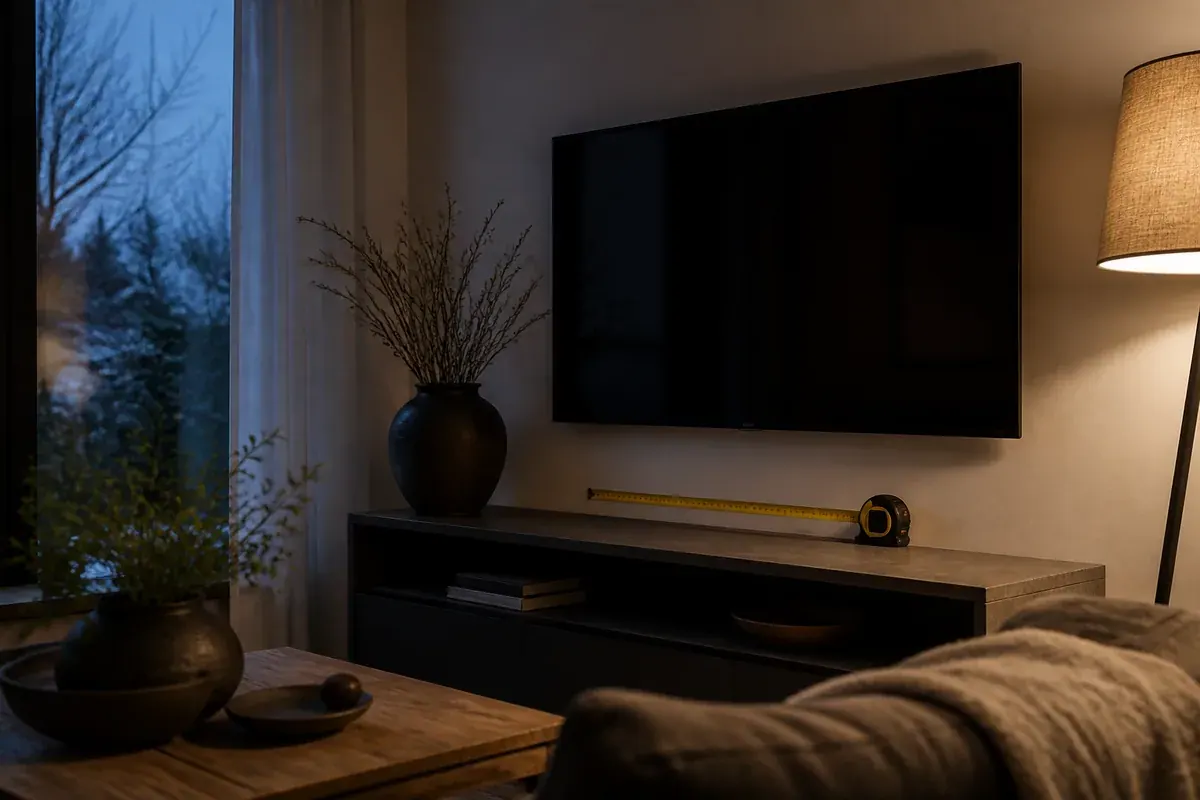
Sit down where you actually watch television. Not perched on the arm, not leaning forward for the remote. Settle back into the cushion, look straight ahead, and have someone measure from the floor to the center of your pupil.
That figure is seated eye height. It is the one input you cannot look up, because it depends on your sofa’s seat height, how far its cushions compress under your weight, and your own torso length. Everything else is derived arithmetic: the line you mark on the wall, whether a tilt mount is worth paying for, how far back the seating belongs.
Every worked example below uses 41 inches. Substitute your own.
The Fireplace Position, Measured in Degrees of Neck Extension
Put a 65-inch set above a mantel and the geometry stops being a matter of taste. A 16:9 panel at that diagonal is roughly 31.9 inches tall. If the mantel shelf sits at 54 inches and the bottom edge of the screen clears it by 2 inches, the center of the picture lands near 71.9 inches from the floor. Against a 41-inch eye height, that is a 30.9-inch rise.
Converted to an angle, at a 78-inch viewing distance the sight line runs 21.6 degrees above horizontal. Back the sofa off to 106 inches and it eases only to 16.2 degrees. Either way you are holding your head in extension for the length of a film.
For comparison, OSHA’s computer workstation guidance puts the center of a monitor 15 to 20 degrees below horizontal eye level, and states plainly that a screen set high enough to tilt the head backward fatigues the muscles that support the head. That guidance addresses desk work at arm’s length, not television at seven feet, and no equivalent published figure exists for TV viewing. The direction of the error is still not ambiguous.
Screen Center, Panel Height, and the Arithmetic Between Them
A 16:9 panel’s height equals the diagonal multiplied by about 0.49, and its width equals the diagonal multiplied by about 0.872. A 65-inch screen is therefore 31.9 inches tall and 56.7 inches wide in active area. Measure your actual set including bezel and frame, because that overall figure, not the active area, is what you mark the wall from.
Set the vertical center of the picture at seated eye height and the rest resolves itself. With 41 inches of eye height and a 65-inch panel, the top edge sits at 56.9 inches and the bottom edge at 25.1 inches. Your gaze travels no more than about 16 inches up or down to reach either edge.
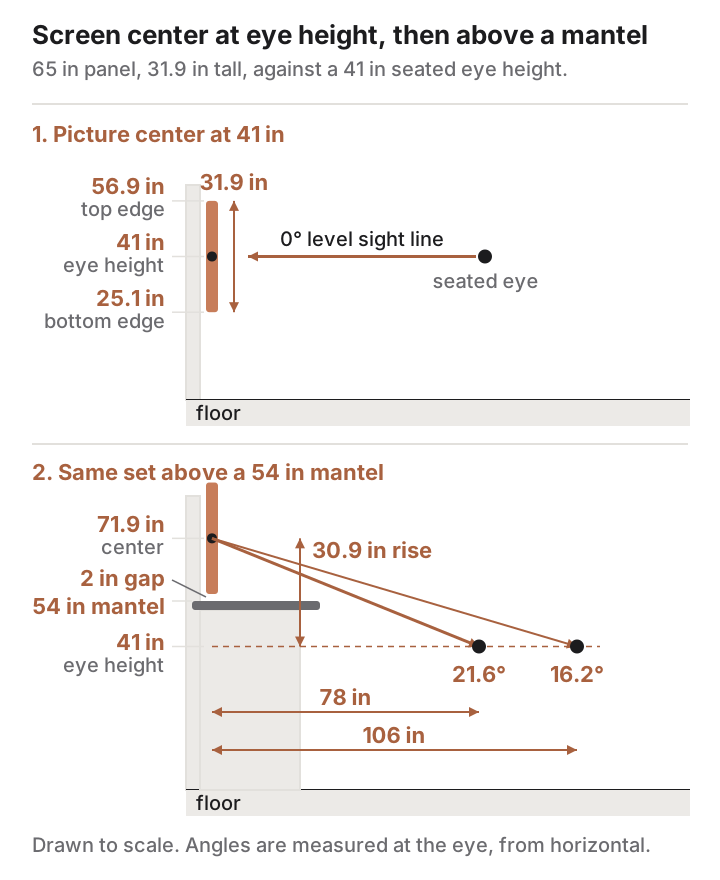
Dropping the center an inch or two below eye height costs nothing. Raising it is where the trouble starts.
Three Distance Recommendations That Disagree With Each Other
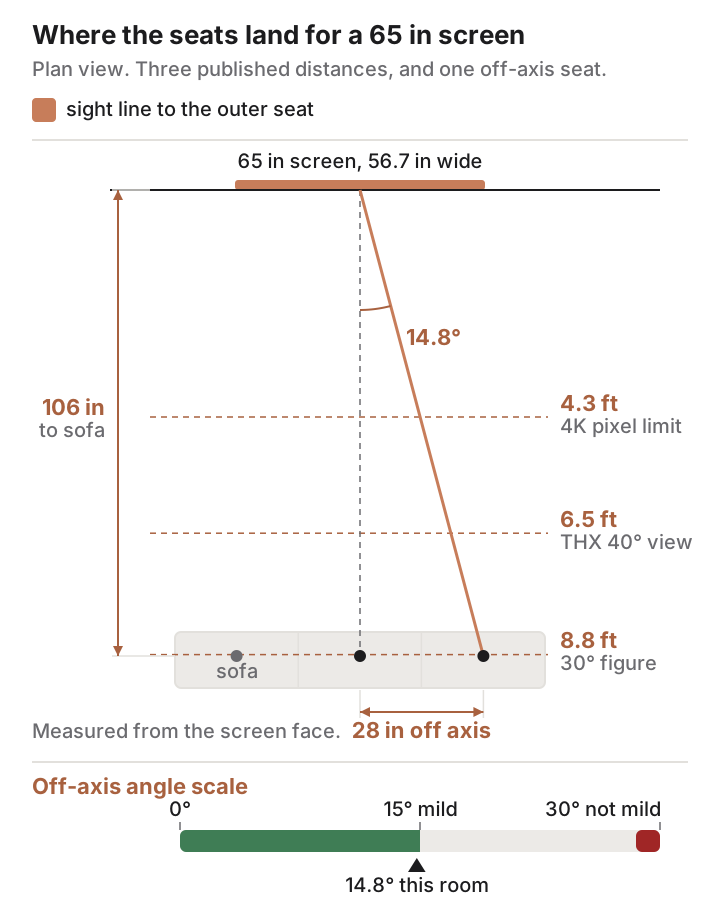
Published viewing-distance advice comes from three directions and produces three different answers. THX recommends a seat-to-screen distance where the screen fills roughly a 40-degree field of view, calculated by dividing the diagonal by 0.84, which works out to about 1.2 times the diagonal. The widely repeated 30-degree figure attributed to SMPTE gives about 1.63 times the diagonal, though the same reference notes that no direct SMPTE recommendation on the question appears to exist. A third approach ignores comfort and asks only where the eye stops resolving pixels, and the distances it gives are 1.6 picture heights for 4K and 3.2 picture heights for 1080p.
| Screen (16:9) | Panel height | THX 40° distance | 30° figure | 4K pixel limit (1.6H) | Bottom edge at 41 in eye height |
|---|---|---|---|---|---|
| 55 in | 27.0 in | 5.5 ft | 7.5 ft | 3.6 ft | 27.5 in |
| 65 in | 31.9 in | 6.5 ft | 8.8 ft | 4.3 ft | 25.1 in |
| 75 in | 36.8 in | 7.5 ft | 10.2 ft | 4.9 ft | 22.6 in |
| 85 in | 41.7 in | 8.5 ft | 11.5 ft | 5.6 ft | 20.2 in |
Read the fifth column against the third. At 4K the pixel structure disappears well before you reach the comfortable-angle distance, so field of view, not resolution, is the binding constraint on a modern set. Note the last column too: an 85-inch screen centered at 41 inches puts its bottom edge near 20 inches, below the top of many media consoles.
Where the Off-Center Seats Land
Measure from the screen’s vertical centerline out to the center of the furthest seat, divide by the viewing distance, and take the arctangent. A seat 28 inches off axis at 106 inches gives 14.8 degrees.
Check that figure against your panel’s published off-axis behavior, which varies enormously between display technologies. Fifteen degrees is mild. Thirty degrees, easy to reach in a long room with a sectional, is not.
Tilt Rotates the Panel, It Does Not Lower It
A tilt bracket changes the plane of the screen, not its position. Your neck angle after tilting is identical to your neck angle before it, because the center of the picture has not moved. What tilt fixes is optical: it squares the panel to your sight line, reducing off-axis degradation and steering ceiling-light reflections off the glass.
Now check whether your mount can even do it. Squaring a panel against that 21.6-degree fireplace sight line requires 21.6 degrees of downward tilt. The Sanus VLT16 tilts 0 to negative 10 degrees, sits 0.82 inches off the wall, handles 40 to 85-inch sets up to 125 pounds, and lists at $219.99.
The full-motion Sanus VLF728 manages 5 to negative 15 degrees, extends from 2.15 to 28.00 inches, swivels 57 degrees each way, carries 125 pounds, and lists at $429.99. Neither one squares a mantel install.
Tilt earns its price in a narrower case. A screen center 12 inches above eye height at a 96-inch distance produces a 7.1-degree sight line, comfortably inside a 10-degree tilt range. Tilt compensates for a modest rise, not for a fireplace.
VESA Patterns, Screw Threads, and Which Weight Number Governs
The bolt pattern on the back of your TV follows the VESA Flat Display Mounting Interface standard, which assigns designations by hole spacing, screw size, and load. The published table lists MIS-D at 75 by 75 millimeters with M4 screws to an 8-kilogram limit, or 100 by 100 with M4 to 14 kilograms; MIS-E at 100 by 200 with M4 to 22.7 kilograms; and MIS-F covering square patterns from 200 by 200 millimeters upward, using either M6 screws to a 50-kilogram limit or M8 screws to 113.6 kilograms.
Those kilogram figures are limits on the interface itself, roughly 110 and 250 pounds. They are not your mount’s rating. The mount publishes its own number and that is the one that governs: the VLT16 above is rated at 125 pounds across a VESA range of 100 by 100 through 750 by 400 millimeters.
Measure your pattern center to center between adjacent holes, horizontally and vertically, before ordering anything, and thread a screw in by hand to confirm the size. Some sets ship with the holes plugged or recessed behind a decorative panel.
Studs, Wall Plate Width, and Where the Load Goes
Wall framing in North American houses is commonly laid out on 16-inch or 24-inch centers, but treat that as a starting hypothesis, not a fact about your wall. Older houses, remodeled walls, and framing around openings all break the pattern. A multi-sensor stud finder such as the Franklin Sensors ProSensor 710, which uses 13 sensors to read the full width of a stud to a stated detection depth of 1.6 inches and lists at $52.95, reads more honestly than a single-point scanner that only reports edges.
Confirm what the scanner tells you: drill a small pilot hole at the marked center and feel for solid resistance through the full depth of the bit. A void means a metal plate, a pipe, or a false reading.
Hollow-wall anchors are not a substitute for framing, and a full-motion arm at full extension sharply multiplies pullout force on the top fasteners. Masonry and steel-stud walls need their own hardware. A stud that has been cut, notched, or bored through to make a mount fit no longer carries what it used to carry, which is why that repair gets specified by a licensed contractor and, in a good many jurisdictions, pulled on a permit.
Marking the Wall in Six Steps
- Bolt the TV brackets to the back of the set through the VESA holes, then join that assembly to the wall plate while everything is still flat on the floor.
- With the assembly joined, measure from the top edge of the TV straight down to the top row of mounting holes in the wall plate. Call this distance D. In the worked example, D is 14.5 inches.
- Measure the TV’s overall height including bezel. For the 65-inch example, 32.5 inches. Half of that is 16.25 inches.
- Add half the TV height to seated eye height to get the target top-of-TV line: 41 plus 16.25 equals 57.25 inches from the floor.
- Subtract D from that line to get the wall plate line: 57.25 minus 14.5 equals 42.75 inches from the floor.
- Locate and mark stud centers, transfer 42.75 inches across the wall with a long level, check the wall plate’s own bubble vial once it is held in position, and only then drill pilot holes on the stud centerlines.
Back-check step 5 before drilling. Top edge at 57.25 minus half the panel height of 16.25 returns 41 inches, the eye height you started with. If that arithmetic does not close, one of your measurements is wrong.
Cable Routes and the Point Where an Electrician Takes Over
Two kinds of cable run behind a mounted television, under different rules. Signal cables carrying HDMI and network traffic can generally be routed inside a wall cavity provided the cable jacket carries a printed in-wall rating, commonly CL2 or CL3. The jacket printing is where you check, not the box.
Power is narrower. Pushing the television’s factory power cord through the wall cavity is the common shortcut, and it is prohibited: NEC 400.12 bars flexible cords both as a substitute for the fixed wiring of a structure and where run through holes in walls, structural ceilings, suspended ceilings, dropped ceilings, or floors. Your jurisdiction adopts its own edition of that code and may amend it, so confirm locally. The legitimate routes are a surface raceway that keeps the cord on the wall face, or a listed in-wall power relocation kit, which pairs a recessed inlet behind the TV with a plug-in module near the floor and joins the two with in-wall rated cable supplied in the kit.
The cord is the dividing line. Plugging the set into a receptacle that already exists, or into a listed relocation kit wired for the purpose, asks nothing of the house. Adding a receptacle, extending a branch circuit, moving a box, or cutting into a cable you cannot positively identify crosses into electrical work, which an electrician has to hold a license to perform, and a new or extended branch circuit is permitted work in the great majority of jurisdictions. Where exactly that threshold falls is a local decision, not one any figure on this page can settle.
The Numbers to Write on the Wall Before You Drill
Write these on the drywall in pencil: seated eye height, the TV’s overall height and half that figure, distance D from the top edge to the wall plate holes, the target top-of-TV line, the wall plate line, and the two stud centerlines. Add the mount’s weight rating and the TV’s weight beside each other.
Then check three things. That the top-of-TV line minus half the panel height returns your eye height. That your pilot holes found the stud centers you marked. That the seating distance falls inside the range your screen size calls for.
Pencil erases. Drywall with eight wrong holes in it does not.