How Sunlight Fades Fabric, Wood, and Paint
A faded cushion is not dirty, and it is not worn. It is chemically different from the cushion it used to be.
Light arrives as packets of energy, and when a colorant molecule absorbs one, that energy has to go somewhere. Often it leaves harmlessly as heat. Sometimes it breaks the bond that gave the molecule its color, and that particular bit of color never comes back.
The usual explanation stops at ultraviolet. Block the UV, block the fading. The glass industry’s own published numbers say that story is incomplete, and the gap is wide enough to change what you should spend money on.
The Number the Glass Industry Uses Instead of “UV Blocked”
Window manufacturers rate fade potential with damage-weighted transmittance, written Tdw-ISO. It applies a wavelength-by-wavelength weighting to everything the glass lets through, and the range it covers runs from 300 to 700 nanometers. That reaches past the ultraviolet band and deep into visible light. A lower number means less fade-driving energy landing in the room.
Cardinal Glass publishes UV transmission and Tdw-ISO side by side for four common configurations, calculated in the Berkeley Lab WINDOW program under NFRC conditions. Read the two columns against each other.
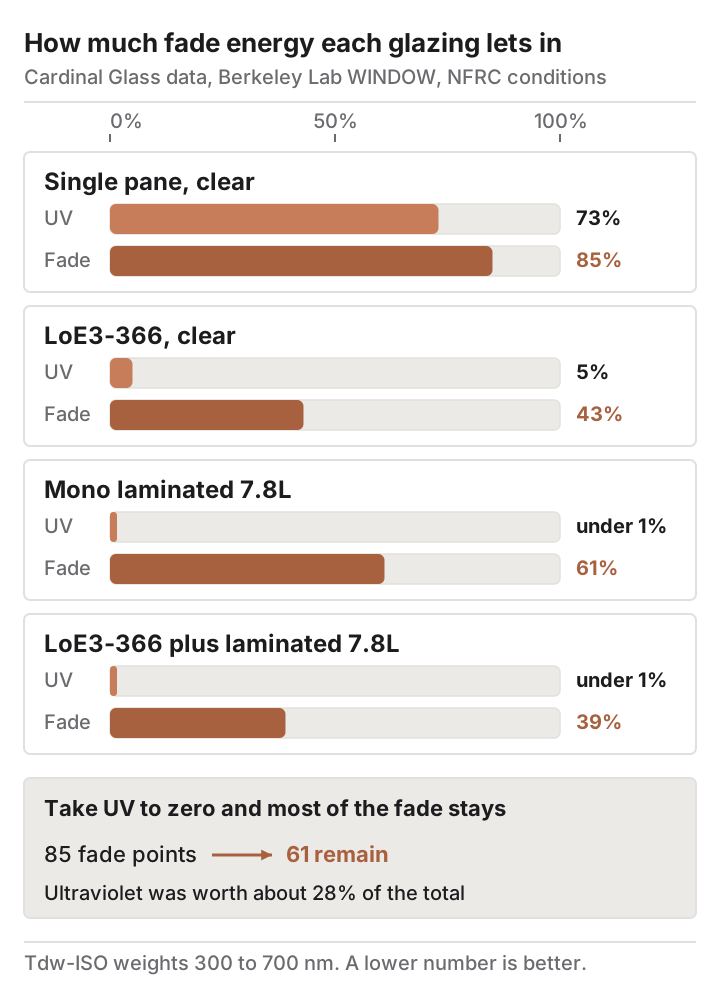
| Glazing | UV transmission | Fade (Tdw-ISO) |
|---|---|---|
| Single pane, clear | 73% | 85% |
| LoĒ3-366, clear | 5% | 43% |
| Mono laminated (7.8L) | under 1% | 61% |
| LoĒ3-366 plus laminated (7.8L) | under 1% | 39% |
Look at the third row. Laminated glass, a 3 mm pane over a 0.060 inch PVB interlayer over another 3 mm pane, takes UV transmission from 73 percent down to under one percent. It removes effectively all of it. Its damage-weighted transmittance still sits at 61 percent, per Cardinal’s published fade-protection data.
Do the subtraction. Strip every trace of ultraviolet out of a clear window and 61 of the original 85 points survive. Ultraviolet was worth roughly 28 percent of the total. Everything left is visible light, because the weighting stops at 700 nanometers and does not include anything past it.
Ultraviolet, Visible Light, and Heat Are Three Different Problems
Ultraviolet carries the most energy per photon and does the most damage per unit of light reaching a surface. It is also the easiest of the three to remove, which is why nearly every product in this category leads with a UV number. That number is real. It is just not the whole bill.
Visible light is the large, slow, unglamorous share. You cannot take it out without taking out the daylight you wanted in the first place, which is why every honest fix here is a trade between view and protection rather than a solution.
Infrared sits outside the damage function entirely. Its effects are dimensional rather than chromatic. Sun-warmed wood and leather dry and move, adhesives soften, and a tabletop in a window can develop problems that have nothing at all to do with its color.
Why Two Cushions in the Same Beam Fade at Different Rates
A colorant’s fade rate is set by two things: which wavelengths it absorbs, and how stable the molecule is once it has absorbed them. Because the damage weighting is steeply uneven across that 300 to 700 nanometer span, two fabrics sitting in one beam are not receiving the same effective dose. One is absorbing where the weighting is heavy. The other is not.
That makes guessing a poor strategy and asking a good one. Upholstery and outdoor fabrics are tested for colorfastness to light, most often by AATCC Test Method 16.3, which exposes a partly masked swatch to a xenon-arc lamp and grades the change on a five-point class scale: 5 is no fading, 1 is severe fading. Ask a retailer for the class instead of for reassurance. A figure can be compared against another figure; “fade resistant” printed on a hangtag cannot be compared against anything.
The allocation follows from that. Plain, low-contrast fabric belongs on the seat that lives in the sun patch, and the fabric budget belongs on the chair that lives in shade.
Cherry Darkens, Walnut Lightens
Wood does not simply lose color the way a dyed textile does. It changes color, and the direction depends on the species. The American Hardwood Export Council states the pattern directly: lighter timbers such as cherry and tulipwood will darken, while darker timbers such as walnut will lighten.
That matters most when two species share one room or one piece. A walnut top over a cherry base, half of it catching a window, will drift apart rather than together. The sunlit walnut goes pale, the sunlit cherry goes deep, and the shaded parts of both stay roughly where they started.
Rotation does not reverse any of it. What rotation does is even it out. Turn a sunlit table 180 degrees each season and the whole top ages at one rate instead of splitting into two halves with a visible seam between them.
What a Rug Loses Between May and September
The damage announces itself as a boundary, not as general dullness. Lift a rug that has spent a summer under a south window and you find a line: saturated fiber where a sofa leg or a stack of magazines sat, lighter fiber everywhere the sun reached. The eye reads the edge long before it reads the fade.
You can put a number on the exposure before it happens. Take the bare single-pane baseline of 85 percent damage-weighted transmittance. Swap to LoĒ3-366 and you are at 43.
Divide 43 by 85 and you get 0.51, so over a 120-day run of summer sun the coated glass delivers roughly the dose the old glass would have delivered in 61 days. Laminated glass alone, at 61 percent, works out to about 86 days. One window, one rug, three very different clocks.
Before spending anything, find out where the sun actually lands.
- Pick a clear day. Mark the far edge of the sunlit patch on the floor with painter’s tape at 10 a.m., 1 p.m., and 4 p.m.
- Measure from the wall below the window out to each tape line. Write all three distances down.
- Repeat the same three marks once in the opposite season. The patch will not land in the same place twice.
- Combine the two sets into one footprint. Anything permanently inside it is on an exposure clock. Anything outside it is not.
Sometimes that measurement ends the project. The expensive rug moves about eighteen inches out of the footprint, and nothing else has to happen.
Cutting the Light Dose at the Glass
Spectrally Selective Film on the Glass You Already Own
3M’s Prestige series is non-metallized and built from over 200 micro-layers of optical film. Prestige 70 transmits 69 percent of visible light while rejecting 99.9 percent of UV, up to 97 percent of infrared in the 900 to 1000 nanometer band, and up to 60 percent of total solar energy, according to published Prestige series specifications. Darker options in the same line come in at 60, 50, 39, and 21 percent visible transmission.
Installed pricing for the Prestige line is quoted at roughly $10 to $12 per square foot, against $5 to $8 per square foot for ordinary residential film. A 3 by 5 foot window is 15 square feet, so material and labor land near $150 to $180, and most installers set a job minimum above that, so one window rarely prices out alone. Read the window’s warranty before filming an insulated unit, and have the installer confirm in writing that the film is approved for that specific glass.
Solar Shades and the Openness Number
A solar shade’s spec sheet leads with openness factor, meaning the percentage of the weave that is hole rather than yarn. Phifer publishes the pairing style by style, and every figure below comes from Phifer’s SheerWeave style data.
Style 2500 sits at approximately 1 percent openness, blocks approximately 99 percent of UV, and weighs 16.2 oz per square yard. Style 2410 is 3 percent openness and 97 percent UV blockage at 14.1 oz. Style 2390 is 5 percent and 95 percent at 11.8 oz. Style 2360 is 10 percent and 90 percent at 10.4 oz.
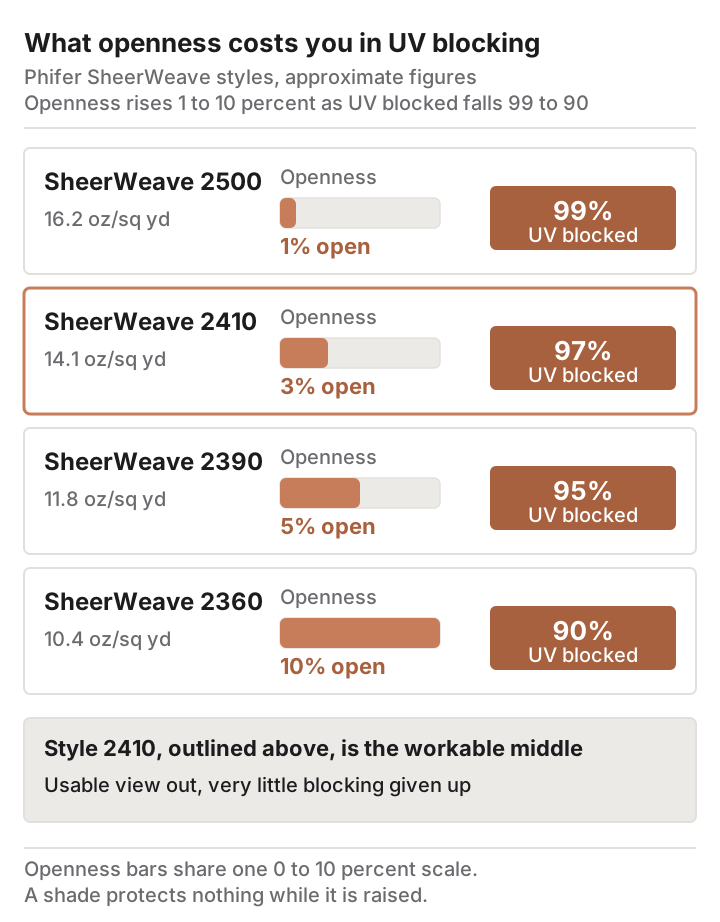
Three percent openness is the workable middle for most rooms. You keep a usable view out and give up very little blocking. The catch is behavioral rather than technical: a shade protects nothing while it is raised, and the hours it most needs to be down are exactly the hours you most want the light.
Sheers, Linings, and Quarterly Rotation
A sheer panel scatters light more than it removes it, and it carries no published blocking figure worth planning around. Lined drapery is a different object. Closed, it is opaque, and opaque is the only condition that stops visible light outright.
Rotation costs nothing and fails less often than either. Turn rugs 180 degrees quarterly, swap sofa cushions front to back on the same day, and the fade distributes instead of collecting in one stripe. Put it on the calendar reminder you already use for filter changes.
Conservation Glazing for Framed Work
Framed paper and photographs are the most vulnerable things on the wall, and among the cheapest to protect properly. Tru Vue’s Conservation Clear glass blocks up to 99 percent of UV across the 300 to 380 nanometer band, transmits more than 89 percent of visible light, passes the Photographic Activity Test to ISO 18916, and meets ISO 18902, per Tru Vue’s product specifications. At a custom framer it is a modest per-frame upcharge, tens of dollars rather than hundreds on a 16 by 20 inch piece.
Be clear about what it does not do. Conservation glazing is a UV filter, and the table above already shows what UV filtering alone buys you. An original work on paper still belongs on the wall the sun never reaches.
Placing the Piece You Cannot Replace
Placement is free, and against everything above it wins on cost outright. If the footprint from step 4 contains something irreplaceable, move the object rather than treating the window. The wall perpendicular to the glass, outside the combined footprint, is the safest surface in a bright room.
One caution on the replacement route. Swapping a window rather than filming one is regulated work. A bedroom escape opening has to clear a minimum size, written in the model residential code as 5.7 square feet of net clear opening, at least 24 inches of height and 20 inches of width, with the sill no more than 44 inches above the floor. Glazing set near doors, low floors, tubs, and showers falls into hazardous locations that require safety glazing. Those are model-code figures and the version your jurisdiction has adopted governs. Permits are normally required, and the work belongs to a licensed window installer or general contractor.
Where the Money Goes on One South-Facing Window
For a typical residential window whose glass is otherwise sound, spectrally selective film is the best result per dollar, and the margin is not narrow.
The reasoning is arithmetic. New LoĒ3-366 glazing takes damage-weighted transmittance from 85 to 43, the largest single-step reduction on the table, but replacing one window reaches four figures once labor is counted. Film lands near $150 to $180 on the same opening, removes 99.9 percent of the UV and up to 97 percent of the near-infrared, and still returns 69 percent of the visible light. It also works every hour of every day without anyone remembering to lower anything, which is precisely where shades and drapery lose.
Here is the honest limit. 3M does not publish a Tdw-ISO figure for Prestige 70 in its product specifications, so setting film against the glass numbers is directional rather than exact.
Film takes the UV share out almost completely and takes a real bite out of the visible share. It will not reach zero; nothing short of an opaque surface does. For the single object in the room that could never be replaced, step 4 remains the answer, and it costs a roll of painter’s tape.