Seasonal Home Upkeep, Quarter by Quarter

A house does not wear out at a steady rate. It absorbs four different loads across a year, and each one arrives on a schedule you can predict months in advance: direct sun, airborne moisture, mechanical heat, and abrasive grit. Upkeep written as one rolling to-do list ignores that schedule and never gets finished; upkeep written by quarter turns into four short sessions with an end point.
Materials also run on the same clock the weather does. Solid wood takes on moisture through a humid August and gives it back through a dry February, so the jobs that protect it have to land before the swing rather than during it. Sealing a draught in December is repair; sealing the same draught in October is maintenance.
What follows is organized by season, limited to finishes, textiles and fixtures rather than structural work, and names the publishing body behind every measurable target.
The Four Loads That Set the Upkeep Calendar
Sun peaks in summer and reaches dyes, leather and unprotected wood tops first. Moisture peaks in late summer in most humid-continental and humid-subtropical climates, then collapses once heating runs, and that swing is what moves wood. Mechanical heat arrives in the fourth quarter and pulls indoor humidity down for months at a stretch. Grit comes in on winter footwear and behaves like fine abrasive paper against a floor finish.
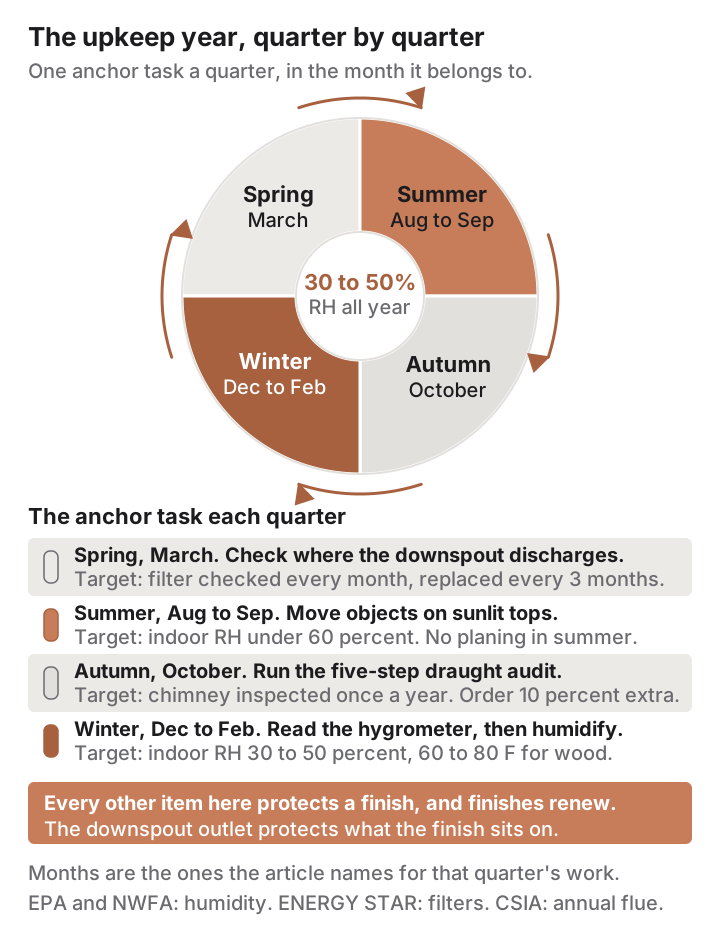
| Quarter | Dominant load | What it reaches first | Measurable target |
|---|---|---|---|
| Spring | Water and pollen | Gutters, screen mesh, filters, rug pile | Filter checked every month |
| Summer | Ultraviolet and humidity | Dyes, leather, drawer fit | Indoor RH under 60 percent |
| Autumn | Air leakage and combustion | Draughty perimeters, flues, burners | Chimney inspected once a year |
| Winter | Dry air and abrasive grit | Wood joints, floor finish, static | Indoor RH 30 to 50 percent |
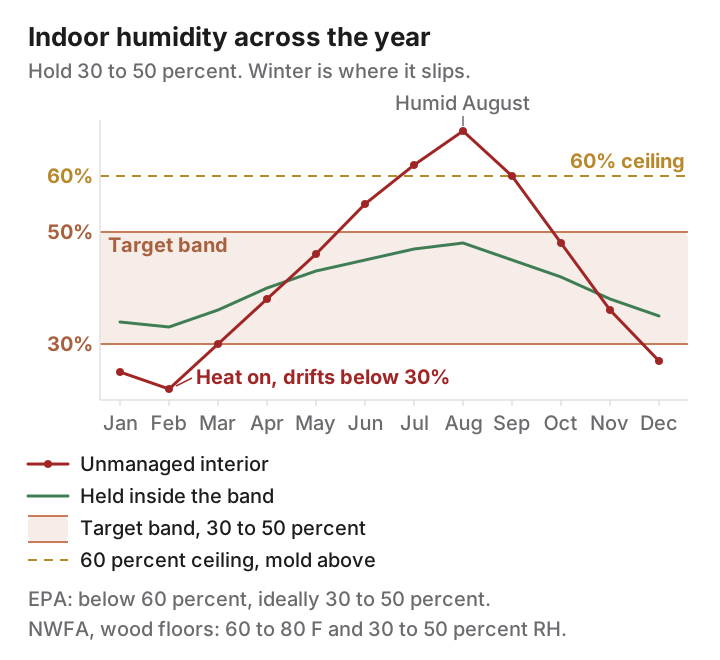
Two numbers carry that table. The EPA caps indoor humidity at 60 percent, with 30 to 50 percent relative humidity as the preferred band, because condensation above that upper figure invites mold (A Brief Guide to Mold, Moisture and Your Home).
Wood flooring guidance lands in the same band. The NWFA recommends holding the interior at 60 to 80 degrees Fahrenheit and 30 to 50 percent relative humidity for wood floors to stay dimensionally stable (Hardwood Floors Magazine). One band covers mold risk and wood movement at once, which makes it the spine of the calendar.
Spring: Screens, Gutters, Filters and the Rugs That Held the Winter
Window Glass and Screen Mesh
Interior glass carries a film by March that is mostly cooking residue and heating dust. Wash it before you wash the outside, so you can tell which side any remaining haze is on. Screens come out, get rinsed with a hose and a soft brush, then dry flat rather than propped, because propped mesh dries with a bow.
The Gutter Line and Where the Downspout Ends
Clear the troughs first, then run water through and watch the outlet. What matters is not the trough, it is where the water lands. Add an extension long enough to discharge past the backfill zone against the wall, onto grade that slopes away.
Rug Rotation and the Deep Clean
Rotate 180 degrees so the traffic lane and the sun lane swap places. Pile compressed all winter under a sofa leg will not recover on its own, so vacuum both faces and let the rug rest unweighted for a day.
HVAC Filters Before the First Cooling Cycle
ENERGY STAR advises checking the filter every month during heavy-use seasons, changing it if it looks dirty, and replacing it at a minimum every three months (Heat and Cool Efficiently). Buy by nominal size and verify the actual one: a Filtrete Micro Allergen Defense filter sold as 20x25x1, rated MPR 1000 and MERV 11, actually measures about 19.69 by 24.69 by 0.81 inches. Nominal size is a naming convention, not a measurement, so a filter that looks a quarter inch undersized in the slot is usually the correct one. Match the airflow arrow as well as the size: it points toward the blower, and a pleated filter installed backwards loads on the wrong face and starves airflow before the three-month mark. Write the install date on the cardboard frame in marker, because nobody remembers otherwise.
Caulk Joints at Trim, Tub and Sill
Walk the bathroom and the window casings looking for hairline splits along painted joints. A siliconized acrylic such as DAP Alex Flex, sold in a 10.1 fluid ounce cartridge, is formulated for fast paintability, so a bead run in the morning can take colour the same day. Cut the nozzle at 45 degrees for a bead near an eighth of an inch, tool it once, and stop; a second pass drags the skin.
Summer: Ultraviolet Load, Outdoor Textiles and Wood on the Move
Fade Control on Rugs, Upholstery and Wood Tops
Fading is cumulative and invisible until you create a comparison. Lift a lamp base or a tray off a sunlit wood top in September and look at the outline. Move objects a few inches each month on any surface that takes direct afternoon sun, and rotate seat cushions front to back so one face is not permanently exposed.
Window Film Worth Specifying
Film is the one summer purchase with published numbers behind it. 3M Sun Control Window Film Prestige 70 uses a multilayer construction that contains no metal, so it does not interfere with cellular or Wi-Fi signal, and on the PR70 grade visible light transmission still runs near 69 percent, while the series is rated to reject 99.9 percent of UVA and UVB (3M Prestige series specifications). Installers price by the square foot and quote per opening, so film is worth pricing for the two or three windows that take direct afternoon sun rather than for the whole house. Measure the glass only, and check the glazing warranty with the window manufacturer before ordering film for an insulated unit.
Cushions, Canvas and the Storage Question
Outdoor cushions absorb far more water than they look like they do. Rinse them, stand them on edge, and give them a full dry day before anything goes into a deck box. Anything stored damp in a sealed container sits above 60 percent relative humidity by definition, the condition the EPA guidance is written to avoid.
Doors, Drawers and the August Swell
Drawers stick in August because the wood is at its widest, not because they are broken. Do not plane a drawer side or a door edge in summer. Wait for January and check the fit again; the problem has usually removed itself. If it still binds in winter, it is a real fit problem and worth cutting.
Autumn: Air Leaks, Heat Sources and the Textile Swap
Sealing air leaks is the job that changes how the fourth quarter feels indoors, and the comfort arrives long before any change shows on a fuel bill. The audit below takes roughly an hour for a whole house and needs nothing beyond a ruler and a strip of paper.
A Five-Step Draught Audit
- Depressurize the house. Turn on the range hood and every bathroom fan with the windows closed. Outdoor air gets pulled in through every gap that exists.
- Run the paper test on each exterior door. Close the door on a strip of printer paper. If the strip slides out with no drag at all, that edge is not sealing.
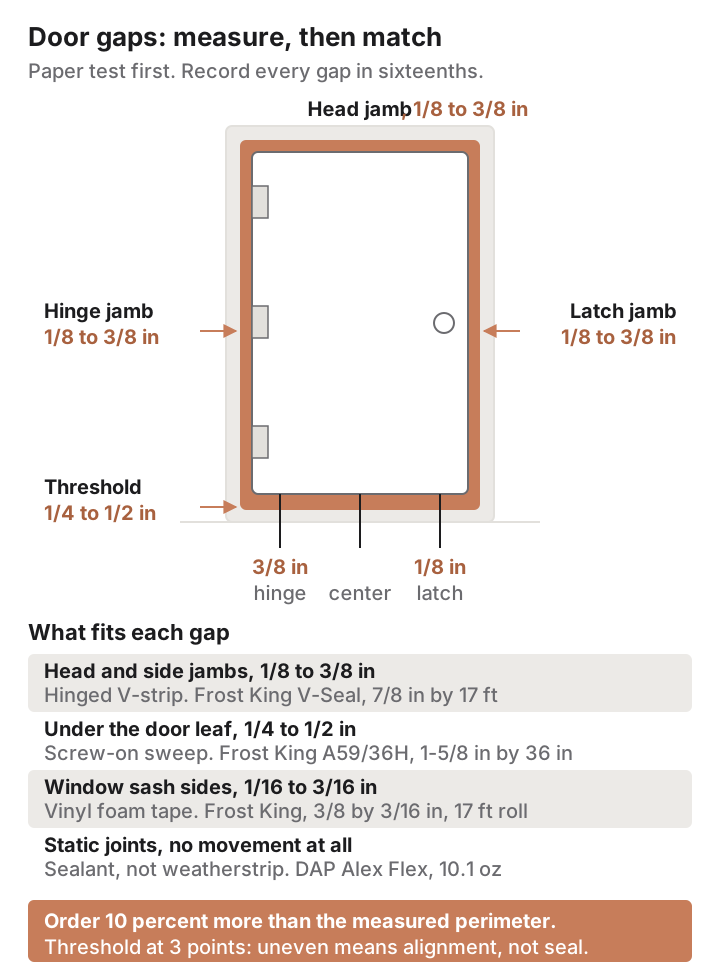
- Measure the threshold gap at three points: latch side, center, hinge side. Record each in sixteenths of an inch. A door that reads 1/8 at the latch and 3/8 at the hinge is out of alignment, not just unsealed.
- Pass the back of your hand slowly along each window sash perimeter, about an inch off the stop; skin there picks up moving air better than fingertips do.
- Add up the perimeter of every opening you plan to treat, then order 10 percent more than that figure. Corners and restarts eat the difference.
Weatherstrip Types by Gap Width
| Measured gap | Where it occurs | What fits it | Named example |
|---|---|---|---|
| 1/16 to 3/16 in | Window sash sides, meeting rail | Adhesive vinyl foam tape | Frost King vinyl foam, 3/8 by 3/16 in, 17 ft roll |
| 1/8 to 3/8 in | Door jamb sides and head | Hinged V-strip | Frost King V-Seal, 7/8 in by 17 ft |
| 1/4 up to 1/2 in | Under a door leaf | Screw-on aluminum and vinyl sweep | Frost King A59/36H, 1-5/8 in by 36 in |
| No movement at all | Casing to jamb, trim to drywall | Paintable sealant, not weatherstrip | DAP Alex Flex, 10.1 oz cartridge |
The last row is the one people get wrong. Weatherstrip belongs on parts that move; a static joint wants sealant, and foam tape put there will need redoing next autumn.
Burner Service and the Annual Flue Inspection
Book the heating tune-up before the first cold week, when contractors still have calendar space. ENERGY STAR makes the same comparison a mechanic would, noting that a yearly tune-up of the heating and cooling system improves efficiency and comfort just as a car tune-up improves gas mileage (Heat and Cool Efficiently). If you burn anything, the flue is not optional: CSIA cites the national standard that chimneys, fireplaces and vents be inspected at least once a year for soundness, deposits and correct clearances (CSIA homeowner resources).
Swapping Textiles Before the Heat Comes On
Summer curtains, cotton throws and lightweight covers should go into storage clean, not merely folded. Body oils and food residue that are invisible in September oxidize into visible marks by April. Wash, dry completely, and store in breathable cotton bags rather than sealed plastic bins.
Winter: The 30 to 50 Percent Band, Static, Plant Light and Entry Grit
Holding Wood Inside the Target Band
Buy a digital hygrometer, put it in the room with the most solid wood in it, and keep it away from supply registers and exterior walls. That is the reading you manage against. Once the heat runs continuously, interiors commonly drift below the 30 percent floor and stay there for weeks, which is when joints open and panel gaps appear in case furniture. A humidifier sized for the room, run to hold the band rather than to feel humid, is cheaper than refinishing anything.
Static as a Humidity Readout
Frequent shocks off a doorknob are a symptom, not the problem; read them as an instruction to check the hygrometer. Under 30 percent, the static, the shrinking floor gaps and the dry plant leaves all have one cause.
Plant Placement When the Sun Sits Low
Light that reached four feet into the room in July stops at the sill in January. Move plants toward the glass, but keep foliage off cold panes overnight. Watering should drop with the light, so cut frequency first.
Salt, Grit and the First Six Feet of Floor
Grit is abrasive and de-icing residue is corrosive, and both arrive on the same shoe. Run two mats: a coarse scraper outside the door and an absorbent one inside, long enough that both feet land on it. Wipe up salt residue with plain water and the floor manufacturer’s own cleaner before it dries into a white bloom.
Why the Downspout Outlet Outranks Everything Else Here
Skip the summer film and a rug fades. Skip the autumn weatherstrip and a heating bill rises. Skip the spring check on where the downspout discharges and water goes into the ground against the foundation wall, every storm, for a year, with nothing visible happening indoors until something is already wet.
Almost everything on this list protects a finish, and a finish can be renewed. Roof water that is aimed wrong attacks the material the finish sits on, it compounds instead of plateauing, and it produces no symptom you would notice until the repair is structural. So the spring check on the outlet is not the same kind of task as the rest. Every other item here is finish maintenance, verified indoors against a hygrometer reading and a measured gap. That one is drainage, verified outdoors, during rain, at the point where the extension lets the water go.