Nine Materials That Hold Up to Claws, Fur, and Accidents
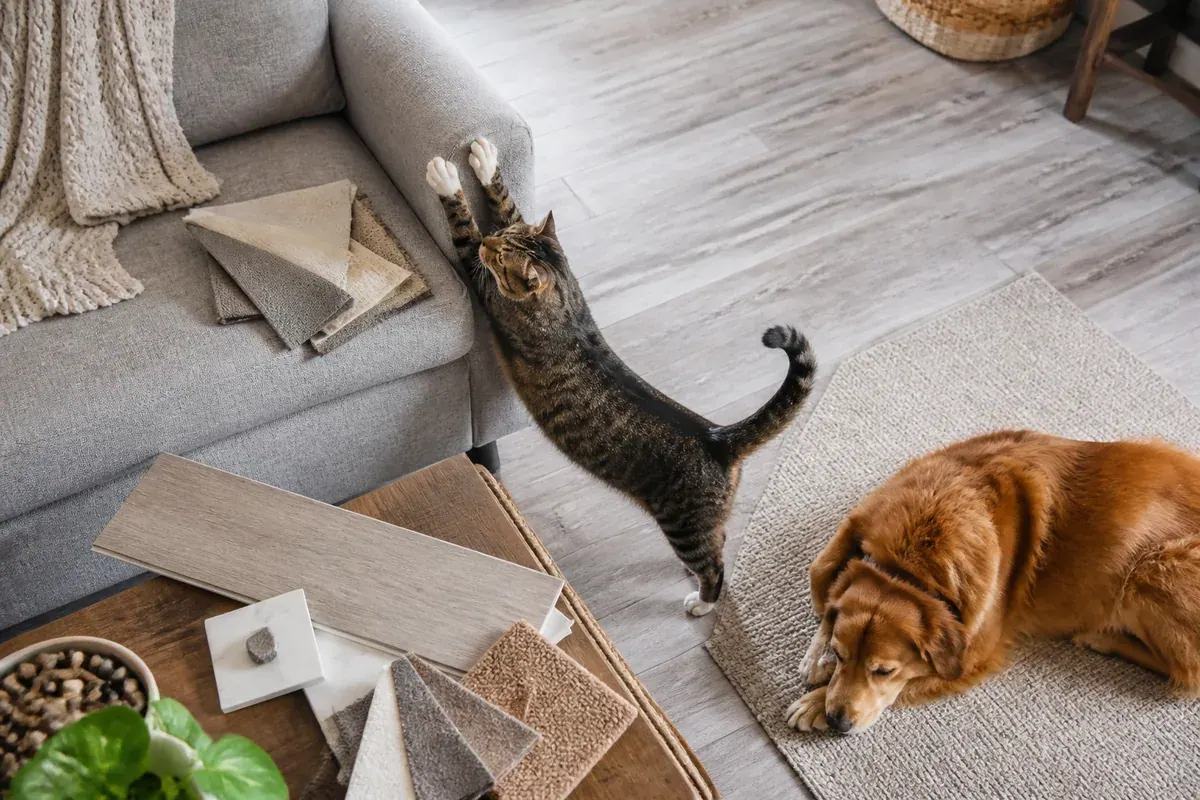
Pets damage a home in three separate ways, and a material that shrugs off one of them can fail badly at the next.
The first is mechanical. A claw hooks a fiber and pulls it into a run, or drags across a soft finish and leaves a pale line. Scratching is worse, because it is deliberate and repeated in one spot.
Second is liquid. Urine, vomit and drool travel down through whatever they land on, and the smell settles one layer below the surface you can see.
Third is slow wear: body oil in a cushion corner, dander in a weave, fur that needs vacuuming twice a week. Most shopping advice collapses all three into one label, which is how a sofa that wipes clean of anything still ends up covered in claw punctures.
Sorting Nine Materials by the Damage Each One Resists
The nine run from the top of the room down: upholstery, then soft floor coverings, then hard surfaces. Each is judged on why it survives, the spec that proves it, the failure it hides, and 2026 cost.
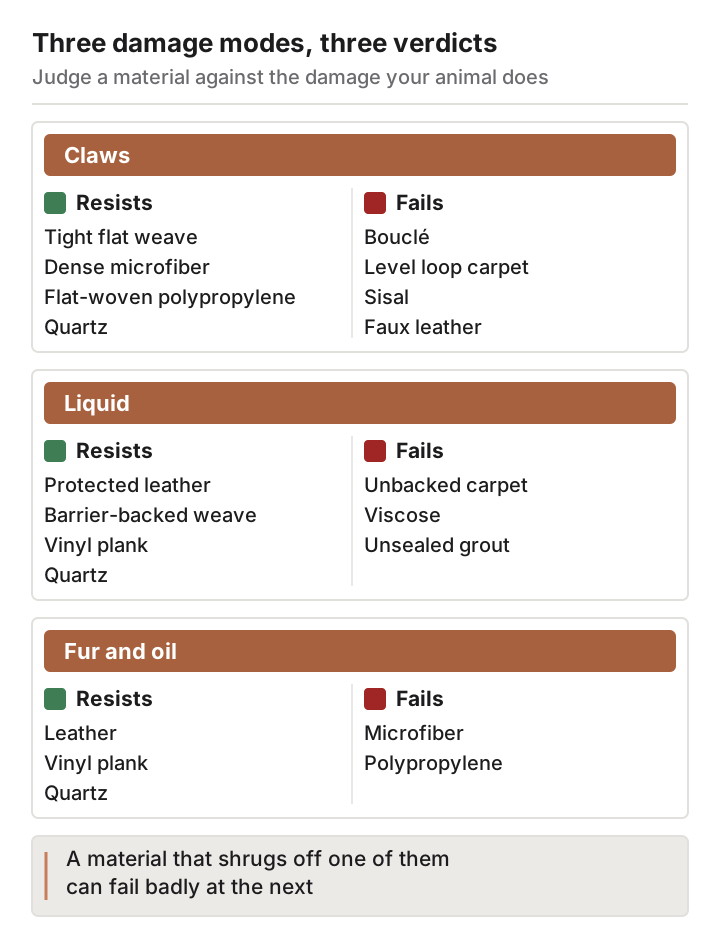
Sorted by damage mode the pattern is plain. Claws are turned away by tight flat weaves, dense microfiber, flat-woven polypropylene and quartz, and defeated by bouclé, level loop carpet, sisal and faux leather. Liquid is stopped by protected leather, barrier-backed weaves, vinyl plank and quartz, and gets through unbacked carpet, viscose and unsealed grout. Fur and body oil wipe off leather, vinyl plank and quartz, and build up fastest on microfiber and polypropylene.
Solution-Dyed Acrylic, Where Color Goes In Before the Yarn Is Spun
Ordinary fabric is woven and then dyed, so color sits near the surface. Solution-dyed acrylic reverses the order. Sunbrella is made of 100% solution-dyed acrylic in which each fiber is saturated with color and UV-stabilized pigments before being spun into yarn, and the manufacturer lists it as bleach cleanable, the property that matters when a dog has been sick on a cushion.
Look for “solution-dyed” in the fiber content line, not “solution-dyed look” or “performance finish,” and check the cleaning code for a bleach-safe designation. Sunbrella publishes a 5-year limited warranty on its upholstery fabrics.
The weakness is hand feel, and a nubby solution-dyed texture still gives claws something to grab. Expect $45 to $95 per yard.
Barrier-Backed Performance Weaves That Stop Liquid at the Cushion
A stain-resistant face only delays a problem. What decides whether an accident becomes a smell is whether liquid reaches the foam. Crypton describes a moisture barrier that protects seat cushions from liquids, with protection sealed into every fiber rather than washed away, and lists its current fabrics as PFAS-free and GREENGUARD Gold certified.
Ask whether a pattern includes the moisture barrier or only the stain-resist treatment. The barrier belongs to specific lines, and both are sold under the same brand name.
Barriers cost breathability, and they do nothing about a spill that runs off the front edge into the deck below. Budget $55 to $130 per yard.
Tight Flat Weaves and Dense Microfiber Instead of Bouclé Loops
Claws need purchase. A tight plain weave with short yarn floats offers almost none, and dense short-pile microfiber lets a claw skate rather than hook. Bouclé, chenille and loose linen present hundreds of raised loops at claw height instead.
There is a five-second test. Drag a fingernail sideways across the fabric, with the weave and against it. If your nail catches or lifts a fiber, a claw will do far more with the same motion.
Microfiber’s cost is visual: it shows fur and dust, develops shiny patches where a dog always lies, and records body oil in pale colorways. Yardage runs $28 to $65.
Protected Top-Grain Leather, and Where Faux Leather Splits
Leather is the strongest performer against liquid and fur and one of the weakest against claws. A pigmented, protected top-grain hide sheds urine long enough to wipe it, holds almost no odor, and releases fur with a dry cloth. What it cannot do is heal a puncture, and a determined cat will leave a permanent constellation of them on the front arm. Ask for top-grain with a pigmented or protected finish rather than “genuine leather,” a lower grade of split hide.
Faux leather trades one failure for another. Polyurethane over a knit backing resists liquid well, but once a claw opens the coating the film delaminates and peels outward, so a single puncture spreads. So the two separate on cost per year, not cost at purchase: roughly $2,200 to $5,500 for a protected hide sofa against $700 to $1,600 for the faux equivalent.
Solution-Dyed Polypropylene Indoor-Outdoor Rugs for Doorways and Feeding Corners
Polypropylene absorbs very little water, which is why an indoor-outdoor flat weave can go outside, get hosed down, and come back. That suits the two places accidents concentrate: the landing zone inside the door and the floor around food and water bowls.
Buy the flat-woven construction rather than the shaggy one, and confirm the yarn is solution-dyed if the rug sits in sun. Flat weaves have no pile for a claw to enter.
Polypropylene glazes under heavy traffic, holds oily soil more stubbornly than water, and never feels like wool underfoot. A 5 by 8 runs $90 to $300.
Two-Piece Washable Rugs and the Drum Size They Need
The washable category solves a problem no fiber can solve: a rug big enough to matter is too big to clean properly. Two-piece systems, of which Ruggable is the most widely sold, separate a printed cover from a gripping pad. Ruggable’s instructions are to machine-wash the cover in cold water on the delicate cycle with a mild, non-bleach detergent, and to spot-clean the pad only.
Check your washer before you check the rug. Drum capacity, not price, decides whether an 8 by 10 cover is realistic at home or a laundromat trip. Thin covers ripple at the edges and the pad wears out first. Most sizes land between $150 and $500.
Low Cut Pile Carpet, Never Level Loop
This is the clearest fork in the category. In a level loop carpet both ends of each yarn are anchored in the backing, so a claw that enters a loop and pulls drags an entire row into a visible run across the room. Cut pile has free yarn ends and nothing to hook, so the same claw passes between the tufts.
Keep the pile at half an inch or less. A 0.5 in cut pile holds less fur, dries faster after cleaning, and shows fewer crush marks than a plush one. Under it, ask for moisture-barrier construction; the American Kennel Club notes that carpet with moisture-barrier backing helps prevent spills or accidents from reaching the subfloor.
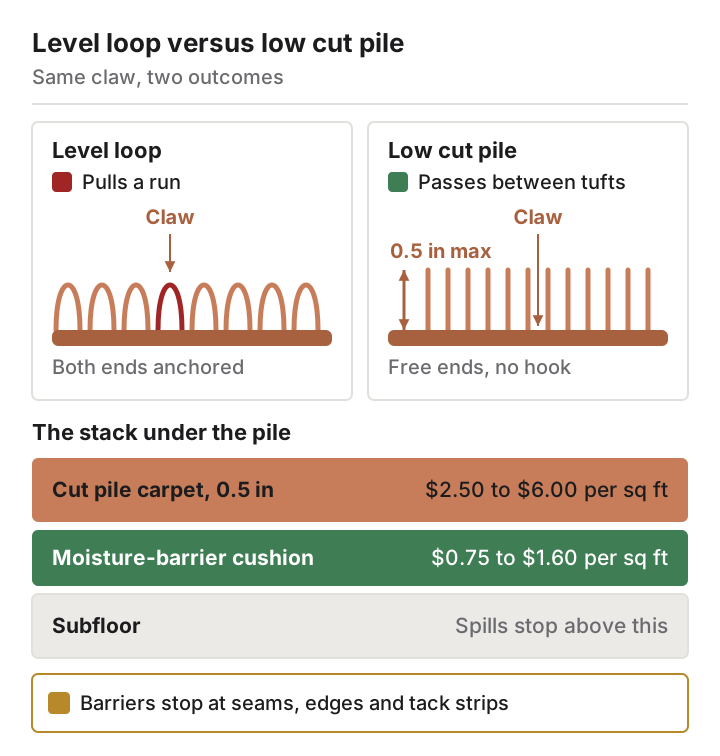
Even so, carpet remains the material most likely to turn one accident into a permanent smell, because barriers stop at seams, edges, and tack strips. Figure $2.50 to $6.00 per square foot for carpet plus $0.75 to $1.60 per square foot for barrier cushion.
Vinyl Plank Wear Layers, Counted in Mils
Luxury vinyl plank sells on being waterproof, but the number that predicts scratch survival is the wear layer, quoted in mils. One mil is a thousandth of an inch. Shaw’s Endura Plus in Cinnamon Walnut, item 0736V-00150, lists a 12 mil wear layer over a 4.8 mm plank measuring 7 inches by 48 inches at $4.19 per square foot, sold as 100% waterproof under a 30 Year Residential Resilient Limited Warranty.
Twelve mil is 0.012 inch of clear film between a dog’s nails and the printed image below. Take the highest mil figure your budget allows, because that layer cannot be refinished; a gouge that reaches the print film means replacing the plank.
Work the cost before you fall for a color. A 12 by 15 foot room is 180 square feet; add 10 percent for cuts and waste and you are buying 198 square feet, which at $4.19 is $829.62 in material before underlayment, transitions, or labor.
Quartz and the Case for Nonporous Slab Around Pet Zones
Accidents on a hard surface are only a cleaning problem when the surface cannot absorb them. Engineered quartz qualifies. Cambria states its surfaces need no sealing or polishing and are nonabsorbent, with NSF-51 certification for food preparation, which is why a hairball on the counter is a thirty-second event.
The relevant spec is porosity, not brand. Sealed porcelain tile behaves the same way; honed limestone, unsealed marble and unsealed grout do not, and acidic vomit will etch a polished carbonate stone.
Quartz has a resin binder that dislikes heat, and its edges chip if something heavy swings into them. Installed pricing generally falls between $65 and $120 per square foot, and that figure assumes a fabricator: templating, cutting and seaming are trade work, and a licensed plumber, not the fabricator, is the one who reconnects the sink underneath; the plumbing code says so across most of the country.
Materials to Keep Out of a Household With Claws
Some surfaces fail so reliably around animals that they are worth ruling out first: bouclé and chenille, any loose open weave with visible floats, and sisal or seagrass, which cats read as scratching posts and which hold urine in the fiber.
Viscose and art-silk rugs lose strength when wet, so cleaning an accident does more visible damage than the accident did. Rule out aniline and nubuck leather, unsealed limestone and marble, and unsealed grout in a feeding area.
The First Ten Minutes After a Urine Accident
Speed matters more than product choice: remove the liquid before it reaches the layer you cannot get to.
- Stack six to eight paper towels on the spot, lay a folded bath towel over them, and stand on it for thirty seconds. Standing loads the spot far harder than hand pressure.
- Replace the towels and repeat until a fresh sheet comes up dry. Do not rub, which spreads the stain sideways.
- Pour a small amount of cold water over the spot and blot it out the same way.
- Apply an enzyme cleaner labeled for pet urine, using enough to reach the full depth the liquid reached, which is wider than the visible mark. Ohio State’s Indoor Pet Initiative recommends an enzymatic cleaner and cautions to never use ammonia or ammonia-based products on the carpet, because the smell may attract the cat to that area.
- Let it sit for the dwell time printed on the label, then blot again and weight a dry folded towel over the spot overnight.
- Air dry with a fan on the area, and keep a hot-water extractor off the spot until the odor is gone.
Run the same sequence on upholstery. If the cushion cover is not barrier-backed, unzip it and blot the foam directly, because the foam holds the smell.
The Layer That Decides Whether Pet Damage Stays Cosmetic
Every material here protects something. A scratched sofa arm is a few hundred dollars and an afternoon of annoyance. A subfloor that has absorbed urine through a carpet seam is a demolition job, and the smell survives new flooring laid over it.
A soft subfloor or a stained joist has stopped being a flooring problem. Cutting out sheathing or a framing member and setting new material in its place is structural repair. A licensed contractor carries it out, under a permit that opens the job and an inspection that closes it, and the threshold that triggers that permit is written into your municipality’s code rather than into any national figure.
That is the argument for spending at the bottom of the stack rather than the top. A waterproof floor with sealed seams, or a moisture-barrier backing under whatever soft surface you choose, is the purchase that keeps a pet accident from becoming a structural repair. Everything above it can be cleaned or replaced on its own.