Countertop Materials Ranked by What Ruins Them
A countertop can be ruined in three separate ways, and the three have almost nothing to do with each other. Heat is the first. Abrasion and impact are the second. Chemistry, which covers both staining and acid attack, is the third.
Most buying advice folds all three into one word: durable. A surface can be nearly impossible to scratch and still scorch under a pan lifted off a burner, while another shrugs off cast iron and holds a beet stain for life. The comparison below sorts ten mainstream surfaces by what kills each one, drawing on manufacturer specifications, trade-association care guidance and a published 2026 installed pricing table.
Etching and Staining Are Different Injuries With Different Cures
A stain is pigment that has entered the stone. Wine, oil, turmeric and coffee migrate into the pore network and settle below the polished plane, leaving the surface smooth. A poultice pulls the pigment back out, and a penetrating sealer slows the migration.
An etch is not pigment at all. It is a small quantity of missing stone. The Natural Stone Institute describes calcareous stone as “composed mainly of calcium carbonate” and warns that products containing lemon, vinegar or other acids “may dull or etch calcareous stones.” Marble, limestone, travertine and onyx are calcite stones. Granite and quartzite are silicate stones, and kitchen acids do not eat them.
Sealer does nothing for etching. The same guidance states that “sealing does not make the stone stain proof, rather it makes the stone more stain resistant.” Acid attacks the calcium carbonate itself, through any penetrating sealer. A lemon wedge forgotten on sealed polished marble still leaves a dull ring.
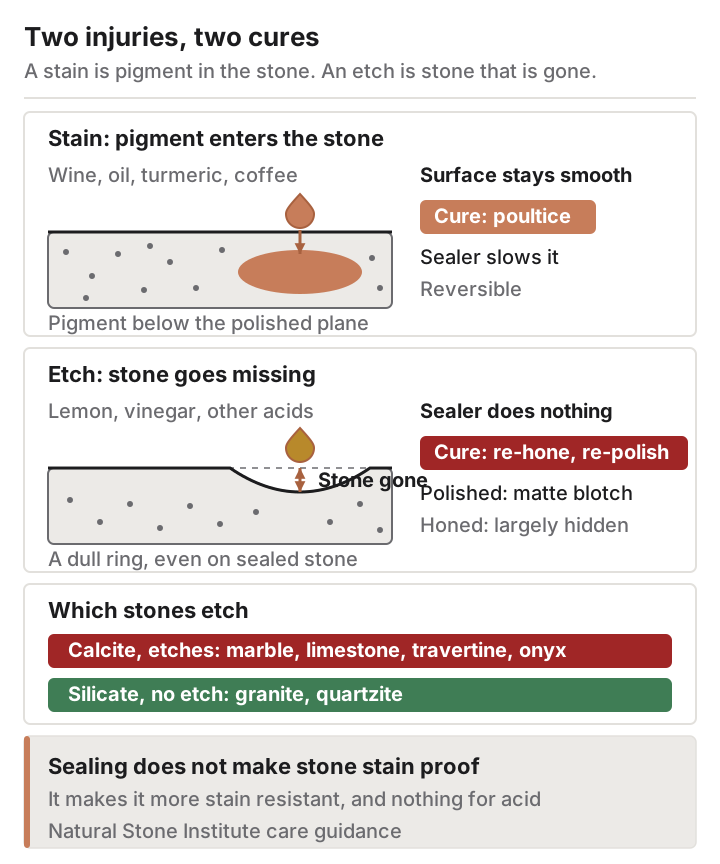
The practical consequence is a finish decision. On polished marble an etch reads as a matte blotch against gloss, and correcting it means re-honing and re-polishing. On honed marble there is no gloss for the etch to interrupt, so the same damage largely disappears. That is the argument for honed calcite stone.
Where Each Countertop Surface Gives Up First
Engineered Quartz: The Binder Quits Before the Stone Does
Engineered quartz is crushed stone held in a polymer resin. The stone is hard; the resin is not heat tolerant. Caesarstone states that “the resin can only withstand approximately 150 degrees” Fahrenheit, which is why the brand calls its surfaces heat resistant rather than heat proof. A sheet pan straight from the oven leaves a brown or yellow scorch, a specialist repair at best.
Scratching is rare, staining rarer, and there is no sealing step at any point in the surface’s life. Caesarstone 5031 Statuario Maximus is typical: a polished dove-white base with broad light-gray veining, sold in 20 mm and 30 mm, jumbo slab 128 by 64.5 inches, about 58 square feet of raw material.
Granite: Silicate Hardness, Usually With No Sealer Required
Granite takes direct heat, resists knives and does not etch. Its exposure is staining, and that is overstated for dense stones. The Natural Stone Institute is blunt: “Most granite countertops do not need to be sealed.”
Test yours instead of guessing. Leave a small puddle of water on an inconspicuous spot and watch whether the stone darkens. Darkening means liquid is entering and a sealer has something to do; no darkening means the sealer is decorative spending.
Marble and Limestone: Etch First, Stain Second
Softer than granite, so knives leave marks. Calcite, so acid leaves dull spots, and porous enough that oil migrates in if left sitting. Marble accumulates visible wear faster than anything else on this list, which some owners read as patina and others as ruin.
Soapstone: Scratches Easily, Ignores Acid Entirely
Soapstone is talc rich and chemically inert. Lemon juice, vinegar and wine do nothing to it, and it takes a hot pan without complaint. What it will not take is a dragged pot: the surface scratches and dings readily.
Damage sands out with fine abrasive and the color evens up with mineral oil. Oiling is cosmetic, not protective; skip it and the stone still works, just paler and patchier.
Solid Surface: Damage Sands Out, Seams Go Invisible
Acrylic solid surface is homogeneous through its thickness, which is the whole point: scratches, scorches and gouges sand flat and the sheet looks new again. Seams are chemically bonded and effectively disappear, so long runs and integrated sinks read as one piece.
Its weakness is heat. A hot pan melts and discolors it, and though the repair is straightforward it is one you will repeat if you cook hard. Corian Glacier White is the reference product, sold as half-inch sheet; a 30 by 144 inch sheet lists at $849 at one national distributor.
Laminate: The Core Fails Before the Sheet Does
High pressure laminate is nonporous and reasonably tough, but the countertop is not the laminate. It is particleboard or MDF with laminate glued on, and the core is what dies. Water finds a seam at the sink cutout, the core swells, and the surface lifts.
Heat separates the adhesive bond and blisters the sheet permanently. Scratches do not sand out; there is nothing to sand into. Formica 180fx 3460 Calacatta Marble shows how good the printing has become, offered in general purpose grade at 0.035 inch in SatinTouch, Etchings and Gloss finishes and in 5 by 12 foot sheets listed near $141 by one distributor. When laminate looks tired, replacement is the only answer.
Butcher Block: The Sink Edge Is Where It Dies
Wood tolerates knives and moderate warmth and sands back to new better than anything else here. Standing water ends it. The strip beside the sink and the run behind a faucet are where joints open and the surface goes black.
Oiled tops need re-oiling whenever the wood looks dry and pale. A film finish such as a water-based polyacrylic topcoat resists water far better but cannot be cut on.
Stainless Steel: The Scratches Become the Finish
Stainless takes any heat a home kitchen produces, does not stain, does not etch and never needs sealing. It also scratches from the first week, permanently, with no in-place repair short of a full refinish.
The scratches accumulate into an even satin patina that looks deliberate on a brushed or antique-matte finish and looks like damage on a mirror finish. Ask your fabricator for the gauge in writing. One stainless fabricator calls 16 gauge, 0.063 inch, a popular choice for home and commercial use and 18 gauge, 0.050 inch, the budget option for lighter duty.
Porcelain Slab: Tough in Service, Delicate in the Shop
Sintered porcelain is the most damage-proof surface here in daily use: unaffected by heat, extremely scratch resistant, nonporous, UV stable and never sealed. Neolith Calacatta Luxe CL01 is a current example, stocked as a 12 mm slab at 125 by 63 inches in an Ultra Soft finish; Cosentino’s Dekton competes in the same category.
The catch is fabrication. Thin slabs chip at cut edges, and the miter that makes 12 mm look like a thick stone top is precision work not every shop does well. Chips at a finished edge are not convincingly repairable, so pay for a fabricator with porcelain experience.
Concrete: You Are Buying the Sealer, Not the Concrete
Concrete’s performance is almost entirely a property of its sealer. A penetrating sealer preserves the raw look and leaves the surface open to acid and oil. A film-forming topical sealer blocks stains well, then scorches or scratches like the plastic it is.
Ask which sealer was used, what it tolerates and what the reapplication interval is, in writing, before installation. Hairline cracking in cast concrete is normal and cosmetic, not structural.
Seams, Edges, and the Cutouts That Need a Licensed Trade
Seam visibility tracks pattern, not material quality. Solid surface hides seams best, followed by uniform-color quartz and dark granite; heavily veined slabs show every joint unless the fabricator books the pattern across it.
Edge options narrow with thickness. Thick stone and quartz accept bullnose, ogee and mitered profiles; 12 mm porcelain offers a squared edge or a miter; laminate is limited to postformed and applied edges.
Cutouts are where trades meet, and this is the part not to improvise. An undermount sink means supply and drain work; a cooktop or range cutout means an electrical circuit, and in a gas kitchen a gas connection as well. Book the licensed plumber, the licensed electrician and, where gas is involved, the licensed gas fitter before the fabricator templates anything, because an inspector will not pass connections made by anyone else. Heavy stone on an island raises a separate question: a loaded slab can push cabinets and floor framing past what they were built to carry, and that one goes to a structural engineer or your building official, not to the countertop shop. Every requirement here shifts at the county line, so read any figure from this page or from a supplier as a starting point and check it against the adopted code before ordering.
Installed Price per Square Foot in 2026
Ranges below come from a published 2026 installed pricing table by material, except stainless, which one fabricator prices at $80 to $225 per square foot installed. The granite and marble rows cover level 1 to 2 granite and Carrara marble; that same table runs exotic granite to $250 and Calacatta marble to $350.
| Surface | Direct heat | Scratching | Stain and etch | Sealing | In-place repair | Installed, 2026 |
|---|---|---|---|---|---|---|
| Engineered quartz | Poor, scorches | Very good | No etch | Never | Poor | $50 to $200 |
| Granite | Very good | Very good | Stains, no etch | Usually none | Fair | $40 to $130 |
| Marble | Good | Fair | Stains and etches | Slows stains | Fair, re-hone | $65 to $160 |
| Soapstone | Very good | Poor | Inert | Oil, cosmetic | Good, sand | $70 to $180 |
| Solid surface | Poor, melts | Fair | No etch | None | Excellent | $40 to $110 |
| Laminate | Poor, blisters | Poor, permanent | Core swells | None | None | $25 to $65 |
| Butcher block | Fair | Poor, sands out | Absorbs water | Oil or film | Excellent | $35 to $120 |
| Stainless steel | Excellent | Scratches early | Inert | None | Poor, refinish | $80 to $225 |
| Porcelain slab | Excellent | Excellent | Inert | None | None | $55 to $140 |
| Concrete | Sealer dependent | Sealer dependent | Sealer dependent | Yes, by sealer | Fair | $65 to $185 |
A Worked Estimate for a 64-Square-Foot Kitchen
Measure before you shortlist. Take a common layout: a 12-foot run and an 8-foot run, both 25 inches deep, plus an island top of 84 by 39 inches.
- Convert depth to feet: 25 inches divided by 12 equals 2.08 feet.
- Long run: 12 times 2.08 equals 25.0 square feet.
- Short run: 8 times 2.08 equals 16.7 square feet.
- Island: 7 feet times 3.25 feet equals 22.8 square feet.
- Total: 64.5 square feet, call it 64.
At the bottom of the laminate range, $25 per square foot, that kitchen is about $1,600. At the top of the stainless range, $225, it is about $14,400. The same room, a nine-fold difference.
Slab materials are bought whole, and a 58-square-foot jumbo slab will not yield 64 square feet of finished top once cutouts, edge buildup and vein matching take their share. Budget two slabs, roughly 116 square feet of purchased material, and ask the fabricator to confirm yield from your drawing.
A Decision Procedure Built on How Your Kitchen Actually Runs
Answer four questions about the last month of cooking, not about the kitchen you intend to have.
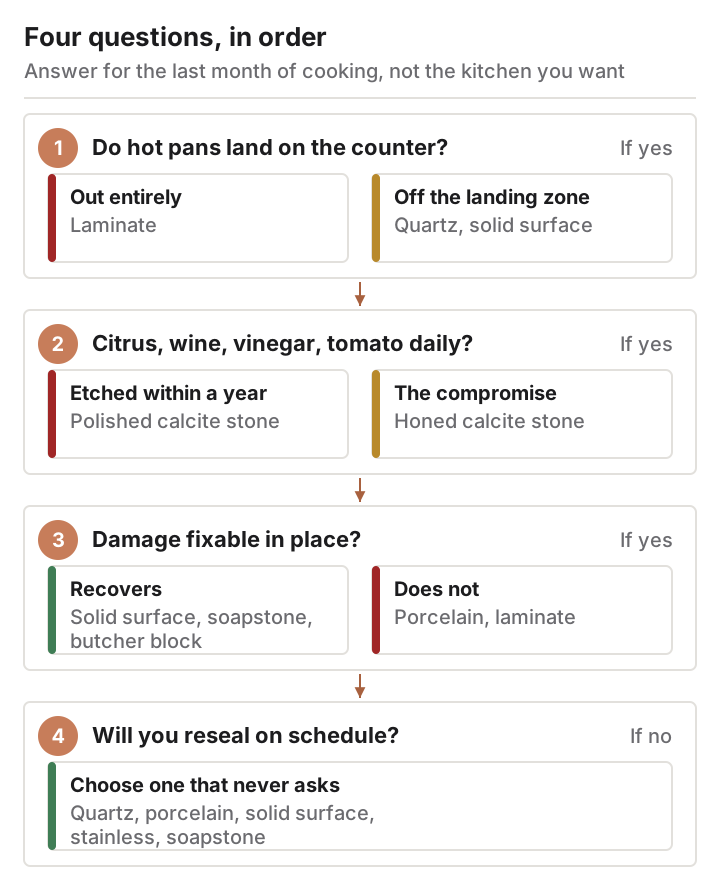
First, do hot pans land directly on the counter? If yes, quartz and solid surface are out of the landing zone and laminate is out entirely. Second, is there citrus, wine, vinegar or tomato in daily play? If yes, polished calcite stone will look etched within a year, and honed is the compromise.
Third, do you want damage fixable in place? Solid surface, butcher block and soapstone recover; porcelain and laminate do not. Fourth, will you reseal on schedule? If the honest answer is no, choose a surface that never asks: quartz, porcelain, solid surface, stainless or soapstone.
The Failure Mode Your Kitchen Will Keep Producing
None of these surfaces is best. Each carries one failure mode it cannot escape, and the only question worth answering is whether that failure is the one your kitchen will keep producing.