Reading a Tile Spec Sheet Before You Buy Tile
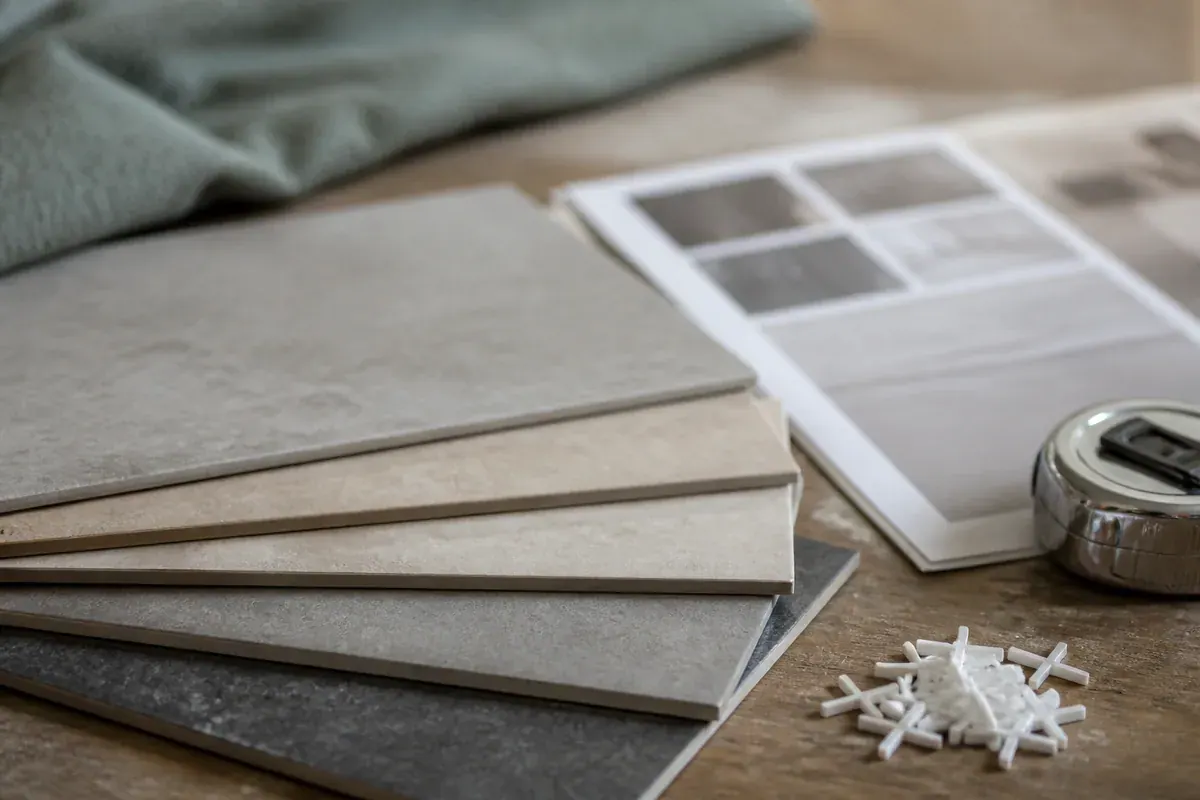
Every tile sold through a North American showroom has a specification sheet behind it, usually a one page PDF linked from the listing or a card in the sample rack. Most buyers never open it. The display board answers color, size and finish. The sheet answers everything else.
On that page sit water absorption, an abrasion class, a slip resistance figure, a breaking strength, a frost declaration, an edge description, a shade variation grade and a recommended grout joint. Some are laboratory results; others are the manufacturer stating what the tile is for. A tile can be right on the board and wrong for the room in three of them at once.
The Absorption Number That Sorts Porcelain From Ceramic
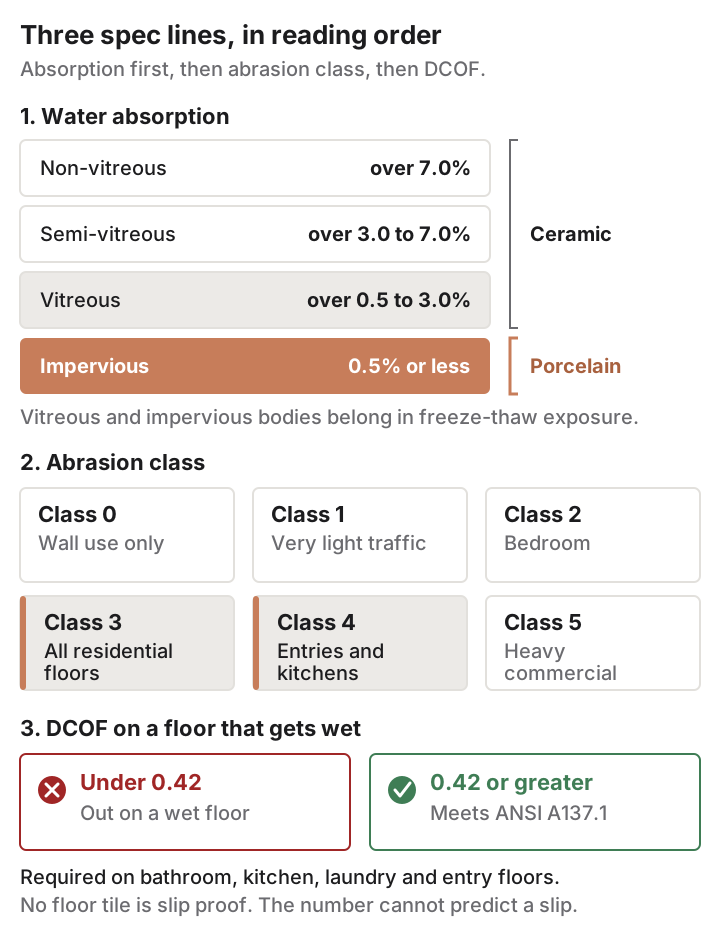
Find water absorption first, because it decides what the tile can legitimately be called. Tiles fall into four absorption bands: non-vitreous above 7.0 percent, semi-vitreous above 3.0 and up to 7.0 percent, vitreous above 0.5 and up to 3.0 percent, and impervious at 0.5 percent or less. The Tile Council of North America defines porcelain as an impervious tile at 0.5 percent or less by the ASTM C373 test method. Anything above that figure is ceramic, whatever the display sign implies.
That figure carries more weight than any other line on the page. Impervious and vitreous bodies belong in freeze-thaw exposure; non-vitreous tile outdoors in a cold climate spalls, and nothing else on the sheet compensates.
Ceramic is not a failure grade. A 4 percent absorption wall tile performs well on a dry interior wall and costs less. The error is buying it for a floor because the word porcelain appeared in the listing.
Three Durability Lines: Abrasion, DCOF, and Breaking Strength
Abrasion Class 0 to 5
The abrasion class, still printed on most sheets as a PEI rating, describes how long the glaze holds before wear shows. The scale runs 0 through 5: 0 is wall use only, 1 is very light traffic, 2 is light traffic on residential walls and floors walked with bare feet or soft footwear, 3 is light to moderate traffic covering all residential walls and floors, 4 is moderate to heavy traffic covering all residential plus light to medium commercial, and 5 is heavy to extra heavy traffic for heavy commercial or institutional floors.
Read the scale as a floor, not a target. Class 3 already covers every residential floor. Class 4 adds the light to medium commercial band, which is why it gets specified at entries and kitchens, where wear concentrates into narrow walking paths. Class 5 in a guest bathroom buys an institutional margin no household will consume. Unglazed tile carries no class at all, because its wear surface runs through the body.
DCOF and the Wet-Floor Threshold
DCOF stands for dynamic coefficient of friction, measured wet with a tribometer. Daltile’s explanation of the test states that ANSI A137.1 requires a DCOF of 0.42 or greater for tile recommended for a level interior space intended to be walked upon when wet. Look for that number on any bathroom, kitchen, laundry or entry floor.
The same page is candid about what the figure does not do. It states that no floor tile is slip proof, and that the measurement should not be treated as an indicator of whether a slip can occur. Footwear, contaminants, drainage and maintenance all sit outside the test.
Treat 0.42 as a product standard, not a code number. Slip resistance in spaces open to the public is governed by local building code and accessibility rules that may set their own figures, and those override anything a manufacturer prints.
Breaking Strength and What Sits Under the Tile
Breaking strength is a load figure in pounds-force taken from a bend test. Under ANSI A137.1, porcelain tile carries a 275 lbf minimum, while the minimum average for pressed floor tile that is not porcelain is 250 lbf. The test method is ASTM C648, which loads a single unsupported tile until it fails.
Do not read a high number as insurance. Breaking strength describes the tile unsupported, the opposite of how a tile lives once it is set. A tile bonded over a springy floor cracks because the floor moves under it. Deflection, joist span and subfloor buildup are structural questions the spec sheet never touches. A floor that feels lively underfoot has to be stiffened first, and the number saying how much stiffening it needs comes from a structural engineer or a licensed contractor, never from a tile catalog.
Frost Resistance Is a Pass or a Blank
Frost resistance is not a scale. The sheet either declares the tile frost resistant or says nothing, and silence is an answer. Manufacturers making the claim have run freeze-thaw cycling on the body, and the result tracks the absorption band. The line matters where the installation sees freezing temperatures: an unheated garage, a covered porch, an exterior stair tread.
Edges: Rectified, Cushioned, and the Joint Each Forces
Pressed tile leaves the kiln slightly out of square and out of size, because clay does not shrink evenly as it fires. A cushioned or calibrated tile keeps its as-pressed edge, with a small radius where the face meets the side. A rectified tile has been ground square after firing, which is why those lines cost more and why their edges feel sharp.
Edge type is not a taste question, because it sets the minimum grout joint. The Ceramic Tile Education Foundation’s reading of the installation standards puts those minimums at an average of 1/8 inch for rectified tile and an average of 3/16 inch for calibrated tile, on any tile with a side longer than 15 inches. A broader rule sits under both: the joint should be at least three times the actual variation in facial dimensions, so a tile varying 1/16 inch across the batch calls for a 3/16 inch joint. In no case should a joint drop below 1/16 inch.
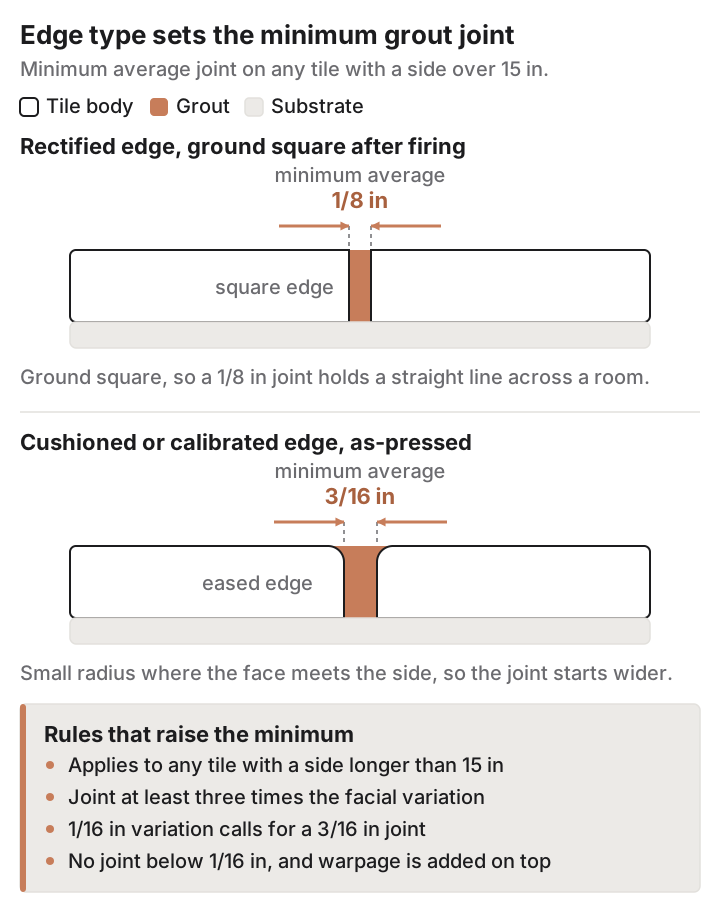
Rectified does not put a hairline joint within reach. It means the tile is consistent enough that a 1/8 inch joint holds a straight line across a room. Warpage along the long edge is added on top of that minimum, which is why large planks often need more than 1/8 inch.
Shade Variation, Caliber, and the Lot Number on the Carton
Sheets grade appearance on a four step scale from V1 to V4, and the number climbs as pieces differ more from one another. Marazzi’s Montagna Rustic Bay 6 by 24 is listed at V2, the Donatello 24 by 48 3D rectified porcelain at V3. At V1, pieces from one run are close to interchangeable; at V4, the carton is the sample. The higher the number, the more tile has to be dry laid first and the more cartons opened at once, because a V4 floor laid box by box bands visibly.
Cartons also carry a lot or batch number, and many lines add a caliber code. Caliber is the tile’s actual fired dimension inside the allowed tolerance, so a nominal 12 by 24 can measure slightly differently from one caliber to the next. Mixing calibers shows up as uneven grout joints. Check those codes on the pallet before the installer opens it.
Three Real Spec Sheets Compared
| Spec line | Montagna Rustic Bay 6 x 24 | Forge 24 x 48 | Donatello 3D 24 x 48 |
|---|---|---|---|
| Seller | Home Depot | Avalon Flooring | Avalon Flooring |
| Body | Glazed porcelain, under 0.5% | Porcelain | Porcelain |
| Edge | Calibrated | Rectified | Rectified |
| Joint on the listing | 3/16 in. recommended | Not stated | Not stated |
| Abrasion class | 4 | 4 | 4 |
| DCOF | 0.42 or greater | Listed as “passes” | Listed as “varies” |
| Shade variation | V2 | V2 | V3 |
| Frost resistance | Yes | Not published | Not published |
| Thickness | 9 mm | Not published | Not published |
| Coverage per box | 14.53 sq ft | 15.5 sq ft | Not published |
| Listed price per sq ft | About $1.79 | $2.99 list, $1.25 clearance | $5.99 |
Prices move, so read that last row as a spread. The line that matters is DCOF, and two of the three listings never give a number. Passes and varies are not test results. The Donatello line ships honed, matte and polished, which is why its listing says varies. Ask for the tested value on the color you intend to buy.
A Seven-Step Pass Through a Spec Sheet
- Read the absorption line and name the band. For a shower, a patio, or anywhere that freezes, the tile must be impervious or vitreous. Nothing else matters until that clears.
- Match the abrasion class to the room rather than to the price. Class 2 for a bedroom, class 3 for general residential floors, class 4 for entries and kitchens.
- Look for a DCOF figure, not a word. If the listing offers a word, request the tested value for your color and finish.
- Check frost resistance where the installation sees freezing temperatures. If it does and the line is blank, stop there.
- Note the breaking strength, then look under the floor. Find out what the subfloor is and how far the joists span before treating 275 lbf as sufficient.
- Read the edge line and write down the grout joint it forces. That number changes how many full tiles reach a wall.
- Read the V rating, then check delivered cartons for matching lot, caliber and shade codes the day they arrive.
Some of what a spec sheet touches is not a shopping decision. A questionable joist span, or tile hung on a load-bearing wall, wants a structural engineer’s sign-off before anyone buys tile for it. A shower pan’s slope, its drain placement and its waterproofing are plumbing work in nearly every jurisdiction, inspected before the tile hides them. Electric floor heat is wired by a licensed electrician onto a circuit with the ground-fault protection the electrical code demands. Every figure on this page comes from a product standard or a seller’s listing, and where those and the adopted building code disagree, the code is what you build to.
Overage Math for a 120-Square-Foot Bathroom Floor
Overage is a judgment call rather than a specification, so work it in real numbers.
Take a bathroom floor measuring 11 feet by 12 feet, which is 132 square feet. Subtract the footprint of a 30 inch by 60 inch tub, which is 2.5 feet by 5 feet, or 12.5 square feet. That leaves 119.5 square feet. Round it to 120.
Now add overage. Fifteen percent suits a straight lay in a rectangular room, since cuts fall along all four walls and a few pieces break at the wet saw. Fifteen percent of 120 is 18, so the order becomes 138 square feet. Patterns that cut every piece twice push that figure higher.
Convert to cartons last, because tile is sold by the box. Montagna Rustic Bay ships 15 pieces per case covering 14.53 square feet, so 138 divided by 14.53 gives 9.5 cases, rounded up to 10. That is 145.3 square feet, and at $26.00 per case it comes to $260.00 for the field tile. The 7 extra square feet become attic stock for replacing a cracked tile from the correct lot.
Box size changes the answer. At 15.5 square feet per box, that same 138 square foot order needs 8.9 boxes, rounded to 9, or 139.5 square feet, which leaves almost nothing spare.
Reading Order, and the One Rating That Disqualifies a Tile
The sequence matters more than the reading speed. Absorption first, because it decides whether the tile is a candidate at all. DCOF second on any floor that gets wet. Everything after those two is ordered by the room.
Only one line disqualifies a tile outright, and which line it is depends on that room. On a bathroom, kitchen, laundry or entry floor it is DCOF: under 0.42 the tile is out, however well the rest of the sheet reads. On an exterior surface in a freezing climate it is absorption above 3.0 percent, which no sealer will rescue. Everything else is a trade made with the numbers in view: a V4 tile is harder to lay convincingly, not unbuyable, and a class 3 glaze in a low traffic bedroom is fine. The disqualifying lines are few, and they are worth finding before the sample leaves the store.