What a Living Room Refresh Really Costs, Line by Line
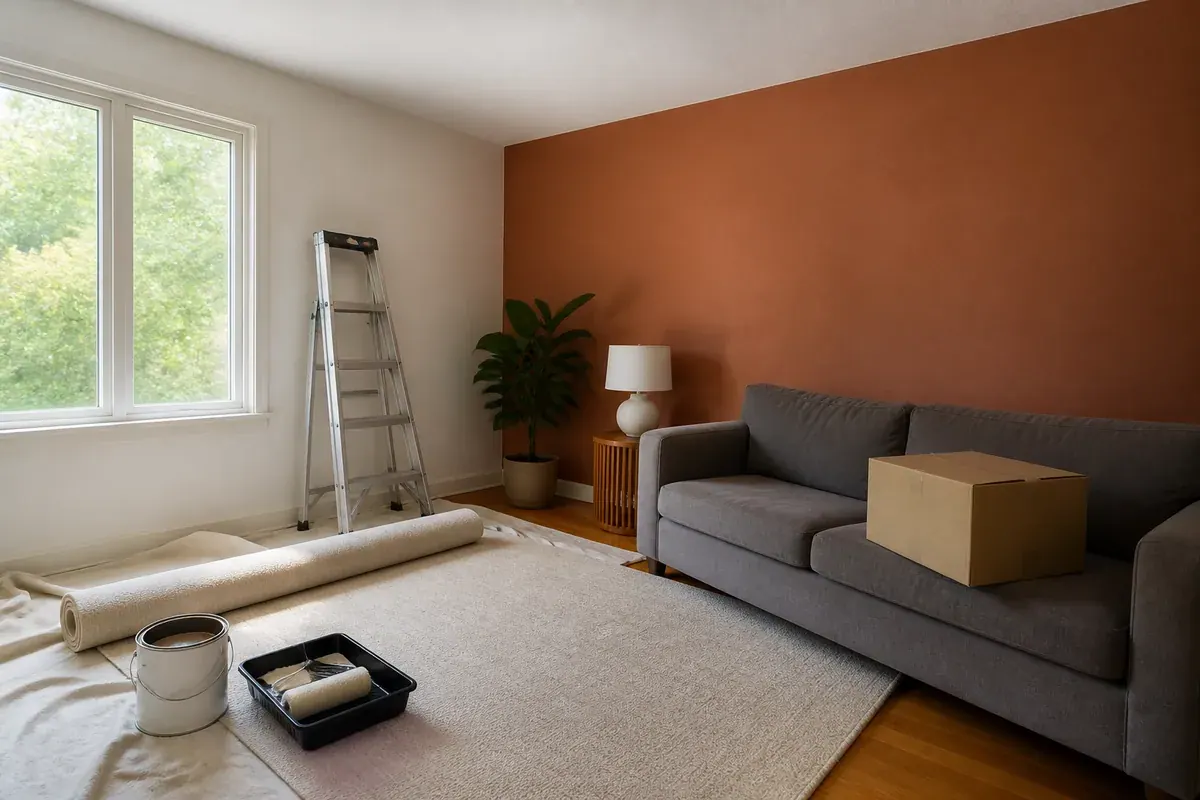
A 14-by-18-foot living room can be refreshed for about $1,900. The same room, with the same two windows and the same eight-foot ceiling, can also come to $15,000. Nothing structural changes between those two figures.
Three lines produce most of the gap. Seating runs from a $60 ready-made slipcover to a $4,500 sofa on a kiln-dried frame. The rug runs from a $150 machine-woven polypropylene to hand-knotted wool past $4,000. Labor is the third: it is $0 on a Saturday with a roller, and it becomes a four-figure line the moment a painter, an electrician and a drapery installer are booked.
Everything else moves inside a narrower band. Lamps, tables, art and plants vary by a factor of three or four, not twenty. Knowing which lines are elastic is most of the budgeting work.
The Paint Line: Gallons, Grade, and the Supplies Column
Start with wall area, because it sets the gallon count. A 14-by-18 room has a 64-foot perimeter; at an eight-foot ceiling that is 512 square feet. Subtract a door at roughly 21 square feet and two windows at roughly 15 square feet each, and you are covering about 461 square feet. Two coats means buying 922 square feet of coverage.
Read the spread rate printed on the can rather than assuming one. At a stated 400 square feet per gallon, 922 square feet works out to 2.3 gallons, so three cans. At 300 square feet per gallon it is 3.1 gallons, and a fourth can goes in the cart.
Grade is the next variable. Benjamin Moore’s Regal Select line is sold in five finishes, flat, matte, eggshell, satin/pearl and semi-gloss (Benjamin Moore), and takes any color in the range, including Classic Gray OC-23 and Stonington Gray HC-170 (Benjamin Moore). Independent dealers typically ask $75 to $95 a gallon for it in 2026, against $30 to $45 for contractor-grade wall paint. Three gallons is therefore a $90 to $135 line at contractor grade, or $225 to $285 in Regal Select.
Supplies are the column budgets skip. A first-time kit of a nine-inch roller frame and three covers, a 2.5-inch angled sash brush, two canvas drop cloths, tape, spackle, caulk with a gun and tray liners runs $70 to $130. Own the tools already and it drops to $25 to $40 in consumables.
Hiring reshapes the line completely. Homewyse put the basic cost to paint a living room at $4.22 to $8.19 per square foot as of May 2026 (Homewyse), which against a 252-square-foot floor plan works out to roughly $1,060 to $2,060.
The Rug Line and the $300 Gap Between Two 8-by-10s
Compare rugs by price per square foot and the tiers separate cleanly. An 8-by-10 covers 80 square feet, so machine-woven polypropylene at $1.50 to $3.50 per square foot lands at $120 to $280. Hand-knotted wool runs $25 to $55 per square foot, which is where four-figure totals originate.
The middle band is where most refreshes land. IKEA’s STOCKHOLM flatwoven rug in checkered brown measures 8’2” by 11’6”, carries a 100 percent wool surface over a cotton warp at a quarter-inch thickness, and sells for $599.99 (IKEA). Across roughly 94 square feet that is about $6.40 per square foot; applied to an 8-by-10 it comes to $512, roughly $300 above the same size in polypropylene.
Add the pad. A felt-and-rubber pad sized for an 8-by-10 runs $50 to $120, and it is the most frequently omitted item on a refresh sheet.
Window Panels, Rods, and the Multiplier Most Budgets Miss
Panels are sold singly; budgets get written per window. Two windows means four panels, and that doubling is where estimates quietly break. Ready-made polyester panels run $15 to $30 each, linen-cotton blends $70 to $130 each, and made-to-measure work starts near $180 per panel before lining.
Hardware multiplies a second time. A plain rod is $20 to $40, while a rod with rings, finials and a return runs $60 to $140, and you need one set per window. Installation adds $75 to $150 per window when brackets go into plaster or the drop is unusually long.
Lighting: Fixture Count, Bulbs, and the Electrician Line
Plug-in versus hardwired is the fork that decides this line. Floor lamps run $60 to $300, table lamps $40 to $250 each, and LED bulbs $3 to $12 apiece. None of that involves a trade or a permit.
Dimming is where the first upgrade dollar goes furthest at the mid tier. Lutron’s Diva Smart Dimmer Switch Kit for Caséta ships with one hardwired dimmer, a smart hub, a remote, a wall bracket and a wallplate (Caséta by Lutron); the kit is listed at $124.95 across major retailers. Adding a ceiling box where none exists is the expensive move: $150 to $450 per fixture in electrician time, more when the ceiling below is finished.
Seating: Slipcover, Reupholstery, or Replacement
Three routes, three cost profiles. A generic ready-made slipcover is $60 to $180 and reads as exactly that. A model-specific replacement cover is the stronger middle option: IKEA’s UPPLAND sofa cover in Hillared beige is $219, machine washable, and woven from 55 percent cotton, 25 percent recycled polyester, 12 percent viscose and 8 percent linen (IKEA).
Replacement starts near $900. The UPPLAND three-seat sofa is $899 and measures 88 1/4 inches wide by 36 1/4 inches deep (IKEA), a width most 14-foot walls absorb without pinching the walking path. Above that, $2,500 to $4,500 buys a kiln-dried hardwood frame and denser foam.
Reupholstery pays only when the frame deserves it. A three-seat sofa takes 14 to 18 yards of fabric, standard upholstery fabric runs $50 to $70 a yard and labor $40 to $100 an hour, which puts a whole couch at $600 to $4,000 (HomeAdvisor). Get the yardage in writing before comparing bids, because fabric can outrun labor.
Tables, Art, and Plants: The Small Lines That Compound
Tables are quietly the third-largest spend at every tier. A coffee table is $80 to $200 at the budget end, $250 to $600 in the middle, and $900 to $2,500 in solid wood or stone. Side tables double whatever you pick: two at $150 to $350 each is a $700 line before a single lamp sits on one.
Framing catches people out. A printed poster is $15 to $40 and a ready-made frame is $20 to $45, but custom framing a 24-by-36 piece with standard glazing runs $200 to $450, and UV or museum glazing adds $75 to $200 per piece. Framing outrunning the art inside it is the normal outcome.
Plants carry a replacement cost rather than a purchase cost. A six-foot floor plant is $90 to $180 and a ceramic planter at matching scale is $60 to $140. The line worth checking first is species against the light a room genuinely receives, since a plant replaced yearly turns a one-time line into a recurring one.
The Same 14-by-18 Room at Three Budgets
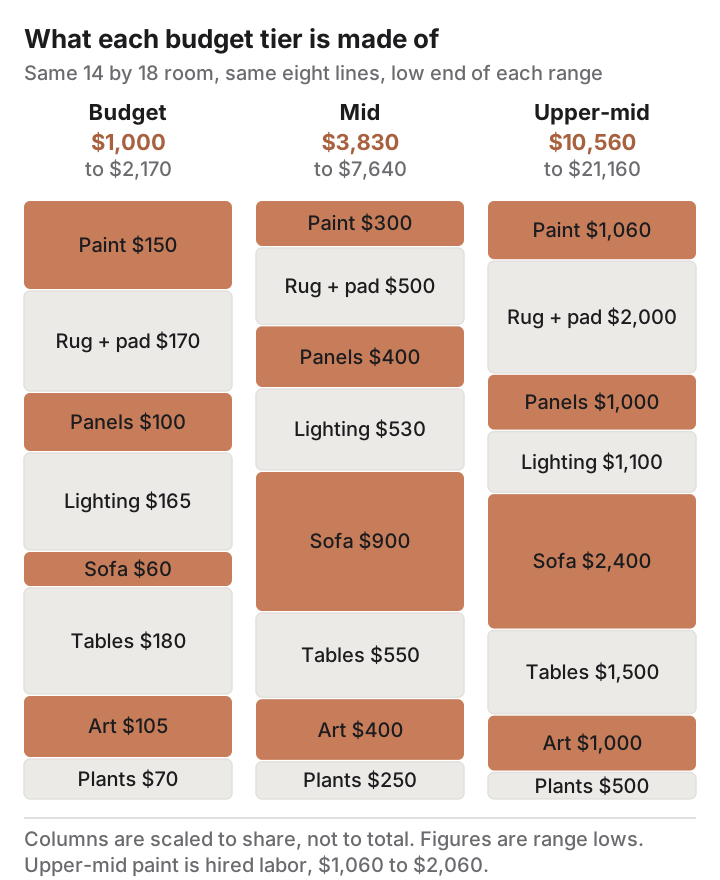
| Line item | Budget | Mid | Upper-mid |
|---|---|---|---|
| Paint, primer and supplies | $150 to $200 | $300 to $400 | $1,060 to $2,060 (hired) |
| Rug plus pad | $170 to $400 | $500 to $820 | $2,000 to $4,000 |
| Window panels and rods | $100 to $200 | $400 to $760 | $1,000 to $2,000 |
| Lighting, bulbs, dimming | $165 to $305 | $530 to $1,010 | $1,100 to $2,200 |
| Sofa or slipcover | $60 to $220 | $900 to $1,800 | $2,400 to $4,500 |
| Coffee table and two side tables | $180 to $440 | $550 to $1,300 | $1,500 to $3,000 |
| Art and framing | $105 to $255 | $400 to $1,100 | $1,000 to $2,400 |
| Plants and planters | $70 to $150 | $250 to $450 | $500 to $1,000 |
| Total | $1,000 to $2,170 | $3,830 to $7,640 | $10,560 to $21,160 |
Totals assume one rug, two windows, three light sources, one sofa, three tables, three framed pieces and two plants. At the midpoint of each tier, the sofa, the rug and hired paint labor alone account for a little over half the distance between the budget and upper-mid columns.
Cost Per Year of Use, Line by Line
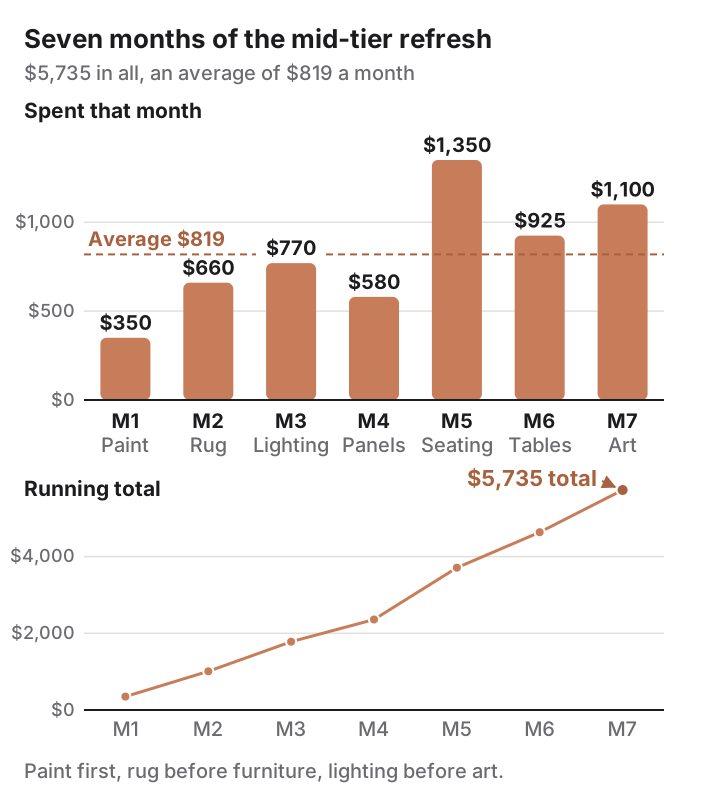
Divide each line by the years you will realistically keep it and the ranking rearranges. A $600 wool flatweave held ten years costs $60 a year. An $899 sofa held eight years costs $112 a year. A $125 dimmer kit wired in for a decade costs $12.50 a year and alters every evening spent in the room.
Poor ratios cluster in three places. Custom framing on inexpensive prints usually outlives your interest in the print, so $650 of framing across three years reads as $217 a year. Made-to-measure drapery in a rental is worse, since panel dimensions rarely carry to the next apartment: $1,600 across a two-year lease is $800 a year. A large plant bought for light the room cannot supply is a $150 annual line.
Paint sits oddly on this scale. Materials are the small half of the bill and labor is the large half, so the per-year figure swings on how long you leave the color rather than on what you paid per gallon.
A Seven-Month Sequence for the Refresh
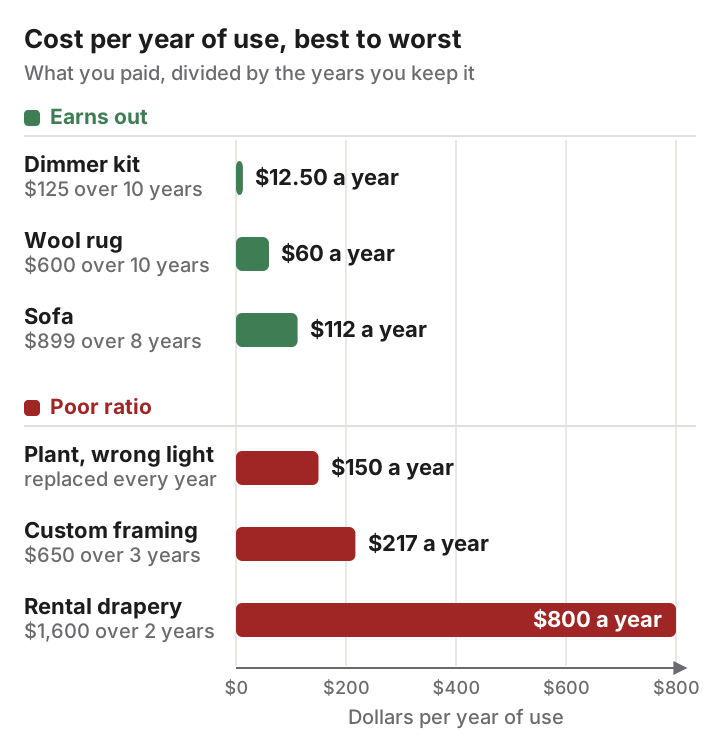
Buying in order costs the same as buying at once, but each purchase informs the next. Paint first, because drips land on things you have not bought yet. Rug before furniture, because the rug sets the color the sofa has to sit against. Lighting before art, because you cannot judge a frame under the wrong bulb.
- Month 1, paint and prep. Patch, caulk and paint. Mid-tier materials: $350.
- Month 2, rug and pad. Buy the pad in the same order. Mid-tier: $660.
- Month 3, lighting. Three sources plus a dimmer kit. Mid-tier: $770.
- Month 4, window panels and rods. Four panels, two rod sets. Mid-tier: $580.
- Month 5, seating. Slipcover now at $60 to $219, or bank the month toward a sofa. Mid-tier: $1,350.
- Month 6, tables. Coffee table plus two side tables. Mid-tier: $925.
- Month 7, art, framing and plants. Mid-tier: $1,100.
Run at those figures and the mid-tier room totals $5,735 across seven months, an average of $819 a month. Splitting it this way also gives seating and the rug their own months instead of forcing them to compete in a single weekend.
Where the Sofa and Rug Money Earns Out, and Where the Framing Money Does Not
Two lines justify spending at the top of your band. Seating is one: frame construction and foam density separate an eight-year sofa from a three-year one, and the $899 tier and the $4,500 tier differ on exactly that. The rug is the other, since price per square foot tracks construction closely, and a wool flatweave near $6 a square foot survives traffic that flattens a $2 synthetic.
Dimming belongs in the same breath at a fraction of the cost: a hardwired dimmer kit near $125 is the cheapest line on the sheet that changes the room every night.
Three lines do not reward the top of the band. Custom framing is first: buy ready-made frames until you own art you expect to keep, because glazing upgrades attach to the frame, not the picture. Made-to-measure drapery is second, and close to indefensible on a lease, where ready-made panels and a $30 rod do the same visual work for a tenth of the cost. Coffee tables are third, since $600 to $2,500 buys material and provenance rather than function.
Paint belongs in its own category. The material is cheap enough that grade is worth paying for, and the labor is expensive enough that a weekend of your own time is the largest single saving in the breakdown.