Ceiling Fan Size and Downrod Length by Ceiling Height
Seven feet is the dimension that decides everything else. Energy Star’s guidance for residential ceiling fans is to install them “at least 7 feet above the floor”, with 8 to 9 feet preferred when the ceiling allows it. That figure sets the vertical budget your fan has to fit inside, and it is why a flush-mount fan and a fan on a 36-inch rod are not interchangeable purchases. Manufacturer instructions govern on top of it, and an inspector holds you to those.
What an Eight-Foot Ceiling Leaves You
Work the subtraction. An 8-foot ceiling is 96 inches; less 84 inches of clearance leaves 12 inches for canopy, motor housing, downrod, and the offset between motor and blade plane. A conventional fan with its shipped 3-inch to 5-inch rod consumes most of that.
A second limit pushes from the other direction. The Department of Energy’s Building America Solution Center advises that fan blades sit no closer than 6 inches from the ceiling, with 8 to 10 inches better for airflow, because a blade tight to the ceiling starves for intake air. Blades hung 8 inches down on a 96-inch ceiling land at 88 inches, or 7 feet 4 inches, which clears the minimum with 4 inches to spare and nothing left to tune.
Blade Span Against Room Square Footage
Blade span is the tip-to-tip diameter of the swept circle, not one blade’s length. Energy Star keys its recommendations to floor area.
| Room area | Recommended blade span |
|---|---|
| Up to 75 sq ft | 29 to 36 in |
| 76 to 144 sq ft | 36 to 42 in |
| 144 to 225 sq ft | 44 in |
| 225 to 400 sq ft | 50 to 54 in |
Square footage is only half the test. The same guidance calls for at least 18 inches between blade tips and any wall, which bites in narrow rooms. A 52-inch fan has a 26-inch radius, so its center must sit 44 inches from the nearest wall on every side. A room narrower than 88 inches, or 7 feet 4 inches, cannot take a centered 52-inch fan whatever its length.
Long rectangular rooms suit two smaller fans rather than one oversized one. Past roughly 20 feet of length, a pair of 44-inch fans on separate centers is the usual arrangement, since air movement falls off quickly outside the swept circle.
Downrod Length by Ceiling Height
Downrod length is arithmetic, not a lookup:
Blade height = ceiling height, minus motor offset, minus downrod length
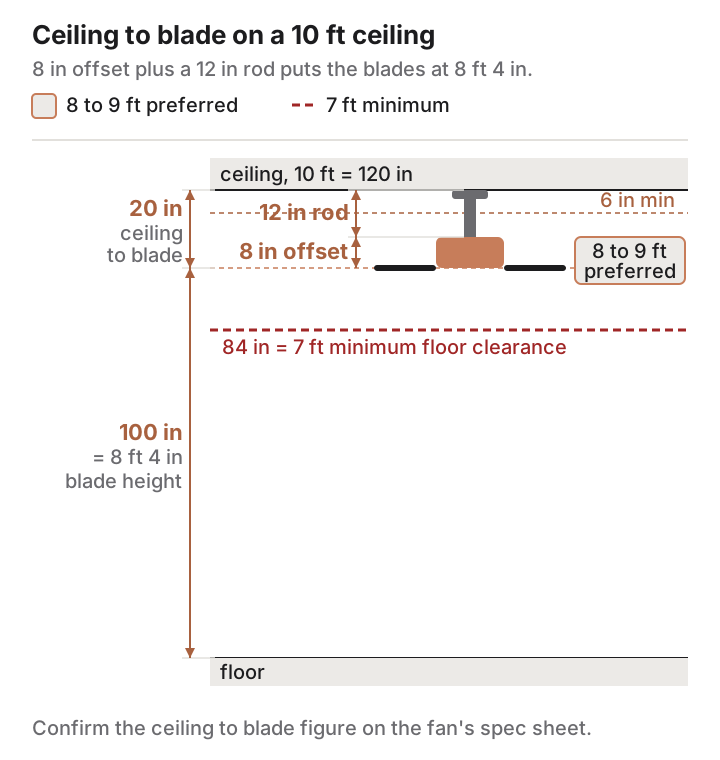
Motor offset is the distance from the ceiling mounting surface to the blade plane with no rod: canopy, motor housing, and the blade’s position on the motor. It is model-specific and belongs on the spec sheet, often labeled “ceiling to blade.” Roughly 8 inches is typical for a full-size fan with a light kit, and the table uses that figure.
| Ceiling height | Downrod | Resulting blade height |
|---|---|---|
| 8 ft | flush mount, no rod | about 7 ft 4 in |
| 9 ft | shipped 3 to 5 in rod | about 8 ft 0 in |
| 10 ft | 12 in | 8 ft 4 in |
| 11 ft | 24 in | 8 ft 4 in |
| 12 ft | 36 in | 8 ft 4 in |
| 14 ft | 60 in | 8 ft 4 in |
| 16 ft | 84 in | 8 ft 4 in |
| 20 ft | 120 in | 9 ft 4 in |
Take the 10-foot row. The ceiling is 120 inches, motor offset is 8 inches and the rod is 12 inches, so ceiling-to-blade is 20 inches and the blades finish at 100 inches, or 8 feet 4 inches. That sits inside the 8-to-9-foot band and leaves 20 inches of intake gap, well past the 6-inch minimum.
Notice that a 9-foot ceiling usually needs nothing extra. The rod in the box already lands the blades near 8 feet. Energy Star lists 6 inches as the 9-foot-ceiling rod size, which with an 8-inch offset puts the blades at 94 inches, or 7 feet 10 inches, still inside the preferred band. Stock rods run from that 6-inch size up to 120 inches for a 20-foot ceiling, which is exactly the last row above.
Sloped Ceilings and the Rise Under the Blade Tip
On a vaulted ceiling, measure ceiling height at the mounting point, not at the ridge and not at the wall. Then check something the flat-ceiling table never asks about: whether the blade tip on the low side of the slope clears the ceiling.
The geometry is one multiplication. Take a 52-inch fan, radius 26 inches, on a ceiling framed at a 6:12 pitch, dropping 6 inches of height for every 12 inches of horizontal run. At 26 inches out from the fan axis, the ceiling on the low side has fallen 13 inches below the mounting point. Add the 6-inch minimum clearance and the blade plane must sit at least 19 inches below where the canopy attaches.
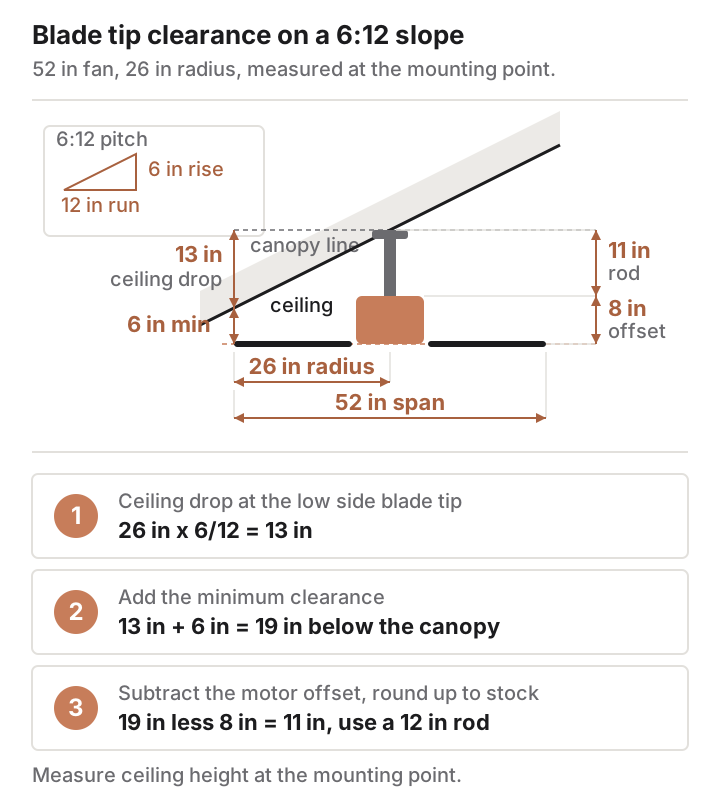
With an 8-inch motor offset, 19 inches of drop means a rod of at least 11 inches, so the 12-inch stock size is the practical minimum. In most vaulted rooms the blade height table decides the rod, not the slope: a ceiling starting at 12 feet needs 36 inches long before clearance matters. You will also need a sloped-ceiling canopy rated for your pitch. Many fans ship with one for moderate slopes; steeper framing takes a separate accessory from the fan’s own maker.
Flush Mounts, Huggers, and the Airflow They Give Up
Energy Star treats huggers as a separate product class with an easier target, which tells you what mounting tight to the ceiling costs. Under the Version 4.1 criteria, a standard fan between 36 and 78 inches must reach at least 2.63 times its diameter minus 26.83 CFM per watt. For 52 inches that is 109.9 CFM/W. A hugger of the same diameter only has to reach 1.75 times diameter minus 15, or 76.0 CFM/W, roughly a third lower.
Certified products show the same gap. In the Energy Star certified ceiling fan data set, the 52-inch Casablanca Vespucci, model 52846, which the data set lists under Hunter, is rated 366.7 CFM/W drawing 13.9 watts on high, and the 52-inch damp-rated Hunter Skyway, model 52598, 363.8 CFM/W drawing 16.3 watts. Compare 52-inch huggers in the same data set: the AFX BNKN523LDC at 139.7 CFM/W pulling 24.8 watts, and the Carro CES523PL-FM at 187.8 CFM/W pulling 23.8 watts. Same diameter, more watts on high, and 38 to 52 percent of the efficiency.
The cause is mounting geometry. Energy Star classes a fan as a hugger when the lowest point on the blades sits 10 inches or less from the ceiling, and the Building America guide is blunt about the cost: performance drops sharply as blade-to-ceiling clearance shrinks. On an 8-foot ceiling a hugger is still the right choice, and the penalty is the price of a legal installation. At 9 feet or more, choosing one for looks gives away airflow you already paid for in ceiling height.
Reading CFM, CFM per Watt, and Blade Pitch
Two numbers describe fan performance and they answer different questions. Airflow in cubic feet per minute is how much air moves; efficiency in CFM per watt is how much air you get per unit of electricity. The Building America guide defines efficiency as airflow divided by power at a given setting, and the Energy Star figure is weighted across low, medium, high and standby rather than read at one speed. That weighting is why the direct-current models above post certified figures in the 300s.
Minimum airflow comes from a formula worth running once. Energy Star requires a standard fan between 36 and 78 inches to move at least 250 times pi times the square of diameter divided by 24, on high. Put 52 inches in and you get 250 × 3.1416 × 4.694, or 3,687 CFM. An uncertified fan may publish no comparable figure at all.
Blade pitch is the blade angle in degrees, and the Building America guide notes that higher pitches usually move more air. Treat it as an input, not a verdict. A steeply pitched blade on a weak motor slows under its own load, and published CFM and CFM/W figures already contain whatever pitch contributes.
The Electrical Box a Fan Hangs From
A ceiling fan cannot hang from a standard lighting outlet box. Under NEC 314.27(C) in the 2023 edition, a box used as the sole support of a ceiling-suspended paddle fan must be listed and marked by the manufacturer for that purpose, and it cannot support a fan heavier than 70 pounds. Boxes rated above 35 pounds must be marked with the maximum weight they carry. A fan over 70 pounds must be supported independently of the box.
States and municipalities adopt and amend that code separately, so the figures above are a national baseline rather than the last word in your town. If the existing box carries no fan-support marking, the remedy is an electrical one: a licensed electrician swaps the box, sets a fan-rated brace between the joists, or runs a switch leg for separate fan and light control, and takes out a permit where the local rules call for one so an inspector can sign the work off. Replacing a fan on an existing marked fan box is a different job from putting a fan where a flush light used to be.
A Nine-Step Fan and Downrod Sizing Sequence
- Measure floor to ceiling in inches directly under the intended fan location. On a sloped ceiling, measure at the mounting point.
- Multiply room length by width for square footage, then read a candidate blade span off the table above.
- Measure from the intended fan center to the nearest wall. That distance must be at least half the blade span plus 18 inches, or you drop to the next smaller span.
- Pick a target blade height: 8 feet 0 inches to 8 feet 6 inches wherever ceiling height permits, about 7 feet 4 inches only on an 8-foot ceiling.
- Find the ceiling-to-blade or motor offset dimension on that specific model’s spec sheet. Do not assume 8 inches; confirm it.
- Subtract ceiling height minus motor offset minus target blade height for the required rod. Round to the nearest stock length, taking the longer one only while blade height stays above 84 inches.
- On a slope, multiply half the blade span by the slope ratio, add 6 inches, and check that offset plus rod exceeds it. Order the canopy rated for that pitch.
- Inspect the box for a listing mark stating fan support and a weight rating above your fan’s shipping weight. If it is absent, budget for a fan-rated box or brace and an electrician.
- Compare finalists on published CFM and weighted CFM per watt at the same diameter, not on blade count or pitch.
The Ceiling-to-Blade Number to Confirm Before Checkout
The measurement that decides whether a fan fits is not blade span. It is ceiling-to-blade distance in the configuration you plan to hang, meaning motor offset plus rod, and it appears on the spec sheet of every fan worth buying. Take your ceiling height in inches, subtract that figure, and you have blade height before anything ships. If the answer is under 84 inches, the fan is wrong for the room whatever its airflow numbers say.
Low ceilings force a compromise no rod length recovers. At 8 feet you are choosing a hugger at 38 to 52 percent of the efficiency of a standard fan of the same diameter, hung closer to the ceiling than the airflow guidance recommends, because the alternative is blades in the path of anyone tall enough to reach them. That is a defensible trade, not a free one.