What Holds a Sofa Up, and Why It Fails
A collapsed sofa seat is almost never one broken part. It is a load path that has lost a member. Your weight enters at the cushion, spreads across the suspension deck, runs into the front and side rails, and leaves through the legs into the floor. Every handoff has to hold, and the seat feels normal until one of them stops.
Three different failures produce nearly the same complaint. Foam that has taken a compression set, a suspension that has stretched, and a frame joint that has opened all read as a seat gone soft. They sit behind three different price decisions, which is why the comparison starts underneath the upholstery.
The Load Path from Cushion to Leg
Read a sofa as four structural jobs stacked on each other. The cushion spreads a point load into a broad one. The suspension turns that broad load into tension or spring force between two rails. The rails carry it to the corners, and the corners and legs push it into the floor.
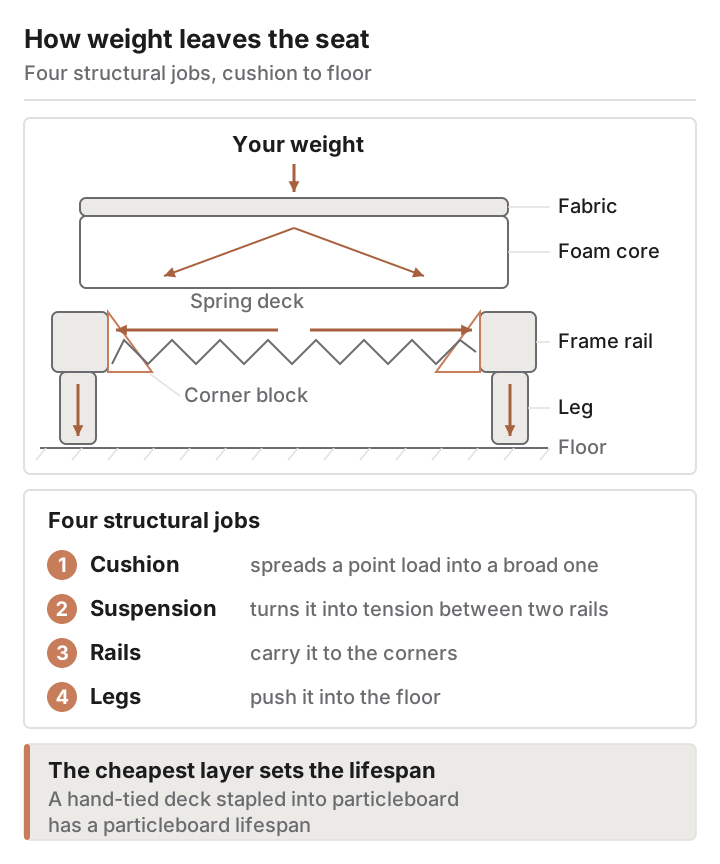
The cheapest layer sets the lifespan. A hand-tied spring deck stapled into a particleboard rail has a particleboard lifespan. Salespeople quote the best layer; the sofa performs to the worst one.
Frame Stock: Kiln-Dried Hardwood, Softwood, and Engineered Panel
Kiln drying is a target, not a marketing adjective. Wood for interior furniture is normally dried to 6 to 8 percent moisture content, roughly where it settles in a heated house. A rail assembled wetter than that keeps shrinking after the glue cures, and every dowel, screw and staple in it loosens as it goes.
Density matters more than species. Maple, oak, ash and poplar hold a fastener under repeated racking, while softwoods hold on day one and slowly let go as the fibers crush around the shank. Engineered panel is not automatically the villain: thick multi-ply hardwood plywood grips a screw across its face and appears in serious frames for backs and decks. The problem is low-density particleboard and thin fiberboard used as structural rails, where a staple has little more than glue and dust to bite.
Dowels, Corner Blocks, and the Staple Question
Joinery is where the money hides. A corner built the expensive way carries three defenses. Two dowels, glued into drilled holes, stop the rails pulling apart. A corner block screwed across the inside face turns the right angle into a triangle, the one shape that resists racking without leaning on fasteners. Glue on both mating surfaces keeps the joint from working loose as the wood moves. Remove any one and the corner still survives compression, which is why it feels fine in a showroom, and loses most of its resistance to twist.
Compare a stapled butt joint, where two rails meet flat and a gun drives fasteners across the seam. Fast, cheap, strong in compression. Under the twisting load of someone sitting down hard on a corner, it opens first.
Suspension Compared by How It Gives Out
| Suspension | How it carries load | New-sofa feel | How it gives out | Usually found in |
|---|---|---|---|---|
| Eight-way hand-tied coils | Hourglass coils on webbing, knotted in eight directions | Firm and deep; the seat moves as one plane | Twine stretches or a knot releases: one soft spot, not a general drop | Built-to-order upholstery |
| Sinuous (no-sag) wire | Zigzag steel wire clipped rail to rail | Springy and shallower, bouncy at the front edge | The wire takes a set or a clip loosens; the deck sinks and the wires read as ridges | Most mid-priced sofas |
| Rubber or nylon webbing | Woven straps held in tension between rails | Soft and low, faintly trampoline-like | The straps relax evenly; the seat sits lower each year, with no single failure point | Flat-pack and imported frames |
| Drop-in coil unit | A pre-assembled spring cassette set into the frame | Even and firm, close to hand-tied when new | The border wire deforms or the cassette shifts in its pocket | Mid-to-upper factory production |
Hand-tied work earns its reputation for repairability more than feel: retying a coil is an afternoon for an upholsterer, while a set sinuous wire means pulling the deck apart. Sinuous wire is specified by gauge, lower numbers meaning thicker wire.
Cushion Cores: Density, IFD, and the Support Factor
Foam is sold on three numbers and bought on one. Density, in pounds per cubic foot, is how much polymer sits in the block, and it predicts how well the block holds shape. IFD is firmness: the force needed to compress a sample by a stated percentage of its height.
The third number separates cushions that last. The Polyurethane Foam Association defines support factor as the ratio of 65 percent IFD to 25 percent IFD and puts the range for foam at about 1.5 to 2.6. A high number means the foam firms up as it compresses instead of bottoming out, which is exactly the property a cheap seat has lost by year five.
| Cushion core | What it is | Feel when new | What year five looks like |
|---|---|---|---|
| High resilience foam | Cut or molded polyurethane, high support factor | Firm, fast rebound | Modest height loss; holds its outline if density is adequate |
| Foam wrapped in down | HR foam core inside a down and feather envelope | Soft surface, firm base | The wrap flattens and needs fluffing; the core is unchanged |
| Spring-down | A small coil unit in a foam box, wrapped in down | Deepest and most forgiving | The wrap compacts; the coil unit stays put |
| Polyester fiber | Batting with no structural core | Soft in the showroom | Packs down hard; the seat goes flat and stays flat |
Down supports nothing. It is a comfort layer around whatever does the actual work, and a wrapped cushion that is not fluffed looks tired years before it is.
Double Rub Counts and Where Fabric Wears First
Wyzenbeek drags an approved cotton duck across a stretched sample and counts double rubs; Martindale rubs a wool abradant over it in a figure-eight and counts cycles. The Association for Contract Textiles publishes the thresholds: for low traffic and private spaces, 15,000 double rubs under ASTM D4157 or 20,000 Martindale cycles under ASTM D4966; for high traffic public spaces, 30,000 double rubs or 40,000 Martindale cycles.
Figures well above those thresholds get quoted hard in showrooms, in larger type than the fiber content. ACT’s own disclaimer states plainly that “a fabric with twice the number of abrasion cycles does not indicate double the service life”, and that results exceeding the guidelines are not an indicator of product lifespan. The guidelines add that the two methods show no correlation with each other, and that repeat tests on similar woven fabrics can vary by 60 percent or more. Neither figure converts to the other, and neither is repeatable enough to choose between fabrics on a few thousand cycles. Past 30,000 double rubs the number is a sales asset, not a prediction.
Fabric does not wear evenly either. It thins at the front rail where legs slide across and at the arm tops where hands land. A tight flat weave resists snagging, a loose bouclé catches claws, and a cut pile crushes before any fiber breaks.
The Year-Five Check on Cushion, Suspension and Frame
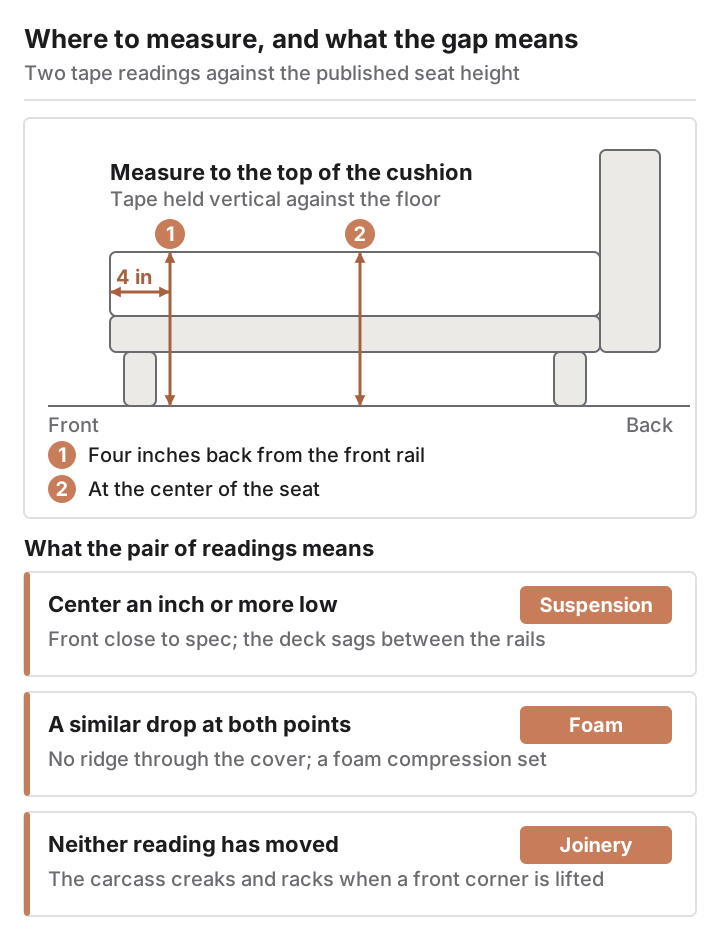
Seat height is the one figure nearly every manufacturer publishes, which makes it a baseline years later. Take two readings with the tape held vertical against the floor: floor to the top of the uncompressed cushion at the center of the seat, then floor to the top of the cushion four inches back from the front rail. Compare both with the published height.
The gap between the two readings is the diagnosis. A center reading an inch or more below the published figure, with the front close to spec, is suspension: the deck sags between the rails while the front edge still rides on the rail. A similar drop at both points, with no ridge detectable through the cover, is foam that has taken a compression set. If neither has moved but the carcass creaks and racks when a front corner is lifted, the joinery is the problem.
Six Sofa Checks to Run in the Showroom
- Lift one front corner six inches off the floor and watch the opposite front leg. If it stays down, the frame is twisting rather than moving as a unit.
- Sit down hard on the front edge, the highest-stress line in the seat, not gently in the middle.
- Reach underneath and press up through the deck fabric. You should feel resistance, not a slack sheet.
- Ask for the cushion core spec in writing: density in pounds per cubic foot, IFD, and support factor.
- Ask which abrasion method the number refers to, Wyzenbeek or Martindale. The scales are not interchangeable.
- Unzip a cushion cover and look at the core, then check whether the legs bolt into a solid frame block or screw into a panel edge.
Motors and Wiring in Power Reclining Frames
Power reclining models add a motor, a low-voltage transformer and a wiring harness to the same structure, and those parts fail on their own schedule. Do not splice, re-terminate or replace a damaged transformer, mains lead or harness yourself. A failed component is the manufacturer’s authorized service program to swap out. The receptacle the sofa plugs into is a licensed electrician’s, along with anything else on the household mains or permanently wired to it. Installation rules for that side of the line come from the code your jurisdiction has adopted, which outranks any general description here.
Cost per Year: Sofa Arithmetic Across Twenty-Four Years
Price per year sets a cheap sofa against an expensive one. Take two figures at opposite ends of the market as a worked example, not as quotes: $1,300 for a flat-pack sofa on a softwood frame with webbing, and $9,000 for a built-to-order sofa on a doweled hardwood frame with hand-tied coils.
Assign a service life to each, as arithmetic and not a warranty: eight years for the first, twenty-five for the second. That gives $162.50 per year against $360.00 per year. Buying the cheap sofa three times across twenty-four years costs $3,900, under half the price of one expensive sofa. For the $9,000 sofa to reach $162.50 per year it would have to last a little over fifty-five years.
The division is not the whole decision. The final third of a cheap sofa’s life is spent on something already gone soft, so those eight years are not eight equal years. A doweled hardwood frame can be stripped and reupholstered, while a stapled panel frame will not take fasteners a second time, so it holds a residual value the arithmetic scores at zero.
The Two Sofa Specifications Worth Paying For, and the One That Is Not
Pay for joinery first. Double-doweled, corner-blocked, glued joints in kiln-dried hardwood are the only layer that cannot be improved later, and they are what makes every other repair worth doing. Everything above the frame is serviceable; the frame is not.
Pay for the cushion core second, and specifically for a manufacturer willing to state density, IFD and support factor rather than the word “premium.” A disclosed number is a commitment; a missing one usually means the answer is unflattering.
The specification to stop paying extra for is the abrasion count above 30,000 double rubs, on the authority of the organization that publishes the guideline. Choose fabric on weave, fiber, cleanability and color, and put the difference into the frame underneath.