How Sheet Fabric Is Made and Why It Feels That Way
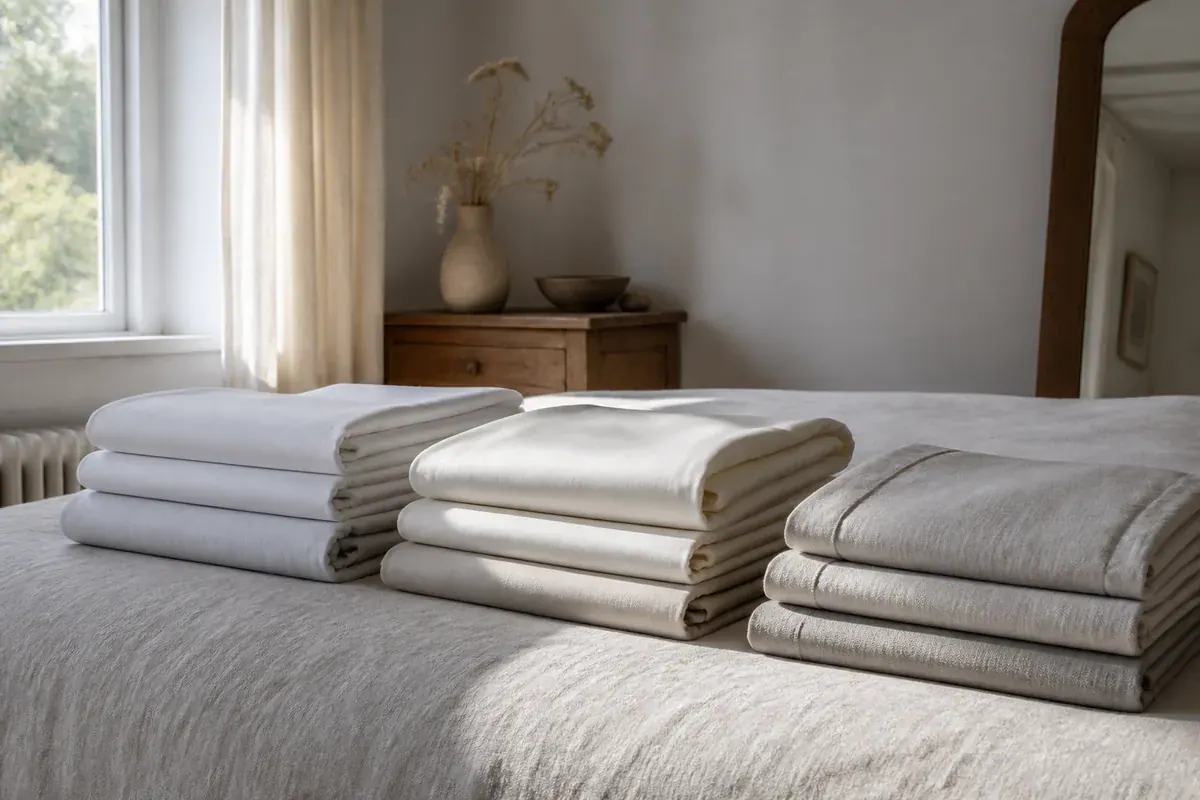
A woven sheet is two sets of threads and one rule about how they cross. The warp runs the length of the loom, held under tension. The weft travels across it, passing over some warp threads and under others. That over-and-under sequence is the weave, and it repeats across the entire width of the cloth.
Change the sequence and you change nearly everything your skin notices. A weft that tucks under a warp at every opportunity is locked down at short intervals, so the cloth sits open, dry and a little stiff. A weft that runs across several warps before tucking under one has what weavers call a float. Floats slide against each other and put longer stretches of uninterrupted fiber on the face, which registers to the hand as smoothness and to the eye as low sheen.
Fiber comes second. The same combed cotton yarn, woven two different ways, produces two fabrics that shoppers describe in opposite language. Most sheet listings bury that under a number.
Percale and Sateen Are the Same Threads in a Different Order
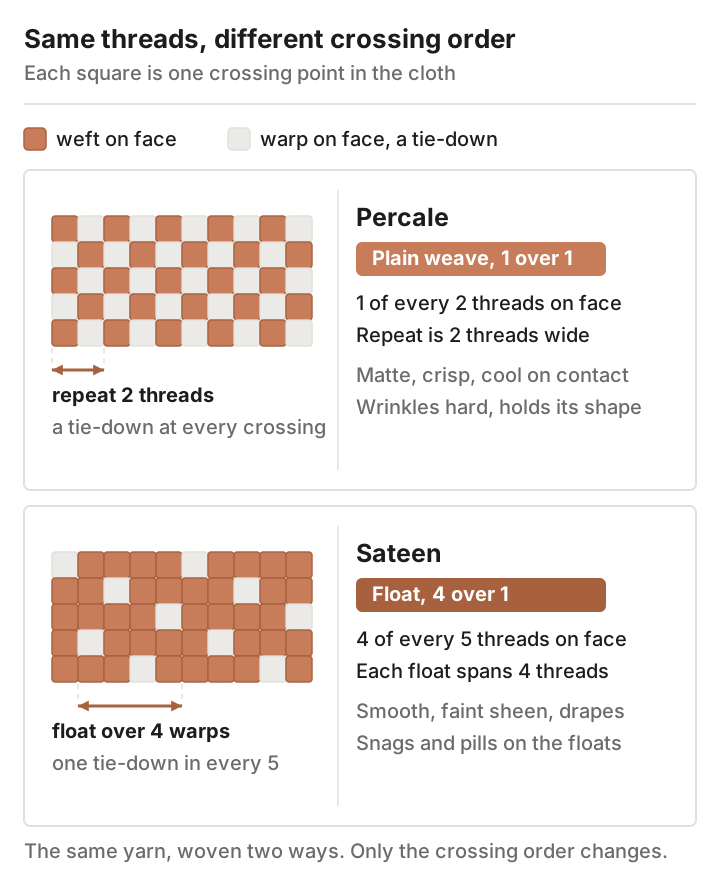
Percale is plain weave. One weft passes over one warp and under the next in strict alternation, and the following weft row offsets by one so the crossings form a checkerboard. The repeat is two threads wide, so one of every two threads sits on the surface. Interlacings are as frequent as a woven structure allows, which is why percale reads matte and holds its shape.
Sateen changes the ratio on purpose. A common sateen sends each weft over four warps and under one, so four of every five threads sit on the face. Fewer tie-down points mean less internal friction, more drape, and the faint luster of fiber lying flat and parallel.
Percale breathes because those frequent crossings hold the yarns apart and leave air paths through the cloth, and it wrinkles hard for exactly the same reason. Sateen holds a little more warmth, creases less and snags more easily, because a four-thread float is four threads of yarn with nothing anchoring the middle of it.
Jersey Is Knitted, Flannel Is Brushed, and Neither Is a Plain Woven Sheet
Jersey has no weft crossing a warp at all. It is a single knit: one continuous yarn drawn in loops through the loops of the row below. Loops stretch and recover, so jersey sheets pull over a mattress like a T-shirt and rarely need ironing. They also grow, bag at the corners, and stop recovering once the yarn has relaxed for good.
Flannel begins life as a woven ground, usually plain or twill, and then goes through napping. Rollers covered in fine wire hooks lift and break fiber ends out of the yarn surface, raising a fuzz layer that traps air. The warmth is the trapped air rather than the fiber. That raised fuzz is also the first thing to leave in the wash.
Better flannel listings state a weight in ounces per square yard and warn that some lint in the dryer screen is normal for napped cloth.
Staple Length Sits Underneath Both Softness and Pilling
A cotton yarn is thousands of short fibers twisted together, and every fiber has two ends. Longer fibers mean fewer ends per length of yarn, so fewer loose tips migrate to the surface over time. Length also lets a spinner draw finer, smoother yarn without giving up strength.
The trade sorts fiber into fixed brackets. The International Cotton Advisory Committee defines extra-long staple as 1 3/8 inches, or 35 mm, and longer, and long staple as 1 1/8 to 1 5/16 inches, roughly 29 to 33 mm; the species behind extra-long staple, Gossypium barbadense, accounts for about 5 percent of world cotton production. Everything shorter is ordinary upland cotton, the bulk of the world crop, and that scarcity is the honest reason extra-long staple costs more.
Supima, Egyptian and Pima describe a source, not a grade
American Pima is the United States name for extra-long staple Gossypium barbadense, and Supima is a registered trademark for goods made from American-grown Pima fiber. Egypt is a looser case. The country grows both long staple and extra-long staple varieties, so the word Egyptian on a label reports geography and stops there. Ask a seller for the staple class, not the country.
Linen, Tencel lyocell and microfiber
Linen is bast fiber pulled from flax stalks, far longer and stiffer than cotton, spun into a slubby, irregular yarn. It softens through mechanical breakdown across years of washing rather than through any finish.
Tencel lyocell is regenerated cellulose. Wood pulp is dissolved in an organic solvent, extruded into filament and washed in a closed loop that recovers the solvent. The fiber is then offered in two forms: a staple version cut to length and spun into yarn, which is the standard textile form, and a continuous filament version that skips spinning entirely. Most sheeting uses spun staple, so the cool slick hand is a property of the fiber rather than an absence of fiber ends. The extruded strand has a smooth, uniform surface, and the fiber structure absorbs and releases moisture, which the producer credits with a drier microclimate against the skin. It also drapes limply next to percale, which not everyone enjoys.
Microfiber is polyester spun very fine and usually brushed. It resists wrinkles, costs little, and does not absorb moisture, which is why it shrugs off spills and sleeps warm.
Thread Count Runs Out of Information, and Ply Counting Pushes It Past That
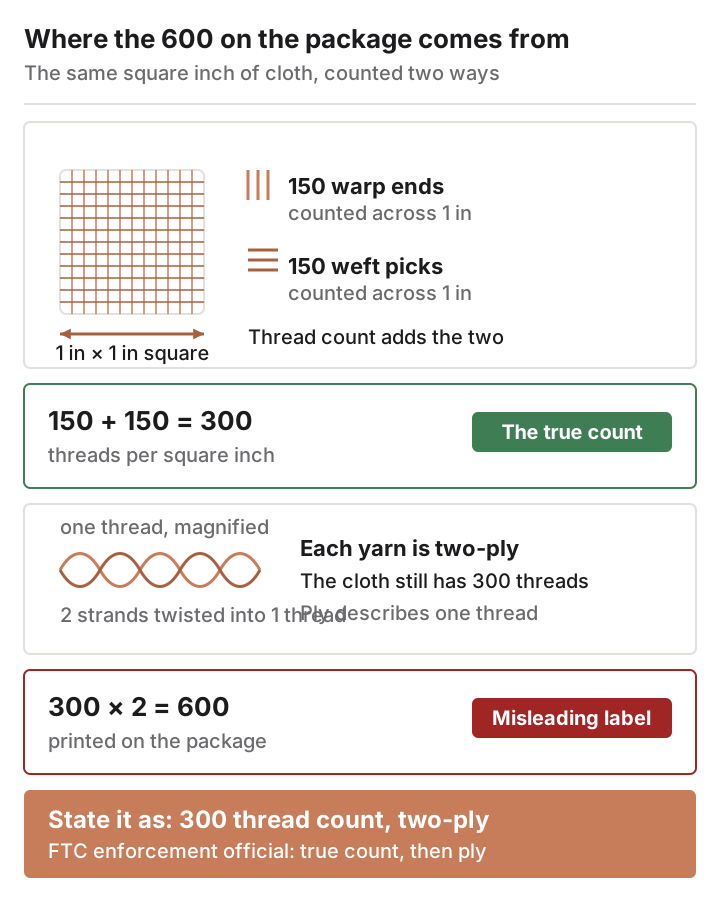
Thread count is warp threads plus weft threads in one square inch. It carries nothing about fiber, staple, finish or weave, and past the point where fine yarns are already packed as tightly as the loom allows, raising the number requires thinner yarns or doubled ones.
Here is the arithmetic behind most inflated numbers:
- Count the warp ends in one inch: 150.
- Count the weft picks in one inch: 150.
- Add them: 300 threads per square inch. That is the thread count.
- Note that each yarn is two-ply, meaning two strands twisted together into one thread.
- Multiply the count by the ply number: 300 × 2 = 600.
- Print 600 on the package.
Nothing in the fabric changed between step 3 and step 6. Trade reporting on the practice records James Kohm, then associate director for enforcement at the Federal Trade Commission, saying that inflating a count by multiplying it by the number of plies could deceive consumers, and that the appropriate disclosure states the true count followed by the ply. By that standard, the fabric above is a 300 thread count, two-ply sheet.
GSM Is the Weight Number Linen and Flannel Report Instead
GSM is grams per square meter: the measured mass of a square meter of cloth. No accounting trick raises it, because a scale settles the argument. Linen leans on it because flax yarns are thick and irregular, so a raw thread count on linen lands far below any cotton figure and invites a comparison that means nothing.
Flannel reports weight too, usually in ounces per square yard in American listings, which is the same kind of measurement in imperial units. Heavier flannel holds more air and more heat; lighter flannel works across three seasons rather than one.
Shrinkage, Pilling and the Finishes Applied After the Loom
Cloth leaves the loom under tension. Wet it and the fibers swell, the yarns take up more crimp, and the fabric relaxes back toward the dimensions it wanted from the start. Most of that movement happens the first time it is washed.
The industry measures it by a published method. AATCC TM135 determines dimensional change in length and width after home laundering, using four wash temperatures, three agitation cycles and four drying procedures. It reports the change as a percentage of the original dimension. It sets no acceptance limit of its own, so whatever threshold a brand applies is the brand’s own choice.
Run the arithmetic against your own bed. A flat sheet panel 80 inches long that relaxes 3 percent gives up 2.4 inches. On a fitted sheet, that same percentage comes out of the deck and the pocket walls together, which is how a sheet that fit a thick mattress on day one starts popping corners by the third wash. Order the deeper pocket.
Where pills come from
A pill is a ball of broken fiber ends, tangled together and held to the surface by a few fibers still anchored in the yarn. Three conditions feed it: short staple with many free ends, long floats that abrade, and polyester content strong enough to keep the ball attached rather than let it drop away. ASTM D4970 abrades fabric on a Martindale tester and rates the surface on a scale of 5 to 1, no pilling through very severe pilling. Sateen and cotton-polyester blends are the usual candidates.
Mercerizing, sanforizing and resin finishes
Mercerizing treats cotton with caustic soda under tension. The fiber swells toward a rounder cross-section and gains luster, dye uptake and strength. Sanforizing mechanically compresses woven cloth so shrinkage happens at the mill instead of in your machine. Both changes are structural, and both are permanent.
Wrinkle-resistant cotton is generally cross-linked with a resin that stiffens the fiber and cuts breathability, and that chemistry has historically involved formaldehyde. OEKO-TEX Standard 100 places bed linen in Product Class 2, products with direct skin contact, and tests against a list of over 1,000 harmful substances, with limit values reviewed at least once a year. A certificate number can be checked; a phrase like chemical free cannot.
Six Passes Through a Sheet Listing
| Construction | Structure | Hand | Spec that describes it | Usual failure |
|---|---|---|---|---|
| Percale | Plain weave, one over one | Crisp, dry, cool on contact | Thread count with ply, staple class | Deep wrinkling, wear at fold lines |
| Sateen | Four over one float | Smooth, faint sheen, drapes | Thread count with ply, staple class | Pills and snags along the floats |
| Jersey | Single knit loops | Soft, stretchy, warmer | GSM | Stretches out, bags at corners |
| Flannel | Woven ground, then napped | Fuzzy, insulating | Ounces per square yard or GSM | Sheds lint, nap flattens |
Work a product page in this order:
- Find the weave word: percale, sateen, jersey, flannel or linen. A listing that never names the construction is telling you something by omission.
- Find the fiber and the staple class. Cotton described with no staple language is upland cotton.
- Check whether the thread count is stated together with ply. A bare count with no ply disclosure cannot be verified, which makes it marketing rather than specification.
- On linen and flannel, look for GSM or ounces per square yard instead, since those resist inflation.
- Measure your mattress height, compare it to the stated pocket depth, and leave headroom for the first wash.
- Look for a certificate number rather than a certificate word.
The Weave Name First, the Thread Count Last
Read the weave first, every time. It is the only line on a sheet listing that predicts the hand before you open the package, because it reports physical structure instead of quantity. Percale is crisp and sateen is smooth for the same structural reason, and sateen pills along those same floats.
Fiber and staple class come second, since they govern how long that hand survives laundering, and weight comes third on linen and flannel, where GSM and ounces measure something a scale can confirm.
Thread count is the number to discount. Past the packing limit of the yarn it stops describing the cloth and starts describing the marketing department, and with no ply disclosure attached it cannot be checked at all. A 300 thread count percale in long staple cotton beats a four-figure count spun thin to reach the number, and the weave word told you which was which before the count did.